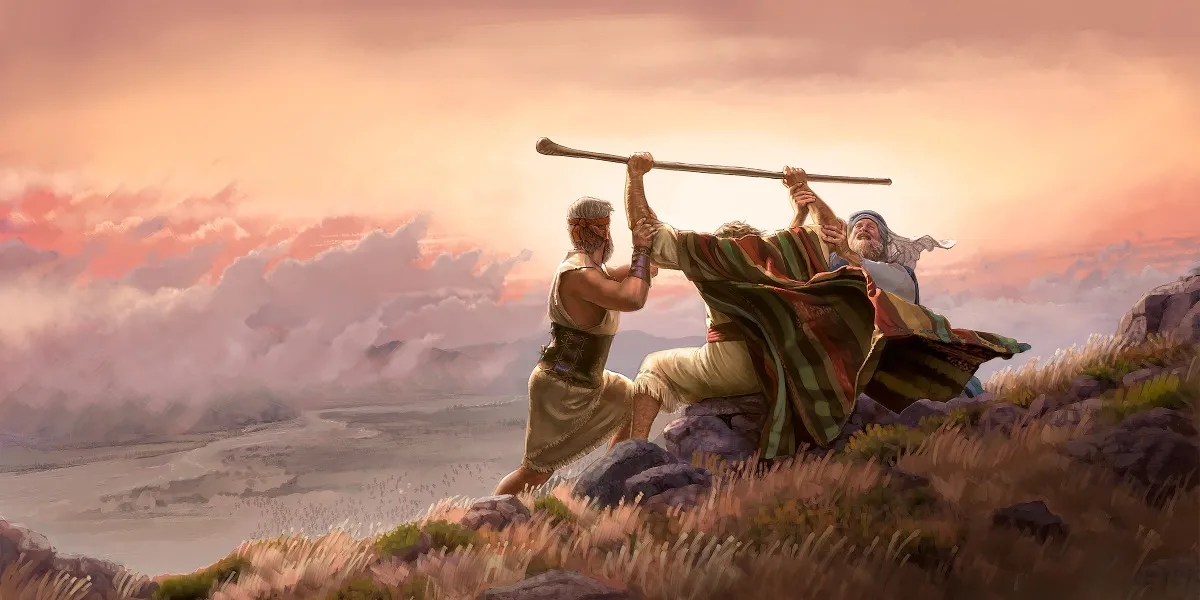
"The Lord confirmed a priesthood also upon Aaron and his seed, throughout all their generations, which priesthood also continueth and abideth forever with the priesthood which is after the holiest order of God. And this greater priesthood administereth the gospel and holdeth the key of the mysteries of the kingdom, even the key of the knowledge of God. Therefore, in the ordinances thereof, the power of godliness is manifest. And without the ordinances thereof, and the authority of the priesthood, the power of godliness is not manifest unto men in the flesh; For without this no man can see the face of God, even the Father, and live."
I've been too long away from writing about scripture, and it's partly because this Section is daunting. I went down a rabbit-hole trying to make sense of even matching subjects with verbs in Section 84's opening verses. They seem to cascade into sets of parenthetical statements, at times in series and at other times nested, without modern grammatical insistence on sentence length. And it gets even worse when you realize that the original manuscript versions of these revelations have zero punctuation--that all of the meaning cues we get from the punctuation we see in the D&C are some later editor's good-faith attempts to make sense of the pauses, the clauses, and the asides. Because of all this, I got a little stuck in verses 4-6, so let's quote and analyze:
"Verily this is the word of the Lord, that the city New Jerusalem shall be built by the gathering of the saints, beginning at this place, even the place of the temple, which temple shall be reared in this generation. For verily this generation shall not all pass away until an house shall be built unto the Lord, and a cloud shall rest upon it, which cloud shall be even the glory of the Lord, which shall fill the house. And the sons of Moses, according to the Holy Priesthood which he received under the hand of his father-in-law, Jethro;"
It seems clear that the Lord is commanding here, but also prophesying from His foreknowledge. He's calling for saints to gather and form a Zion society in a specific location with a temple at its center. The use of the term "shall" is ambiguous--it contains both predictive and imperative functions--but if we assume the imperative ones are operant to the contemporary recipients, we have grounds to understand why the predictions didn't all come to pass with that immediate generation (without moving to the also valid point that "generation" is often scriptural code for an entire dispensational period, not merely the 30-ish years on average between fathers and sons, or the 80-ish years of a natural lifetime which modern parlance often limits the meaning of "generation" to): the recipients weren't obedient to the commandment which would otherwise have guaranteed the prophesied signs and blessings.
Be that as it may, we still have a grammatical puzzle: the coordinating conjunction "and" in verse 5 operates to distinguish between functions of "shall," but the very next "and," initiating a new sentence as it does in our published, punctuated version, seems to either be parallel to it (requiring that the noun phrase immediately to its right be considered a grammatical subject, leaving us in search of a verb to kick off its predicate) or entirely disconnected from it (requiring that it also be considered the subject of a new sentence, leaving us in search of a verb for its predicate). In both cases, no predicate is forthcoming. The next 11 verses leave "and the sons of Moses" hanging, with a series of "and" statements coupled with a content string: the "priesthood lineage" of Moses. In other words, the command is to build a house to the Lord, and the promised blessing is that the glory of the Lord, in the form or sign of a cloud, will be present there; but since the command and the promise are both framed with the ambiguous "shall", we have to read the "and a cloud shall rest upon it" part assuming that the "and" is a consequential "and". It isn't a strictly neutral one because it's not parallel. It doesn't signal command A "and also" command B, but instead signals command A "and if you complete that, the result will be" prediction B.
So this puzzle made me stop and wonder about how it might be parsed with different punctuation. And it occurred to me that if the "which" statements were truly parenthetical, appositives providing extra descriptive details about the cloud, then the main verb in the prediction is "rest", and the "and" in front of "and the sons of Moses" could have been structurally attached as a second thing resting upon the temple. In other words, we can play a "what if" here. What if the period after "fill the house" was artificially preventing us from seeing the cloud (which is the glory of the Lord filling the temple) as thing A which rests upon the temple, with thing B being the "sons of Moses" along with the string of verses parenthetically explaining why this thing B has a logical connection to the glory of God and deserves parallel mention with the cloud as the two things resting upon or filling the temple?
See what I mean by rabbit-hole? That's a lot of close reading brain-twistiness to start with. So let's maybe back up a little.
The immediate occasion of this Section is the return of a wave of faithful missionaries to Kirtland, and a renewed need to incorporate solid, faithful men back into service of an expanding church as its offices and orders were being freshly revealed and expanded. In a conference 15 months prior to this revelation, the first "high priests" were ordained to that office, but as Smith and his scribe and theology partner Sidney Rigdon were working their way slowly through their "translation" of the Bible, it was becoming more and more clear that there was a structure to which the "offices" of these new officers belonged, into which the returning Elders needed to fit. The Priesthood was not merely a pattern of duty-bundles like modern LDS "callings" are, but was rather an "order"--a word found in increasing frequency in tighter proximity to the term "priesthood" than before that time.
It's also worth noting that between that conference and this section, both Smith and Rigdon were violently set upon by a small mob, forcibly removed from their homes, beaten, tarred, and feathered, and threatened with much worse. Smith, younger and more robust, spoke with a whistle for a decade, but escaped the violence with mere flesh wounds otherwise, even preaching a sermon on forgiveness as his own burnt flesh was still healing the next morning. Rigdon wasn't so lucky. He suffered a cranial trauma that prevented him from serving as closely as an advisor on matters of church governance: ecclesiology. Rigdon was an experienced pastor before joining the church with as many of his Kirtland congregation as were willing, but with him working out the day-to-day details less and less while healing, Smith was left more and more to ponder the administrative challenges on his own and take his questions to the Lord.
Can you think back to Section 20, often called the "constitution of the church", given just two short years before this one, back in April 1830? The offices of Elder, Priest, Teacher, and Deacon were spelled out with duties attached, and a procedure was specified to "ordain" each of these offices. Now review that section again to see where the words "confer" or "priesthood" are mentioned. They're not! We think of the Priesthood now in the same way we might think of a military or police organization--once enlisted, you can rise through various ranks like "offices" each with their own scope of authority, and even within certain ranks, there may be need to specify "keys" of leadership over a scope anyone with the same rank might be theoretically able to fill, but don't at the moment. Joining the Priesthood, in that sense, would mean obtaining a certain baseline authority under a certain special commitment of service. But in the 1830-1832 Restored Church, there were officers running their duties within their scope without yet having that overarching "joining" the Priesthood as a grand fraternal order concept. In other words, the Lord trained the first office-holders in this dispensation for two years before giving them the context that helps ground the "why" of their own functions and organization.
And the why is mind-blowing!
The temple--a symbol most Christians still see as a token of law of Moses-era Old-Testament worship that the New Testament covenant does away with through Christ, just as it did away with the need for prophets and continuing scripture because the Holy Ghost could now indwell our hearts under the new regime of grace--was a central organizing principle before Moses. It contained symbolism and housed rituals which transferred power and prepared hearts for closer communion with God than was possible outside of temples (or mountain tops as the ancients used to do) before Moses. Protestants and Catholics both have it wrong: the correct doctrinal analogy is not temple is to sacrificial or carnal liturgy as Christ is to sacramental or spiritual liturgy. Instead, the Mosaic tabernacle is preparatory to temple covenants as the Mosaic law was preparatory to the law of grace and its Melchizedek covenants. They have the central part of the Venn diagram right, but lump too many things in the "changed after Christ" column because they, like the Jews before them, have lost pre-Moses information they need to see how the paradigm actually makes sense to parse out. Moses had a Priesthood before he received the 10 commandments and the Levitical law that accompanied them.. The Patriarchs had access to one as well, one which was not necessarily passed from father to son, as we should note from the cases of Abraham and Esaias (who, stunningly, received it from Melchizedek and God Himself, respectively, despite all other examples showing a father-to-son conferral pattern) from verses 7-16.
The temple is the house of the fulness of this "order" of the Priesthood. It is a spot of hallowed ground, connected to heaven and set apart from the world. Its architecture and the ordinances performed therein are rich in symbolism teaching of Christ and His eternal roles as sole Intermediary between the eternal heavens and this temporal world full of sin and wayward children of infinite worth, all needing His redemption. It is an earthly place of celestial preparation in a way ordinary meetinghouses can never be. It is the higher and holier locus to which the Lord's higher law has always pointed His believers, as it is there, in a holy of holies of sorts into which only priests and priestesses can penetrate, that revealed instructions are received, that covenants are entered into, that relationships with the Lord, between individuals, spouses, and families, are made new, made holy, sealed by the Holy Spirit of Promise. This temple is no longer a place of animal sacrifice, but a place where the law of sacrifice is fulfilled by a higher law of consecration, one where we, after having been prepared by evacuating sin through the outward ordinance of Baptism, can more fully receive an indwelling of His Spirit, advance in closeness to His uniting power, and enter into His rest--becoming more and more one with Him as He is with His Father, knowing them, knowing their mode of existence, their manner of living which is after the manner of happiness, which knowledge is scriptural code for eternal life. The temple is the place where men and women unite in the exercise of Priesthood authority for the commencement of eternal relationships, where covenant oneness endows us with His power from on High.
In other words, this revelation marks a turning point in the conception of the organization of the church. There is a purpose-driven principle organizing it which hadn't occurred to even its most ardent practitioners already on the ground: to make the power of godliness manifest; to impart the knowledge of God (which, again, is scriptural code for eternal life); to prepare us to not just be made innocent of sin, but agents of the Lord, filled with His knowledge and power. With this purpose now unifying the whole, the reasons for the "appendages" or offices have a context that makes them make sense. And with the idea of a temple now firmly at the center of a "Zion" community concept, all we need is a little explanation of the scriptural episode from Exodus to help ground the logical and doctrinal motivation for the paradigm shift from the Catholic conception of Priesthood (a hierarchical brotherhood of professional ministers with authority administered through ordination to essentially gatekeep certain required rituals) to the newly evolving Restored understanding of the Priesthood (as the actual power of God delegated to men, which confers an authority to act and results in a fraternity in a flat Zion-like network rather than in a lay versus cleric hierarchy--in which the priestly function of mediator is democratized rather than funneled).
God knew it wouldn't work beforehand, of course, but He still commanded Moses to work as if the Israelites who had successfully escaped Egyptian slavery and its polytheistic regime of concentrated authorities and mysteries which made no demands on the moral character of the masses were ready for Zion-like unity and purity of heart in consecrating all property and energy, talent and ability to the Lord, to the service of one another, and to each individual's highest potential. Instead, Moses learned, they were stuck in idolatrous and materialist thinking, selfish pleasures, and subservience to worldly leaders and impulses. They weren't ready for sanctification, for individual endowments of power from on high, for communion with the Most High behind His merciful veil which presence would wither all unprepared pretenders with the crushing knowledge of their own unrepented unworthiness. They needed further preparation.
So in another act of mercy, the Lord organized a new administration of the Gospel of repentance, of sacrifice, of His Son's atonement, and of our access to justification through faith in Him. The Hebrews still had the Aaronic Priesthood to make symbolic sacrifices for sin, to teach them in the ways of a humble walk with high moral standards, and mechanical safeguards as guard-rails to bring them later to the new and everlasting covenants available after the Lamb of God was to be sacrificed once and for all. The lineage of the Melchizedek Priesthood did not entirely vanish, is it was held by all the prophets throughout the Old Testament at a bare minimum. But its systematic ordination to all males, and its accompanying blessings and power to all humans, was denied until restored by Christ Himself.
One important note to nuance the interpretation: be careful of the word "ordinance". The modern usage of the term equates it to a rite, and it's not wrong to apply it that way as we read that the power of godliness is not manifest without the authorized rituals that enable covenants which bind us to Him and endow us with greater outflowings of His power than would otherwise be possible. But the 1828 Webster's dictionary reminds us that the term "ordinance" could refer as much to the person ordained as to the rite by which she or he became so. In that sense, it's possible to make the reading that the power of godliness is not made manifest without authorized people--men in the strictest sense, but women too according to God's prescriptions of place and manner. Without a prophet, we can't receive institutional revelation. Without an elder we can't receive the Holy Ghost. Without a Priest, we can't receive the sacramental symbols. The rituals invoked in these examples all also require an officeholder with authority sufficient to the liturgy involved. In other words, the power of godliness is being made manifest in their service, in their mediating position, in a way that isn't fully captured by the way it is manifest in the ritual itself.
The Priesthood in all its senses--both the abstract authority to act in God's name, and the position of mediation that individuals in its brotherhood symbolically occupy--is an order that draws us to the Temple, to higher and holier communion with the Lord, to worthiness, and to openness to His power. Through its ministers and ministrations, the Priesthood prepares us for perceiving His life, His mysteries, His loving embrace. And the immediate recipients of this revelation were under a charge to develop all around them for these blessings--to prepare all for Temple worship, Temple covenants, Temple relationships. Its collection of doctrinal knowledge, its manner of administration, its hierarchical organization with an aim for a flat Zion society, and its institutionally necessary appendages enable all people to see the face of God and live.
The historical excursion into the Mosaic period re-frames the Restoration of this Priesthood and grounds our insistence on conformity to the organization of the Church at Jesus' time in a theology that bridges the Patriarchs, the Law of Moses, and the Christian era into a coherent belief system lost to all of our fellow Christian denominations. The Restored answer to our Protestant fellows is that God does require authority. The Restored answer to our Catholic fellows is that God wants all His children to be priests and priestesses. The Restored Melchizedek Priesthood is the administrative power through which we receive callings by revelation--we don't up and decide ourselves what we "feel" called to, and therefore it places the onus on the Lord to call, and the officer to worthily inquire as to the Lord's will for another within their scope. It is the power by which we receive an individual relationship with the Holy Ghost, an increased connectivity with Christ, and an eternal identity with the members of our eternal social unit, the family, and with the national unit--the kingdom of God, or Zion. And each of these covenant relationships both set us apart further from the world, and require increasing levels of individual worthiness--compliance to successively consecrated laws. This covenant path is what teaches us to live like Him, and therefore brings us eternal life as He Himself defined it: to know the Father, the true and living God. These covenants, these relationships, these Priesthood blessings, are Temple blessings. Every teaching, every ritual, every position of service, every revelation, every structure in this Order points to He whose house the Temple is, and to the eternal realms it connects to earth.