"Wherefore, be faithful; stand in the office which I have appointed unto you; succor the weak, lift up the hands which hang down, and strengthen the feeble knees."
In his inimitable poetic style, Isaiah delivered the word of the Lord to his courtly audience in ancient Jerusalem. He spoke in the present of the need for repentance, not merely because disobedience always has consequences, but also because growing world power Assyria had recently served as the instrument of the Lord's chastening hand upon the 10 tribes of the Northern kingdom, and if the Southern kingdom, where Isaiah prophesied, did not repent, they ran the risk of suffering the same fate as "Israel".
Assyrians introduced an innovation into empire-building in the early 700's BC. Rather than be satisfied with mere military victory, the Assyrians strategized measures to prevent local uprisings, future rebellions, and ensure that tributes got paid. Rather than minority rule by occupation, trusting in superior force or fear of reprisal from a more powerful center, and rather than taking a local ruler captive and/or consolidating power through forcible marriage into the local ruling family, the Assyrians broke their conquered kingdoms' national spirit by exiling vast numbers of ordinary citizens. They could use the populations elsewhere in their empire, and they could disperse them in ways that favored intermixing of the younger generations. Eventually, they thought, there would be no "home" the grandchildren would remember or want to go back to, having lost connection with their traditions, songs, stories, and most of all, worship.
Exile was a fear on the minds of the court of king Ahaz, whose lack of repentance nearly resulted in Assyrian victory, and on the mind of his more pious son, Hezekiah, who listened and who lived to see a miraculous deliverance. But Isaiah's poetic prophecies, as usual, described not only the present day, but a future in which Hebrew exile would be a more universal vehicle of chastening for the covenant people, and in which Gentiles bound to the Savior's covenant would have to be organized into a gathering force for exiled Jews to be gathered back in to Zion.
It is in this context of current threat of exile, and future prophecy of exile that the word of the Lord comes to Isaiah with the poetic command to those gathering the exiles in: "Strengthen ye the weak hands and confirm the feeble knees" (Isa 35:3). The message to those experiencing exile is that they have a God with them who loves them and is gathering them to a place of peace, of power, and of holiness. It's a message of encouragement and faith, of keeping one's meaning and purpose through distressing loss, or disconnection. The strength that the servants of the Lord are supplying is His strength--is a connection to His promises of eternal blessing no matter the current earthly challenge. Weak hands and feeble knees can still travel His path and can still perform His work when they believe in the worth of its end.
Paul picks this image up later in a different context in a message to other Hebrews at Jerusalem and wherever else they felt pressure from their Jewish communities to abandon their newfound Christianity. To this cohort of Christians having entered into a new covenant with the Messiah, and having been made victims of persecution for it, Paul's message is more about meaning-making than avoidance of exile through repentance. Paul's reason for harkening back to Isaiah was a reframing more strongly centered on the theme of chastening. To be fair, Isaiah was not wrong that God has the power of deliverance from suffering, but Hebrews also makes it clear that sometimes our suffering is His will, either as a test of faith or as a loving correction of the kind a devoted father must give his children who, in his wisdom, he knows stand in need of it. Under this new frame, "Lift up the hands which hang down, and the feeble knees," (Heb 12:12) is an encouragement to minister to those physically struggling, and metaphorically to those laboring under a social, mental, or spiritual weight working against their faith. The epistle itself--an extended theological argument speaking directly to sufferers familiar with Jewish doctrine and practice to bolster faith in Christ as the fulfillment of their faith, not as a betrayal of it--functions in precisely the way it encourages: firming up the weak in spirit.
I take comfort from this series of prophets, culminating with Joseph Smith, who teach that one of the highest privileges of every minister is to seek out those in doubt, in suffering, and in need, and then supporting them. As we support each other, we fill gaps, find complementary relationships, and allow our strengths to enmesh together, immunizing the community against hardship where possible, and against despair where hardship is unavoidable. The fundamental thrust of both Isaiah and Paul's references to hands hanging down and feeble knees is outreach, is top-down use of power, authority, and gifts of the Spirit for bottom-up benefit. And that tracks with Smith's allusion as well.
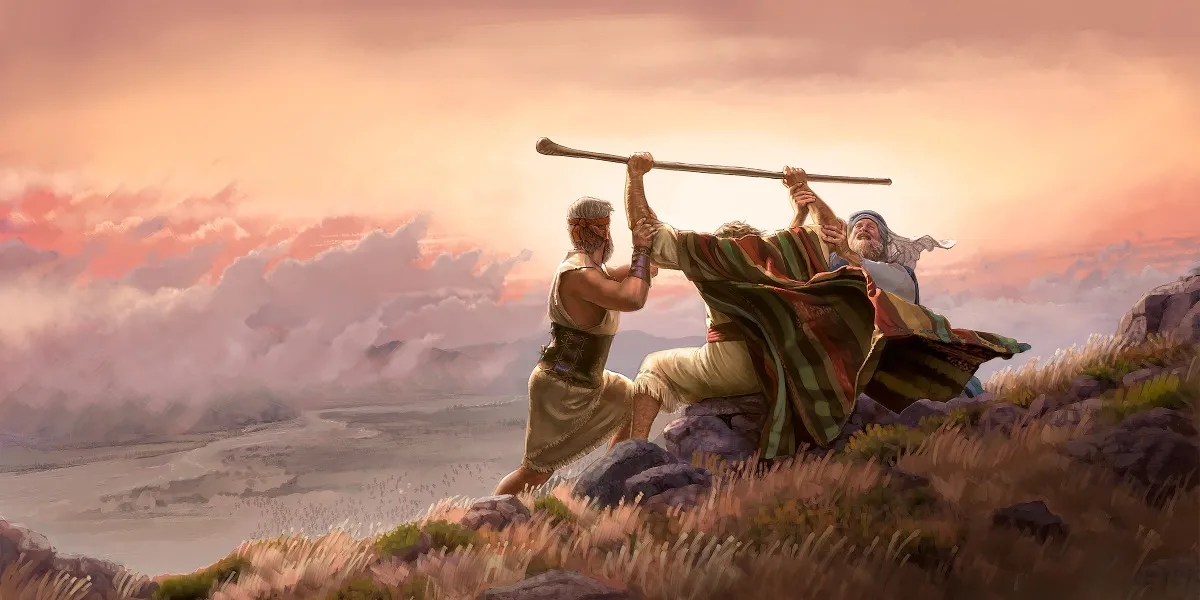
But there's another more ancient prophet whose example provides another valid direction for reading this Section: Moses. Moses did serve the people, and God supported them through Moses in a symbolic way during the battle against the Amalekites, but the Israelites noticed that the fight against their enemies went their way or their enemies' way in proportion to Moses's ability to keep his tired arms aloft with the staff of God in the air. So, to follow this image through, the lesson Aaron and his teammate Hur drew was that sometimes the direction of support needed to flow to the leader--they physically held Moses's arms up, and the Israelites prevailed.
This Section's context is that of the first organization of the First Presidency--which is the Church's first formal calling of a "counsel" if I'm not mistaken. A President who holds Priesthood keys to make decisions for the exercise of God's power according to his sphere of influence, is the ultimate node of both authority and responsibility for the stewardship under his care, but he is not an autocrat, or even a holder of controlling shares, really. Church presidencies are populated by a keyholder and faithful counselors--usually two, but sometimes more--who provide candid advice on shared decisions, and then carry them out and inspire others to carry them out. And this "system" is fundamentally different from the way presidents and chairmen work in the world. Meetings, which come with firm agendas and a focus on efficiency in decision-making, have their place, and can be appropriate to tasks at hand--which is why nearly every corporate organization adopts their mode of governance ad "Roberts Rules" for their mode of operation. But Councils in the Church focus on people, on finding God's will in decisions to benefit individuals, and they are therefore inherently more consensus-driven, and more cooperative in direction. A good Bishop or Stake President is almost always a good man to begin with, but their reputation as such only grows in the measure that they have the support of good counsellors, a good Relief Society presidency, and a full set of good auxiliary leaders whose partnership lifts the leaders above as it attends to the needs below. It tends toward such a flattening of hierarchy in its operation that the terms "above" and "below" don't really even make sense to describe it anymore.
And it's this group of fellow-laborers, knit in one heart for the scope of their ministry, which are also what this passage means--we must lift up the weary arms of the leadership by performing our duties with honor and exactness, by magnifying our calling, by serving with care, by focusing on individuals entrusted to our care, by prayer and by work: in short, by faith. Counselors aren't subordinates, they are sustainers. Prophets aren't worthy of pedestals, but they are worthy of being upheld. When we make a sustaining vote, we aren't merely consenting to service, we are pledging our own efforts and faith.
Let us indeed succor the weak, alleviate suffering, confirm the faith, and align our will with God's for the unity of purity of heart He has with His Father--our perfect model of Zion, and of Councils.




No comments:
Post a Comment