Showing posts with label Book of Mormon. Show all posts

Monday, January 20, 2025

Prophets versus Experts - Isaiah 29:10-14; JS-H 1:64-65


"PHD." Abbreviations.com. STANDS4 LLC, 2025. Web. 19 Jan. 2025.<https://www.abbreviations.com/term/387815>.

"For the Lord hath poured out upon you the spirit of deep sleep, and hath closed your eyes: the prophets and your rulers, the seers hath he covered. And the vision of all is become unto you as the words of a book that is sealed, which men deliver to one that is learned, saying, Read this, I pray thee: and he saith, I cannot; for it is sealed: And the book is delivered to him that is not learned, saying, Read this, I pray thee: and he saith, I am not learned. Wherefore the Lord said, Forasmuch as this people draw near me with their mouth, and with their lips do honour me, but have removed their heart far from me, and their fear toward me is taught by the precept of men: Therefore, behold, I will proceed to do a marvellous work among this people, even a marvellous work and a wonder: for the wisdom of their wise men shall perish, and the understanding of their prudent men shall be hid." (Isaiah 29:10-14)

 1. Outside of Restored Christianity, the above Isaiah quote generates generic commentary about the choice of attitude each of us have in listening to God. In parallel with Jesus's mockery of Pharisees as "whited walls" who profess a great understanding of the law, but who comprehend its fundamentals so little that they can't even recognize the Messiah right in front of their eyes, Protestant thought teaches that book learning doesn't guarantee spiritual wisdom--that you can have credentials and amass readings, and still miss the point. Both the unlearned illiterate and the learned readers get no benefit from the contents of a sealed book. While that's a fair reading of the passage's general content, two things are true: a. few "experts" feel personally implicated by passages like this even though we all should; b. new information initiates interpreters to new hermeneutic possibilities.

Self-satisfied that they would never be guilty of the errors of the Pharisees, many well-meaning Bible believers and Doctors of Divinity fail to note that their careful sola scriptura strictures put them afoul of the very root of Christ's critique--the Pharisees also claimed that only prior scripture should be trusted as the source of God's voice. Their approach to truth was as sophic as the bulk of Protestantism today--Catholicism too, with the exception of the Pope, one could argue. And in all three cases, as extensive compilation of commentary gradually substitutes for scripture itself over time, the mantic spirit Christ Himself embodied and inspired across the centuries of His manifestations to prophets is lost to erroneous argumentation. Please understand: I mean no insult to honest seekers of truth whose consistent philosophies limit their understanding. I only point out that it's possible to be internally consistent and well-meaning, and God-fearing, and honest, and still wrong.

This passage from Isaiah has a more concrete reference to a sealed book and a learned man being unable to read it--not out of over-education, but out of self-interest in not being able to control the profits from it. And the man without proper letters, the very concrete Joseph Smith, may not have had the formal training, but did have the gift and power given by God to read the book that was sealed to others. Isaiah didn't explicitly tie the unlearned man as the agent of producing the marvelous work, but he didn't forbid it either, and his move to describe the kind of work that would be wondrous and bring hearts back into alignment with the Lord in contrast with the lips that merely profess, but don't honor as one that only the unlearned could do (the wisdom of the wise men being insufficient to this task).

The Martin Harris account, published in this canonized history after he had left the church, but which he continued to attest despite incentives to recant, tells of a hand-copied page of "Reformed Egyptian" symbols which a reputable professor at Columbia verbally certified, but who likely had no clue he was uttering nearly to the letter Isaiah's 2600 year-old words when he ripped up his draft of a written certification upon learning that the book was sealed: "I cannot read a sealed book" (JS-H 1:65).

He also could not have predicted, as self-interested as he was in either glorifying himself in its translation, or in discrediting it altogether, how the coming forth of the Book of Mormon and the consequently Restored Church and its advancement would resemble the marvelous work and wonder Isaiah clearly prophesied. And only those open to the mantic mode of truth-seeking will come to know of its truth, further hiding the wisdom of the world's Christian, but misguided prudent men and other scholars.

2. As part of my own project of study to bring scripture as much to life as I can, I did a little digging into the scholarly atmosphere of the day. Maybe a detail or two here will help someone else get more out of their study as well. Contextual elements like this also deepen my sense of how God prepares the conditions for His actions.

First off, Anthon wasn't an Egyptologist, and while he had a background in other ancient cultures and languages, some of his knowledge of Egypt could only have been in the infancy of the West's earliest modern understanding of Egyptian scripts. Napoleonic campaigns in Egypt brought to France and England a number of artifacts whose procurement was of dubious ethics, but whose importance to history, archeology, and linguistics has proven immense. One such was the famous Rosetta Stone which sat undeciphered in a British museum for decades before a young student in the fledgling discipline of "Egyptology" made a few key assumptions about the hieroglyphs on the stele that appeared to match the meaning of the Greek script it also contained. This Jean-François Champollion had to battle a scholarly misconception about hieroglyphs themselves. It was well known that ideographs, glyphs that convey an entire idea rather than transcribe the phonetic form of the idea, can serve as vehicles for multiple languages. It was also well established that across the millenia that Egypt used writing, there were three identifiable scripts that the spoken language, which also evolved over such lengthy periods, made use of. Because the kinds of monarchs and priests who commanded the construction of monuments were also the kind to want themselves memorialized in the most indelible ways, the surviving exemplars of one of these scripts--hieroglyphics--was almost exclusively found in temples and funerary edifices. This led to the false conclusion that hieroglyphics was only used for religious purposes and therefore didn't represent the spoken language of the normal people. Champollion contested this idea, showing how there might be a progression of the more purely ideographic hieroglyphics to the more frequent phonetic markings used on more corruptible papyrii in the hieratic script could finally lead to the more alphabetic demotic script which itself was likely connected as an ancestor to the modern-day Coptic tongue still spoken in parts of Egypt (it's one of the world's oldest continuously spoken languages still extant). This logical leap allowed him to parse out some names on the Rosetta Stone that were attested elsewhere, and then abstract out a few phonetic symbols which then gave him a key to more and more, until the full stone had its translation worked out.

His work on the Rosetta Stone was published posthumously not long after completed, as Champollion died relatively young (age 41) of a stroke that many attributed to the after-effects of an arduous journey to Egypt and back to France. That publication was less than 6 years old, and not likely available in translated form for the contemporary New York professor Charles Anthon to have digested (although I have no idea whether he spoke French) to have very deep insight as to the nature or meaning of any Egyptian script let alone one written in a derived form of Demotic used to transcribe Hebrew rather than the ancestor tongue of the Copts, and then modified over the thousand years of Nephite linguistic evolution.

The state of Egyptology in the US in 1828, when Martin Harris made the trip to New York to obtain second opinions as to the wisdom of his investment in the Book of Mormon translation and publication projects he was heavily leveraged on, simply didn't have a whole lot to it just yet.

But even if it did, the way to test it is in its pages, not through scholarly examination of the archeological materials. The way to know if Joseph Smith was a prophet is to pray, as he did, with real intent and having faith in Christ to know if the Book of Mormon is true. And this manner of proving the prophets isn't contained only in its pages, but is also among the Savior's own prescriptions as recorded in Matthew: "by their fruits ye shall know them". The fruits and gifts of the Spirit seem to scientism too subjective, but they bring precisely the testimony of truth the world needs. The marvelous work and a wonder is afoot.

Wednesday, January 15, 2025

Context is King - Joseph Smith-History 1:41


"He quoted many other passages of scripture, and offered many explanations which cannot be mentioned here."

Untangling context is sometimes a necessary chore. All valid interpretation depends on it, and yet we, as readers, may have varying attentiveness to or knowledge of its elements, and varying judgments as to the elements' salience.

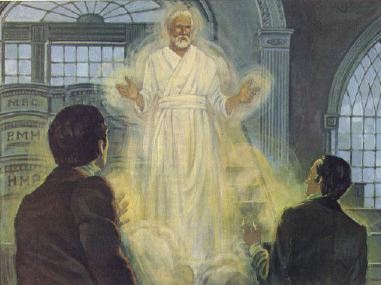
Take the question of how to understand Moroni's first visit to Joseph Smith. You and I, who have read the Book of Mormon and know that this Moroni was its last prophet can't avoid an imposing image when we see the very name. This was a giant of a man--I make no claim on his height, although it's hard not to imagine him as a strong warrior, because we know he was a general in the last of the Nephite armies--whose faith kept him alive and kept sacred records secure for 20+ years after his civilization fell in a great and last battle, and its enemies relentlessly hunted him. We know him as a stalwart Christian who transcribed the record of the Jaredites onto the limited space of the gold plates that he would eventually be inspired to hide up in the hill where Joseph Smith was led to find them. This Jaredite civilization also fell, and its fall was caused by such similar forces to his own, that this Moroni--who knew neither his own people nor his enemies would receive this record, but a Gentile people far into the future--felt the lessons so deeply and powerfully that he felt too weak to communicate them in the ideographic script available to him. In one of the most memorable passages in his recordings, the Lord speaks to him to assure him that only fools would mock at his weakness, but that if men like him came to Christ with their weakness, the Lord would make weak things strong. And how strong is he now! He has come as an angel of glory, able to shine forth, speak messages of world-turning importance with authority, and act as the agent of the fulfillment of ancient prophecy. To us who know him already, this angel is a sign of God's grace, an inspiration, an encouragement to be faithful as he was, to push through despair, challenge, and ill-disposed conditions he had no control over to trust Christ would make something better of himself and his efforts than he could. He is a glorified being as we all can be.

But Joseph Smith at the time didn't know him or his writings or backstory. All 17-year old Joseph Smith saw was a nameless messenger from God of fearfully bright appearance who came as a faithful response to the young man's sincere repentance, who shared news of a calling from God that Joseph needed to rise to, who gave news of a hidden book and tools of its translation, and then who spent the bulk of his visitation time citing and explaining scripture. Smith received basically a heavenly sermon, with text and commentary all pointing toward a Restoration of scriptures, of authorities, of structures, and of a mantic approach to revelation. To the youth in the room, this wasn't a personal example of how strong the Lord could make a weak person, Moroni was instead a dedicated servant delivering messages word for word from God, revealing purpose, giving directions (like those not to show the plates to anyone), and using most of his time and words to contextualize this purpose inside a trajectory of previously revealed prophecies. Moroni was an object of awe, a snap-to-it moment for the young Smith, an abstract position more than a person, and while the bearer of an important and intense message, he was not meaningful in and of himself.

And now take a step away from the agents in the narrative and consider the narrator and his context. This 17-year old experiencing Moroni for the first time is no longer 17, but rather 33. He's a mature leader of a Restored church of over 17,000 members, has completed both the translation of the Book of Mormon and of the Bible, has received over a hundred revelations, and has felt the burden of laying foundations of community amid sometimes mortally hostile conditions. To this more mature narrator looking back on his younger self and selecting the details of his experience most propitious both for responding to growing numbers of critics and for affirming the faith of the believers, Moroni was neither the faceless messenger nor the strengthened and glorified mortal. He was, instead, a seed--the starting point for a trajectory of mighty growth, the miraculous flashpoint from which a growing fire of faith would envelop the earth. Moroni wasn't merely the purveyor of prophecy, but was himself the fulfillment of prophecy, and he signaled the fulfillment of many more. Smith spent much of the year of this history's dictation falsely accused in prison and awaiting trial. Mobs had threatened his people and thought they cut the head off of the snake when they imprisoned Joseph. Joseph's reminder of Moroni as a beginning reminded all who had the faith to see it, that this wasn't Joseph's work--Smith was not the head of the proverbial snake, and no earthly power could stop the growth of the Church because it was the work of the Lord.

Do you see how the same figure of Moroni can have three separate valences according to the contextual details we choose as salient to our interpretive position? Do you see how all three can be true simultaneously? Do you see how the more initiation you have into context, the more you can draw out of the same passage?

Now read the cited verse at the top of this post again.

Smith notes that Moroni relayed verses from Malachi with slightly different wording than in the King James Version he was familiar with. Moroni had no earthly memory of that wording. We have his record, and we know that while Malachi's writings were accomplished a continent away, Christ Himself cited Malachi's words for the Nephites. And those mirrored the KJV exactly.

Between the two versions, and the new context for their delivery, Smith's mind and heart were beginning to open to paradigm-shifting realities.

Moroni also cited Joel and Acts, both scriptures with which he could have had no record (his people's connection with ancient Israel was broken by the year 600, just a decade and less than a half away from the Babylonian exile, and therefore their records couldn't have included Joel or Luke, 1st century author of the Acts of the Apostles), therefore which he could only have learned by some non-terrestrial form of learning. And the context and the guidance given pointed Smith to more new understanding of the imminence of these prophecies' fulfilment.

And apparently there are many others Moroni cited, expounded, and impressed upon the young mind of a Smith hungry for personal forgiveness, and for a purpose to pursue in life, but not necessarily one of such scriptural import. The context and Moroni's way of authoritatively guiding him through all the way from message to interpretation, must have blown Smith's mind.

What ways have new contexts provided you with new applications for familiar scriptures? Do new callings in the Church, or new seasons of life (adolescence, career changes, parenthood, parenthood of adolescents, retirement, serious illness, etc.) give you new perspective on the Lord's Word? Have you allowed Him to blow your mind recently? I promise you, the more you learn about the original context, the more accurately you'll see new applications of truths to your own situation.


Tuesday, January 14, 2025

Turning Hearts - D&C 2


The following text is repeated in some form in all four of the modern Standard Works of scripture, which, by itself, underscores the importance of the prophecy. Similarly, its placement immediately after the preface in our modern version gives it a place of prominence. Other things could have been inserted there--Joseph Smith's history of the First Vision, his retelling of the Moroni visit in its entirety, or, as it was in the 1835 Doctrine and Covenants, the constitution document of the church restoration (current-day D&C 20). But instead, from 1876 on, this portion of the angel Moroni's instructions 4 years prior to Joseph Smith's receipt of the golden plates was what inspired editors placed in this position.

Saints from the original 1831 publication of the "Book of Commandments," which later became the Doctrine and Covenants, all the way until Orson Pratt's 1876 restructuring and properly versified version did not have the following text from the mouth of Moroni, who was paraphrasing Malachi--an old testament prophet his civilization had no direct knowledge of--in visits to Joseph Smith in the 1820s. Saints after 1876 had the benefit of both this prophecy and its fulfillment (in section 110). Since the Moroni paraphrase differs significantly from the King James Malachi with which we are familiar, a study of the differences imposes itself:

"Behold, I will reveal unto you the Priesthood, by the hand of1 Elijah the prophet, before the coming of the great and dreadful day of the Lord. And he shall plant in the hearts of the children the promises made to the fathers2, and the hearts of the children shall turn to their fathers3. If it were not so, the whole earth would be utterly wasted at his coming4." - D&C 2:1-3 (Numbering mine)

"Behold, I will send you Elijah the prophet before the coming of the great and dreadful day of the Lord: And he shall turn the heart of the fathers to the children, and the heart of the children to their fathers, lest I come and smite the earth with a curse." - Malachi 4:5-6

1. Elijah is not a magical being. But he's in limited company among prophets who, tradition holds (but not scripture except between the lines), were taken from the earth without tasting death. Book of Mormon believers are aware of conjecture within that book's pages to the effect that Alma the Younger was also "translated" in this way, but only Moses and Elijah among Old Testament prophets, have had the honor, unless we count Enoch and his entire anomalous city of Zion to which all societies should aspire. 

The place left for him in Jewish tradition during the Passover Seder meal is there for the same reason Christians hold this prophecy dear: His return was a prophesied component of the Messiah's coming. Because Jews believe the Messiah has not yet come, they interpret Malachi's passage as unfulfilled. But even Christians who know that Elijah was present on the Mount of Transfiguration and yet will return before the Second Coming have to reckon with transliterations of his name into Greek: Elias. The angel Gabriel told Zecharias, the serving high priest at the temple in 1 BC, that his son should have the given name John, but that this John, later to be surnamed "the Baptist," would go "before" the Lord in the "spirit and power of Elias" which, in the Hebrew, would have been indistinguishable from the name "Elijah." Later, in explaining that the presence of Elijah on the Mount of Transfiguration didn't negate the prophecies of Elijah's coming before the Second Coming of Christ, Jesus noted how "Elias" was in fact not just a spirit, or power, but an office or a function which applied equally to John the Baptist as it did to Elijah the Tishbite (The Joseph Smith Translation makes the concept even more explicit). 

Because Saints of the Restored Church believe this title and function to apply to more prophets than Elijah himself, or even John, they are more interested in the function and purpose than they are the person. This is evident in the Moroni text, where the purpose is made explicit. Elijah's presence doesn't augur anything, but a Priesthood restoration--the laying on of hands for the passing of keys of authority after the pattern of ordination--is the substantive reason for the visit.

Elijah's coming restored authorities pertaining to the sealing of families beyond this mortal life.

2. In Malachi's version, the turning of the hearts has no explicit cause. We can infer that Elijah's presence itself touches off the turning and reconciliation it figuratively implies. But Moroni's version inserts a causal instrument: promises made of old planted in the hearts of the young. Prophecies made as early as Adam connect all humans into one great family of God. Orders of Priesthood whose offices serve community members which are organized in parallel for our modern-day benefit, were originally part of a Patriarchal order before Moses, before Abraham whose father tragically could not pass it on, causing Abraham to seek after another pathway to the covenants, and even before Melchizedek to whom Abraham paid tithes though not under his lineage. There were reasons that membership among the covenant people and the authorities attached to the ordinances by which the covenants are contracted was conceived as belonging to the family as an institution, rather than to the nation or the church. 

The old covenants are the same in content as the new--that the Messiah would redeem His people and enable their exaltation. And the familial relationships which the Lord has ordered each of us into can now, because of Elijah's return to convey the keys, be redeemed together as well. Christ saves us as individuals, collectively as a church, and intimately as families. These are the promises to which children can turn their hearts, that the heavenly societies we aspire to and render grace to the Savior for have the same basic unit as they do here: the family.

3. The ordinances pertaining to salvation, of which baptism serves as the first and most clear example, are bound to mortality. You can't baptize a spirit, only a body with a spirit inside. All those who haven't received, during their lifetimes, the individual chance to enter into the covenant relationship Christ requires of us all can only do so by proxy, and that authority is what Elijah restored. Because the promises and the temporal corporality are now ours, our hearts in the now can turn to the fathers in the past. But that direction of the heart-turning is only available in the Moroni paraphrase. The KJV Malachi text may still be accurate--fathers and mothers on the other side of the veil are indeed being taught the doctrines that will allow for their faith, repentance, and acceptance of a proxy baptism once one is performed in their name--and are likely therefore filled with the same joy in connection to the hearts of the children whose work can allow their celestial entry alongside those children. The turning of the hearts does indeed go both directions. But the Moroni version insists on the important direction as coupled with Elijah's purpose: that responsibility is ours as the children because they can't do it without us.

4. Lastly, the undefined and general curse the earth would be under if Elijah weren't to come is disconnected with any explicitly causal reason in Malachi's version. We should all take threats of curses from God seriously, even if they aren't specific, and even if they appear arbitrary. But Moroni's relaying of the same basic information adds purpose and specificity. It's not just that the earth will be smitten, it's that the very purpose of the earth--the place where mortal humans may gain experience in a test to become like their Father in Heaven is missing a critical salvific Priesthood power and function which could render moot the end of its entire creation. If Elijah doesn't restore this sealing power to bind families in a chain of covenant stretching back to Adam, the purpose of creation is wholly frustrated. It is, indeed, a waste.

God's great Plan of Salvation, whose center is His Son, our Redeemer, maps a path to Him far in excess of our limited mortal scope. He loves and is mindful of His children whose bodies have returned to the earth from which they sprang, but whose spirits are immortal and destined, by the power of that same Savior, to rise and inhabit their flesh once more, never to divide again. Those spirits in the waiting space before Resurrection are organized intelligences capable of faith and repentance, of decision, but not action, having no flesh to act upon. This Plan of Happiness fills my soul with hope and awe for a Being that allows us to combine our power with His for the individual reaching of all of His children whose choice is not to reject His saving ordinances and binding covenants.

Thursday, January 2, 2025

Zero Tolerance - D&C 1:31


"I the Lord cannot look upon sin with the least degree of allowance"

 Schools and workplaces sometimes have explicit "zero tolerance" policies for certain kinds of misbehavior they find most egregious. In the academic setting, this most often refers to drugs or violence. The idea is that infractions in these areas aren't matters for explaining yourself to authorities who have discretion as to whether or not and to what degree to apply a penalty. Instead, they are a "you do the crime, you do the time" concept where the penalty is applied automatically no matter how light or "first time" your drug use was, or how justified or defensive your violence was. More broadly, the policies are designed to remove all doubt from all members of the affected community that there is no acceptable reason for the infraction. And they are also popular because the administrators don't need to engage in the messy business of moral judgment--they can just be blind to anyone's reasons, the context of the event, and the prevailing moral baseline of the community, and still come off as supporting high standards of behavior. It's using neutrality as cover for moral relativity.

As the moral law-giver Himself, the Lord doesn't fall into the category of moral relativist in the slightest. This verse casts Him as the embodiment of the opposite: moral absolutism.

But be careful to judge only as He does with respect to two implications: 1. Tolerance and allowance are different concepts; 2. Sins are not the same things as mistakes.

1. I know of now other Christian denomination that declares such bold doctrines as to suggest that God is capable of certain behaviors that would result in His immediate cessation of being God. That there are principles superordinate to the Supreme Being. In order for God to be God, He must be a God of justice, and perfectly so. If He is merely an arbitrary Being whose commands are rooted in whim, not reason, then obedience to Him is purposeless. But because He has a purpose, and it has been revealed, all of His laws have a design serving that purpose: our happiness. Purpose, design, and justice are all inherent principles of our creation.

And so is judgment day.

The principle of accountability for our choices in this mortal life is as immutable as God's just character. No matter how small, no matter how justified we think we are, no matter our weakness or the other guy's bad character, we will all have no excuse one day. No excuse, but perhaps a covering. If we repent, the Savior will take upon Himself our guilt no matter how excuse-free our guilt is. His merciful grace is our Good News.

Until then, however, mortality definitely still is a space where sin is tolerated--only temporarily, of course, but this fallen world with sin and sin's consequences in it is part of what makes the space a worthy test.

God doesn't allow sin, we do. And His promise and design is that this temporary allowance teach us in the here and now what is and what is not tolerable. Until it stops, and we are left either covered or convicted.

2. God has a will, and the more we surrender ours to His, the better we grow and benefit. He directs individuals sometimes in very detailed ways. But when it comes to public pronouncements of His will, He chooses authorized voices--prophets--and gives them commandments. Being under commandment and failing to obey is sin. Knowing the commandment and choosing to disobey it is sin. Is one more condemnable for its active and rebellious nature and another less for its passive nature, and for the weak nature of those who fail to obey it? Maybe, but none of it will be excused, which is to say that all of it will prevent our celestial happiness.

But there are tons of choices we can make that don't fall under the obedience versus disobedience to God rubric, and yet can have serious consequences for us. These are mistakes. These aren't what God is judging, so we shouldn't either. God looks upon weakness differently than He looks upon rebellion. And He looks upon mistakes differently than sins.


Tuesday, December 31, 2024

Weak Things - D&C 1:17-20


"I the Lord, knowing the calamity which should come upon the inhabitants of the earth, called upon my servant Joseph Smith, Jun., and spake unto him from heaven, and gave him commandments; and also gave commandments to others, that they should proclaim these things unto the world; and all this that it might be fulfilled, which was written by the prophets—the weak things of the world shall come forth and break down the mighty and strong ones, that man should not counsel his fellow man, neither trust in the arm of flesh—but that every man might speak in the name of God the Lord, even the Savior of the world."

When Paul, prize student of eminent Pharisaic doctor Gamaliel, Roman citizen, scholar of Greek philosophy, and Apostle of the Lord Jesus Christ penned the embedded quote on the "weak things" of the world to the Corinthians who were struggling with the treatment of their belief in Christ and His resurrection, he was including himself as one of the weak. As prominent as his education and status may otherwise have been, the prevailing Greek philosophy devaluing the body, and the prevailing Jewish philosophy denying that the Messiah would fulfill the Law of Moses meant that the Gospel Paul taught had an uphill battle for reception. And yet, the humble, the weak things of the world, all had access to the truth, to covenant belonging, and to the Savior's strength.

Moroni also, the last Book of Mormon prophet, was a high commander in his nation's armies, and son of its most prominent general. And yet, as the task of relaying the message of the entire destruction of two separate civilizations fell to him to inscribe in a condensed and specialized script that must have felt alien to him by comparison with his speaking skill, he too looked to the Lord for strength, recognizing that his conditions made him weak.

Taking weakness to the Lord is the common theme here: yoking with Him taps into light and power in accessible by any other means.

And this is the pattern Joseph Smith applied. With his education arrested at about the 2nd grade, his family impoverished and itinerant, and yet his desires to do the right thing pure, he experimented upon the words of James 1:5 to "ask of God" for the wisdom he lacked of which of his local and competing churches he should join. And the answer he received broke the great dam of apostasy the world had been stewing in for centuries, and began the process of restoring prophets, authorities, and revelations to the earth.

What strikes me in this passage is partly the tone of the lead-up to it. The previous 16 verses are almost entirely in a "fire and brimstone" register, warning the inhabitants of the earth of dire consequences for sin and for failure to hearken to the Lord's voice as given through His chosen vessels.

And then it's how the tone morphs into encouragement, to impetus to seek power with Him. I think the turning point is the phrase "that every man might speak in the name of God."

There is a division because of the differing attitudes and choices of our brothers and sisters in the world--those who think believers are weak, and those who have the "weakness" to accept the callings of the Lord. But the club is utterly inclusive. Everyone can receive the authority to speak in the name of God, have a personal connection with Him, be a conduit for His message of Good News to all people. He wants us all as His instruments, and encourages all to become His mouthpieces.

Prophets are special, but not because they have special access. We can all receive His authority and avoid what calamities He judges fit for the world that rejects truth.


Sunday, December 29, 2024

What is Scripture?


Although many scholars believe the definitive compilation wasn't made until the time of the Babylonian exile (around 600 BC), Jewish tradition has kept a more or less standard list of "books" as canonical from as early as we have record of a Hebrew alphabet, and have added to it what histories, poetry, prophecies and divine directives have been deemed authoritative and noteworthy ever since. There are a few books which remain debatable for their inclusion (the Protestant King James Bible, for example, discards 7 books from the Catholic canon), and there is some evidence that some books have been lost to time for various reasons, but the agreed upon grouping has been stable for centuries. Christians broadly agree, even with Jews, and largely with Muslims on the sacredness and divine provenance of at least 39 Old Testament books, all written in Hebrew.

The New Testament, on the other hand, was written at a time and in a geographic area where Greek was the predominant lingua franca. Its books, which are entirely comprised of letters meant for public consumption, are more standardized across Catholic and Protestant compilations, but there are still a few "apocryphal" books that are excluded sometimes for questions of authenticity, sometimes for doctrinal content. What they share, aside from Greek, is 1st century authors with a maximum single degree of separation from personally witnessing the Savior's mortal ministry.

In both cases, some process of vetting extant copies (which contained variations) and weighting (personal letters for private edification versus letters worthy of parallel inclusion with writings of world-wide importance) had to be made and carried out by accepted authorities, whether subject experts or civil or spiritual authorities. And in both cases, Christians of the LDS variety accept the King James canonical 66 books of the Bible as the word of God as far as they are translated correctly.

The Book of Mormon, on the other hand, was transmitted basically from prophet to prophet (with minor departures from that pattern still remaining in-family), and kept under guard and/or secret during the entire span of its compilation. Because its transmission was centralized and secure, the only errors come from the human flaws of its sources, and from its translation (either from inspired ideas to linguistic forms, or between linguistic forms). Since the Christians who are LDS believe that the Book of Mormon was translated by divine gift, the translation pathway for error introduction is also eliminated and we often assert that it is therefore the most correct book--not the most important, or the most influential, just the most correct.

Finally, translations of certain discovered papyrii, inspired additions to biblical books, and a few testimony accounts and a credo comprise the fourth and least consulted tome of LDS scripture.

But to Christians who believe that the canon is open and that all words inspired by the Spirit are "scripture" even if not officially canonized, the term scripture itself has a broadness problem. Prophets and apostles speak truth to the public regularly, and General Conference compilations are published every six months to log the most official and broadest audience versions of these. But in order to avoid drowning in inspired text, the LDS often distinguish between "the scriptures" (the 4 canonized "standard works") and other inspired writings like conference talks, official declarations, and proclamations. All of them are revealed and useful for instruction--all of them lead powerfully to Christ as all scripture must--and some of them have the force of official doctrine immediately upon publication (the Proclamations, for example), but most are merely useful reflections on, commentary about, and illustrations of doctrine and scripture, not new scripture per se.

Not everything a prophet or apostle says is scripture just because they said it, or even just because it's true. We generally expect that men upheld as revelators will carefully distinguish between their own thoughts or thinking about revealed truths and thoughts they were commanded to transmit to the public as revelations. Only this latter category would be proposed as canonical by its leaders to the church collectively.

I hope that provides a little clarity on what scripture is and is not, and how and why some writings get canonized as we begin a study of the only LDS book of canonized scripture with an open end: the Doctrine and Covenants. We will assume no errors of translation or transmission (although refinement of a minor editorial nature has occurred), divine provenance, and all of it directly into English (although mostly an 1830s American version of it). And we will approach it as we do all scripture: God is its author, men are merely the conduits, and we have to change for the truth--work to discover and apply its truth for ourselves--because the truth isn't affected by our denial of it or disinterest in it.


Friday, December 27, 2024

Explanatory Introductions


Since 1921, the Church of Jesus Christ of Latter-day Saints has published an "Explanatory Introduction" to initiate its first-time readers to its collection of revelations entitled Doctrine and Covenants. This blog needs one as well.

As a literature PhD with a background in linguistics, my dream calling in the Church is Gospel Doctrine teacher. And for the last two years I've been privileged to serve in it. Last year, the service coincided with some aspects of my personal life and a new feature in the Gospel Living app: the ability to make Circles posts to the entire Gospel Doctrine class. The feature kicked in so close to New Year's resolution time and the beginning of the Book of Mormon study in the Come Follow Me curriculum, that I've just now completed a full year of nearly daily scripture reflections, posted in digestible chunks to my ward's adults. The study was so valuable personally that I want to keep it up. I think others have benefited by me publishing my reflections, and I'm gratified to have received reports of such, but it's self-motivating enough for me that I don't need much external confirmation to continue.

So continue I shall. As close to daily as I can manage, I'll post a commentary on the passage of scripture under study. This time the public may be wider, but the goal is the same: share thoughts from a strong and faithful reader so that others may gain insights and grow in faith.

Insiders may get the references more readily, but I'm conceiving of my potential audience as containing non-LDS folks as well. You are all welcome here, and I appreciate and will respond to comments and questions, maybe even some hostile ones if there are any. But I don't plan to initiate outsiders to every detail of the Restored Gospel of Jesus Christ. If you're not a member of the Church, you may have to build your own on-ramp on some terms, concepts and structures.

For today, however, a quick primer:

Christians around the world misinterpret their own book of scripture badly in places. Please don't take that statement wrong. I don't mean they get the core doctrines of Christianity wrong, or are ill-informed on Christ's reality, His atoning sacrifice, or His ability to save us from the effects of Adam's fall. I belittle their faith and sincerity not one whit. I just mean that there are doctrines and patterns of behavior that each denomination disagrees upon, even though they've thought it through as best they can in completely good faith and with all the resources they have at their disposal. And none of it prevents them from fundamental impasses in the theological details. It's possible to be smart, well-informed, broadly correct, and still misguided in a fundamental way.

Theologians use the categories sophic and mantic to distinguish between religions that focus on prior tradition or interpretation from religions that focus on present experience and inspiration. And while other distinctions exist, the term sophic seems to describe the bulk of Evangelical Christianity. Even the more "charismatic" Pentecostals, who consider manifestations of the Spirit such as glossolalia in lived experience and worship as evidence of the Lord's continuing work of inspiration and who therefore fall closer to the mantic side of the Christian spectrum adhere to the Protestant principle of sola scriptura, leaving them more sophic than Christ or His own apostles.

Belief in the Bible as an inerrant text or as the sole authority doesn't guarantee the debate gets settled. But it does close eyes to an otherwise entirely obvious pattern and clear doctrine as demonstrated in the Bible's entirety--the idea of continuing revelation. At no point in the Biblical text did any author, who we accept as canonical, limit himself to commentary on prior revelation as the basis for his own contribution. Protestants counter Catholic insistence on the pope as current-day spokesperson for God partly by foreclosing on the concepts of authority and revelation altogether. They explain away the pattern of an open canon by calling Christ the fulfillment of all need for prophecy, and His gift of the Holy Ghost as the end to any need for mediation between covenant makers and Christ. To them, a personal relationship with Christ obviates the need for a Priesthood and revelation has been democratized since the Resurrection. And yet, they will insist, only the original twelve apostles (or a close living companion to them, like Luke, whose gospel and subsequent book of Acts may have been commissioned by the original apostles) are included by rights into the New Testament canon--meaning that they already implicitly accept some principle of revelation having continued after the resurrection. 

As heretical an idea as both Catholics and Protestants might claim it is, the Bible itself demonstrates a pattern of God choosing men to serve as spokespersons, and Christ's first coming did not do away with the pattern. Subtle word-play on Peter's name (petra meaning "little rock" in Greek) notwithstanding, Christ Himself made continuing revelation--the direct investiture of knowledge by God to a human--the foundational principle of His Church. Sorry Catholics, Peter isn't the cornerstone of the Church and never was. There is also Agabus, an otherwise entirely oblique character who appears twice in Acts, who is mentioned as a post-resurrection prophet who received accurate revelations fulfilled in his own time, and Paul prescribes an ecclesial structure as requiring prophets and apostles (there's no indication he means only dead ones!) for the Church to be well founded. But they either gloss these examples over or explain them away rather than question their fundamental theory that miracles have ceased in our day.

Faith in God and heed for His directives affects reception of revelation. There have been long stretches of history when wickedness and unworthiness has removed the presence of prophets and apostles from the body of the covenant people. But the principle still holds: God is not unable to speak to the world, and still does through chosen receptacles that all may recognize as authorized. One massively influential tool in the reaffirmation of this principle is the Book of Mormon. While its internal narrative also demonstrates that the pattern of continuing revelation crossed the logical resurrection boundary that Protestants erroneously suppose stopped it, the Book of Mormon's provenance is even more important as evidence. It was discovered with the aid of heavenly direction, translated by divine inspiration, and forms the central, testable evidence of the claim that Joseph Smith makes--that he was a duly authorized prophet in the early 1800s whose task it was to restore the Church of Jesus Christ.

As the Introduction explains, the Doctrine and Covenants differs from other volumes not merely because it is primarily a collection of revelations delivered to Joseph Smith and successors in relatively modern times, but because it is not a translation of ancient revelations, but an open-ended compilation to which others may be added as revelations continue to accrue. In the introduction's own words

These sacred revelations were received in answer to prayer, in times of need, and came out of real-life situations involving real people. The Prophet and his associates sought for divine guidance, and these revelations certify that they received it.

Because the Lord has revealed to me that the Book of Mormon is true--it's His word as Joseph Smith claims--I also know that Joseph Smith was a true prophet as he claimed. His words, and those of subsequent prophets, accord perfectly with ideas revealed to Abraham, Moses, Elijah, Paul, John, and all other prophets and apostles of old, and so I'll season my commentary with references as they track back.

I exhort all to come to Christ--He is the Redeemer that all the prophets have testified about--and to accept that coming to Him means accepting the words of His servants.

Receiving Him - D&C 84:33-38

  "whoso is faithful unto the obtaining these two priesthoods of which I have spoken, and the magnifying their calling, are sanctified ...