Showing posts with label Malachi. Show all posts

Wednesday, January 15, 2025

Context is King - Joseph Smith-History 1:41


"He quoted many other passages of scripture, and offered many explanations which cannot be mentioned here."

Untangling context is sometimes a necessary chore. All valid interpretation depends on it, and yet we, as readers, may have varying attentiveness to or knowledge of its elements, and varying judgments as to the elements' salience.

Take the question of how to understand Moroni's first visit to Joseph Smith. You and I, who have read the Book of Mormon and know that this Moroni was its last prophet can't avoid an imposing image when we see the very name. This was a giant of a man--I make no claim on his height, although it's hard not to imagine him as a strong warrior, because we know he was a general in the last of the Nephite armies--whose faith kept him alive and kept sacred records secure for 20+ years after his civilization fell in a great and last battle, and its enemies relentlessly hunted him. We know him as a stalwart Christian who transcribed the record of the Jaredites onto the limited space of the gold plates that he would eventually be inspired to hide up in the hill where Joseph Smith was led to find them. This Jaredite civilization also fell, and its fall was caused by such similar forces to his own, that this Moroni--who knew neither his own people nor his enemies would receive this record, but a Gentile people far into the future--felt the lessons so deeply and powerfully that he felt too weak to communicate them in the ideographic script available to him. In one of the most memorable passages in his recordings, the Lord speaks to him to assure him that only fools would mock at his weakness, but that if men like him came to Christ with their weakness, the Lord would make weak things strong. And how strong is he now! He has come as an angel of glory, able to shine forth, speak messages of world-turning importance with authority, and act as the agent of the fulfillment of ancient prophecy. To us who know him already, this angel is a sign of God's grace, an inspiration, an encouragement to be faithful as he was, to push through despair, challenge, and ill-disposed conditions he had no control over to trust Christ would make something better of himself and his efforts than he could. He is a glorified being as we all can be.

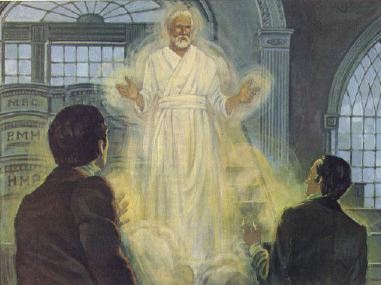
But Joseph Smith at the time didn't know him or his writings or backstory. All 17-year old Joseph Smith saw was a nameless messenger from God of fearfully bright appearance who came as a faithful response to the young man's sincere repentance, who shared news of a calling from God that Joseph needed to rise to, who gave news of a hidden book and tools of its translation, and then who spent the bulk of his visitation time citing and explaining scripture. Smith received basically a heavenly sermon, with text and commentary all pointing toward a Restoration of scriptures, of authorities, of structures, and of a mantic approach to revelation. To the youth in the room, this wasn't a personal example of how strong the Lord could make a weak person, Moroni was instead a dedicated servant delivering messages word for word from God, revealing purpose, giving directions (like those not to show the plates to anyone), and using most of his time and words to contextualize this purpose inside a trajectory of previously revealed prophecies. Moroni was an object of awe, a snap-to-it moment for the young Smith, an abstract position more than a person, and while the bearer of an important and intense message, he was not meaningful in and of himself.

And now take a step away from the agents in the narrative and consider the narrator and his context. This 17-year old experiencing Moroni for the first time is no longer 17, but rather 33. He's a mature leader of a Restored church of over 17,000 members, has completed both the translation of the Book of Mormon and of the Bible, has received over a hundred revelations, and has felt the burden of laying foundations of community amid sometimes mortally hostile conditions. To this more mature narrator looking back on his younger self and selecting the details of his experience most propitious both for responding to growing numbers of critics and for affirming the faith of the believers, Moroni was neither the faceless messenger nor the strengthened and glorified mortal. He was, instead, a seed--the starting point for a trajectory of mighty growth, the miraculous flashpoint from which a growing fire of faith would envelop the earth. Moroni wasn't merely the purveyor of prophecy, but was himself the fulfillment of prophecy, and he signaled the fulfillment of many more. Smith spent much of the year of this history's dictation falsely accused in prison and awaiting trial. Mobs had threatened his people and thought they cut the head off of the snake when they imprisoned Joseph. Joseph's reminder of Moroni as a beginning reminded all who had the faith to see it, that this wasn't Joseph's work--Smith was not the head of the proverbial snake, and no earthly power could stop the growth of the Church because it was the work of the Lord.

Do you see how the same figure of Moroni can have three separate valences according to the contextual details we choose as salient to our interpretive position? Do you see how all three can be true simultaneously? Do you see how the more initiation you have into context, the more you can draw out of the same passage?

Now read the cited verse at the top of this post again.

Smith notes that Moroni relayed verses from Malachi with slightly different wording than in the King James Version he was familiar with. Moroni had no earthly memory of that wording. We have his record, and we know that while Malachi's writings were accomplished a continent away, Christ Himself cited Malachi's words for the Nephites. And those mirrored the KJV exactly.

Between the two versions, and the new context for their delivery, Smith's mind and heart were beginning to open to paradigm-shifting realities.

Moroni also cited Joel and Acts, both scriptures with which he could have had no record (his people's connection with ancient Israel was broken by the year 600, just a decade and less than a half away from the Babylonian exile, and therefore their records couldn't have included Joel or Luke, 1st century author of the Acts of the Apostles), therefore which he could only have learned by some non-terrestrial form of learning. And the context and the guidance given pointed Smith to more new understanding of the imminence of these prophecies' fulfilment.

And apparently there are many others Moroni cited, expounded, and impressed upon the young mind of a Smith hungry for personal forgiveness, and for a purpose to pursue in life, but not necessarily one of such scriptural import. The context and Moroni's way of authoritatively guiding him through all the way from message to interpretation, must have blown Smith's mind.

What ways have new contexts provided you with new applications for familiar scriptures? Do new callings in the Church, or new seasons of life (adolescence, career changes, parenthood, parenthood of adolescents, retirement, serious illness, etc.) give you new perspective on the Lord's Word? Have you allowed Him to blow your mind recently? I promise you, the more you learn about the original context, the more accurately you'll see new applications of truths to your own situation.


Tuesday, January 14, 2025

Turning Hearts - D&C 2


The following text is repeated in some form in all four of the modern Standard Works of scripture, which, by itself, underscores the importance of the prophecy. Similarly, its placement immediately after the preface in our modern version gives it a place of prominence. Other things could have been inserted there--Joseph Smith's history of the First Vision, his retelling of the Moroni visit in its entirety, or, as it was in the 1835 Doctrine and Covenants, the constitution document of the church restoration (current-day D&C 20). But instead, from 1876 on, this portion of the angel Moroni's instructions 4 years prior to Joseph Smith's receipt of the golden plates was what inspired editors placed in this position.

Saints from the original 1831 publication of the "Book of Commandments," which later became the Doctrine and Covenants, all the way until Orson Pratt's 1876 restructuring and properly versified version did not have the following text from the mouth of Moroni, who was paraphrasing Malachi--an old testament prophet his civilization had no direct knowledge of--in visits to Joseph Smith in the 1820s. Saints after 1876 had the benefit of both this prophecy and its fulfillment (in section 110). Since the Moroni paraphrase differs significantly from the King James Malachi with which we are familiar, a study of the differences imposes itself:

"Behold, I will reveal unto you the Priesthood, by the hand of1 Elijah the prophet, before the coming of the great and dreadful day of the Lord. And he shall plant in the hearts of the children the promises made to the fathers2, and the hearts of the children shall turn to their fathers3. If it were not so, the whole earth would be utterly wasted at his coming4." - D&C 2:1-3 (Numbering mine)

"Behold, I will send you Elijah the prophet before the coming of the great and dreadful day of the Lord: And he shall turn the heart of the fathers to the children, and the heart of the children to their fathers, lest I come and smite the earth with a curse." - Malachi 4:5-6

1. Elijah is not a magical being. But he's in limited company among prophets who, tradition holds (but not scripture except between the lines), were taken from the earth without tasting death. Book of Mormon believers are aware of conjecture within that book's pages to the effect that Alma the Younger was also "translated" in this way, but only Moses and Elijah among Old Testament prophets, have had the honor, unless we count Enoch and his entire anomalous city of Zion to which all societies should aspire. 

The place left for him in Jewish tradition during the Passover Seder meal is there for the same reason Christians hold this prophecy dear: His return was a prophesied component of the Messiah's coming. Because Jews believe the Messiah has not yet come, they interpret Malachi's passage as unfulfilled. But even Christians who know that Elijah was present on the Mount of Transfiguration and yet will return before the Second Coming have to reckon with transliterations of his name into Greek: Elias. The angel Gabriel told Zecharias, the serving high priest at the temple in 1 BC, that his son should have the given name John, but that this John, later to be surnamed "the Baptist," would go "before" the Lord in the "spirit and power of Elias" which, in the Hebrew, would have been indistinguishable from the name "Elijah." Later, in explaining that the presence of Elijah on the Mount of Transfiguration didn't negate the prophecies of Elijah's coming before the Second Coming of Christ, Jesus noted how "Elias" was in fact not just a spirit, or power, but an office or a function which applied equally to John the Baptist as it did to Elijah the Tishbite (The Joseph Smith Translation makes the concept even more explicit). 

Because Saints of the Restored Church believe this title and function to apply to more prophets than Elijah himself, or even John, they are more interested in the function and purpose than they are the person. This is evident in the Moroni text, where the purpose is made explicit. Elijah's presence doesn't augur anything, but a Priesthood restoration--the laying on of hands for the passing of keys of authority after the pattern of ordination--is the substantive reason for the visit.

Elijah's coming restored authorities pertaining to the sealing of families beyond this mortal life.

2. In Malachi's version, the turning of the hearts has no explicit cause. We can infer that Elijah's presence itself touches off the turning and reconciliation it figuratively implies. But Moroni's version inserts a causal instrument: promises made of old planted in the hearts of the young. Prophecies made as early as Adam connect all humans into one great family of God. Orders of Priesthood whose offices serve community members which are organized in parallel for our modern-day benefit, were originally part of a Patriarchal order before Moses, before Abraham whose father tragically could not pass it on, causing Abraham to seek after another pathway to the covenants, and even before Melchizedek to whom Abraham paid tithes though not under his lineage. There were reasons that membership among the covenant people and the authorities attached to the ordinances by which the covenants are contracted was conceived as belonging to the family as an institution, rather than to the nation or the church. 

The old covenants are the same in content as the new--that the Messiah would redeem His people and enable their exaltation. And the familial relationships which the Lord has ordered each of us into can now, because of Elijah's return to convey the keys, be redeemed together as well. Christ saves us as individuals, collectively as a church, and intimately as families. These are the promises to which children can turn their hearts, that the heavenly societies we aspire to and render grace to the Savior for have the same basic unit as they do here: the family.

3. The ordinances pertaining to salvation, of which baptism serves as the first and most clear example, are bound to mortality. You can't baptize a spirit, only a body with a spirit inside. All those who haven't received, during their lifetimes, the individual chance to enter into the covenant relationship Christ requires of us all can only do so by proxy, and that authority is what Elijah restored. Because the promises and the temporal corporality are now ours, our hearts in the now can turn to the fathers in the past. But that direction of the heart-turning is only available in the Moroni paraphrase. The KJV Malachi text may still be accurate--fathers and mothers on the other side of the veil are indeed being taught the doctrines that will allow for their faith, repentance, and acceptance of a proxy baptism once one is performed in their name--and are likely therefore filled with the same joy in connection to the hearts of the children whose work can allow their celestial entry alongside those children. The turning of the hearts does indeed go both directions. But the Moroni version insists on the important direction as coupled with Elijah's purpose: that responsibility is ours as the children because they can't do it without us.

4. Lastly, the undefined and general curse the earth would be under if Elijah weren't to come is disconnected with any explicitly causal reason in Malachi's version. We should all take threats of curses from God seriously, even if they aren't specific, and even if they appear arbitrary. But Moroni's relaying of the same basic information adds purpose and specificity. It's not just that the earth will be smitten, it's that the very purpose of the earth--the place where mortal humans may gain experience in a test to become like their Father in Heaven is missing a critical salvific Priesthood power and function which could render moot the end of its entire creation. If Elijah doesn't restore this sealing power to bind families in a chain of covenant stretching back to Adam, the purpose of creation is wholly frustrated. It is, indeed, a waste.

God's great Plan of Salvation, whose center is His Son, our Redeemer, maps a path to Him far in excess of our limited mortal scope. He loves and is mindful of His children whose bodies have returned to the earth from which they sprang, but whose spirits are immortal and destined, by the power of that same Savior, to rise and inhabit their flesh once more, never to divide again. Those spirits in the waiting space before Resurrection are organized intelligences capable of faith and repentance, of decision, but not action, having no flesh to act upon. This Plan of Happiness fills my soul with hope and awe for a Being that allows us to combine our power with His for the individual reaching of all of His children whose choice is not to reject His saving ordinances and binding covenants.

Receiving Him - D&C 84:33-38

  "whoso is faithful unto the obtaining these two priesthoods of which I have spoken, and the magnifying their calling, are sanctified ...