Sunday, March 30, 2025

Disciples et Désordre dans l'Église - D&A 28:2-7


"Nul ne sera désigné pour recevoir des commandements et des révélations dans cette Église, si ce n’est mon serviteur Joseph Smith, fils, car il les reçoit tout comme Moïse. Et, tout comme Aaron, tu seras obéissant aux choses que je lui donnerai, en annonçant fidèlement, avec puissance et autorité, les commandements et les révélations à l’Église. Et si tu es conduit par le Consolateur, à un moment quelconque ou en tout temps, à parler à l’Église ou à l’instruire à titre de commandement, tu peux le faire. Mais tu n’écriras pas à titre de commandement, mais par sagesse ; et tu ne commanderas pas à celui qui est à ta tête et à la tête de l’Église ; car je lui ai donné les clefs des mystères, et des révélations qui sont scellées, jusqu’à ce que je leur en désigne un autre à sa place."

Une des bénéfices que j'ai eues d'avoir été appelé dans une mission où l'Église était tellement nouvelle, c'est que certains passages de la Doctrine et Alliances ont pris vie devant mes yeux. On a calculé, je crois, que je devais être le 13e missionnaire occidental à débarque de l'avion, couples exclus, en Côte d'Ivoire, une mission ouverte juste quelques années avant mon arrivée. Et il me semble que Satan n'aime pas inventer de nouvelles stratégies. Il aime exploiter les conditions de confusion et de crédulité pour semer l'orgueil là où les semences en puissent prendre prise, et puis enfoncer sa cale pour éloigner les fidèles de leur course étroite par degrés jusqu'à ce que leur foi en chancelle. Je suis content quand il échoue, mais entendre les expériences de comment il essaie peut me renforcer les défenses, car il se répète dans ses méthodes même à travers les siècles.

En exemple, j'offre une histoire qui m'a été racontée. Un des nouveaux présidents de branche dans la mission se sentait inspiré à faire grandir la foi de sa branche en augmentant leur révérence pour l'ordonnance central de l'adoration hebdomadaire : la sainte-cène. Digne objectif ! Il comprenait bien la doctrine derrière cette rite sacrée comme tous les membres : c'est le renouvellement de l'alliance du baptême, autre ordonnance rare parmi les pratiques de l'Église parce qu'elle aussi exige des prières fixes. Il a observé que pour ce baptême-là, on insiste aussi sur un habillement spécial. Ça doit être l'Esprit, pensait-il, travaillant à travers ses clés de direction qui l'appelait à ordonner que tous ceux de la Prêtrise d'Aaron qui bénissaient, préparaient, ou distribuaient la Sainte-Cène soient vêtus de combinaisons blanches de baptême. Depuis sa perspective, après avoir ostensiblement consulté le Manuel, il n'y avait rien qui s'opposait à ce qu'il reçoive une telle "révélation". Son but, après tout, était centré sur le Christ et avait comme cible la croissance de la foi en Lui des membres de son propre troupeau. Que pouvait-il y avoir de mal ?

Le président de mission à l'époque était un homme chaleureux, mais imposant. Il était ancien militaire et servait, avant sa présidence, comme dirigeant dans l'agence du code d'honneur à l'Université de Brigham Young. Alors, il lui arrivait par occasion, de communiquer de manière assez brusque, pour ne pas dire sévère parfois. Son habitude, le dimanche, était de visiter une branche différente. Quand, donc, il était le tour de cette branche dont tous les diacres filaient entre les bancs tous en habit blanc, il a immédiatement pris le président de branche à côté pour lui expliquer que lui aussi a eu une révélation qui dictait que la sienne avait tort. Je suis sûr qu'ils ont eu une échange plus détaillée que ça, mais peu plus.

Les principes qui s'imposent de cet épisode sont multiples :

1. Le grand Séducteur sait manipuler même les bonnes intentions. Il ne tente pas souvent les fidèles dans une direction à 180 degrés de leurs convictions. Plutôt, il est patient et subtile. Il n'a pas, certes, l'omniscience de Dieu, mais il est suffisamment stratégique avec la connaissance qu'il a pour être satisfait de petits pas jusqu'à ce qu'il puisse captiver par une ligne plus fermement traversée. Il réjouit même d'un degré d'écartement comme d'une victoire.

2. La révélation est un principe avec une portée. Un président de branche n'a aucune autorité d'altérer le Manuel général de l'Église entière. Et oui, malgré la lecture initiale du président de branche en question, tellement fidèle comme grand-prêtre qu'il était, son "incitation de l'Esprit" se résumait à précisément ça. Juste parce qu'on n'essayait pas de l'appliquer ailleurs que dans sa propre sphère d'influence ne veut pas dire qu'on peut inventer tout un nouveau code vestimentaire. C'est une manière subtile de s'étendre juste un peu plus loin que sa portée, mais c'est dans cette subtilité que la pente glissante tient son pouvoir de vous avancer doucement de plus en plus vers un abus d'autorité plus absolu.

3. L'Esprit guide, oui, mais un bon sentiment ne fait pas infailliblement une révélation. Et le contrefaits sont abondants.

Ne me méprenez pas ! Cet incident était assez isolé. Oui, comme partout il y a eu des anomalies et des apostasies individuels--certaines avec des effets plus répandues et certains ayant affaire avec des péchés plus sérieux--dans les années pionnières de l'Église en Côte d'Ivoire. Mais pour la plupart, mon impression personnelle est que les membres récemment convertis approchaient les pratiques de leur nouvelle institution religieuse et leurs appels individuels avec un degré élevé d'humilité. Ils savaient que l'expérience des Elders d'Utah qui avaient grandis avec les doctrines et les traditions de l'Église intégrées dans leur culture, n'était pas la leur. Alors ils s'accrochaient fidèlement au Manuel et aux écritures pour toute question de pratique, doctrine, et manière. Ils cherchaient soigneusement la ligne droite entre la doctrine et la culture, et implémentaient la doctrine et ses pratiques associées par conséquent avec un haut degré d'exactitude et intentionnellement. Et ceci libérait le domaine culturel pour une plus libre expression dans sa portée à elle aussi.

Ce président de branche particulier, à son crédit, s'est repenti. Et si mon information ne fait pas défaut, il a continué son service avec fidélité et a dirigé sa branche avec efficacité dans leur démarche chrétienne pendant des années après cette expérience.

Et cela semble avoir été l'écho de l'expérience de Hiram Page.

Dans un environnement historique similaire dans son ouverture aux moyens instrumentaux pour accéder à la volonté de Dieu (les baguettes de sourcier, pierres de voyant, et d'autres objets étant plus communs aux États-Unis de 1830 qu'aujourd'hui) ainsi que dans la nouveauté du concept que Joseph Smith a définitivement éclaté l'idée du canon clos ouvrant l'horizon de possibilité pour tout un chacun de recevoir pour lui aussi une révélation du ciel, Page fut parmi les fidèles fermes. Même avant le Rétablissement de l'Eglise, Page fut sélectionné comme témoin des plaques d'or, parmi très peu d'autres, et se fit baptisé juste quelques jours après ce 6 avril 1830 fatidique. Vers cinq ans plus âgé que le prophète, les deux toujours dans leur vingtaine, Page servit sa communauté en tant que médecin et sa nouvelle église dans l'office d'enseignant. À cause de son éducation, il dut sembler fiable quand il enseignait, et il s'avoua assez raisonnable pour attirer l'intellect d'Oliver Cowdery quand il spécula sur le thème de Sion. Mais ses idées rationnelles et bonnes intentions ne garantirent pas contre l'aveuglement spirituel. Et son humilité, comme celle du président de branche dans mon histoire, fut suffisamment développée pour le permettre de se retirer, d'accepter la correction, et d'ajuster sa démarche pour l'avenir immédiat, ce qui confirma la foi des autres en Dieu, en Son Fils, et en leur méthode ordonnée d'investir les clés pour la révélation à l'Eglise entière dans un seul prophète à la fois.

Notez bien trois observations de plus sur ce passage et épisode historique :

1. Cowdery, soutenu juste quelques mois avant comme deuxième Ancien de l'Eglise, n'a PAS été écarté de son droit de révélation pour le commandement général à l'Eglise à cette occasion. Juste parce que Joseph Smith était le prophète ne voulait pas dire qu'il était le seul à recevoir des révélations générales. Lisez soigneusement la limite imposée. La réponse du Seigneur, révélé à travers Smith, était que Cowdery devait se sentir renforcé dans son autorité de PARLER à l'Église à titre de commandement lorsque le Consolateur l'y conduisait. La limite à sa portée, alors, semblait les affaires en temps réel, pas les commandements écrits, plus permanents, qui resteraient dans la portée de Smith pour le moment. Smith n'hésitait pas à partager l'autorité, mais cet incident avec Page a donné l'occasion de chercher la volonté de Dieu, ce qui a permis la portée des nouveaux offices et procédés dans l'Église et du concept des clés de la Prêtrise d'accumuler de la signification et de la spécificité.

2. L'analogie de Moïse à Smith et d'Aaron à Cowdery est apte, mais proximal. Smith est "à la tête" de Cowdery tout comme Moïse l'était d'Aaron, certes, et comme il ne fallait pas à Aaron de commander Moïse, Cowdery ne devait pas prétendre à une autorité supérieure à celle qu'il avait. Mais un sens existe qui insiste que la tête de l'Eglise n'est pas Smith non plus, mais Christ Lui-même. En prenant la parole d'un homme raisonnable mais pas autorisé que l'Église devait faire X ou croire à Y avec la force d'un commandement sans chercher consensus avec Smith d'abord, Cowdery cherchait, essentiellement, à commander Dieu. Il est d'autant plus instructif alors de noter que le ton de réponse du Seigneur est doux, patient, et encourageant au lieu d'outragé. Le Seigneur veut que nous tous soyons des prophètes. Il faut seulement que nous apprenions à parler à notre tour et vérifier nos bonnes idées avec les autorités d'en haut pour que nous soyons unis avec Lui en même temps qu'unis avec nos partenaires de service, tous Le servant selon Son plan.

3. La Prêtrise a un ordre, la révélation a une portée, et même la manière de discipline--d'affirmer la pureté doctrinale, liturgique, et comportementale chez les disciples--a un ordre charitable qui lui est propre. Cowdery ne devait pas corriger Page en public, mais en privé. Il ne devait pas punir ou haranguer celui-ci, mais de le prendre à part comme "frère", lui dire la vérité nette, et observer sa réaction. Si Page avait mal réagi avec une attitude de défi, je suis sûr que d'autres actions seraient de rigueur, mais pour le moment, l'objectif pour un dirigeant corrigeant un offenseur en privé c'était d'encourager la confiance, offrir l'espace pour le repentir, et d'avoir une vraie affection pour l'âme éternel de son frère. Ce genre de confrontation directe douce, animée par l'amour, crée les conditions pour construire sur une terrain d'entente, pour le repentir d'élargir les âmes des deux côtés, et pour un engagement vers l'avenir en confiance, en solidarité, et en amour sincère.

Dieu est le Grand Prêtre par excellence. Il organise, délègue, et inspire selon des principes éternels auxquels nous sommes tous à mêmes de nous conformer. Les offices et le pouvoir de la Prêtrise marchent selon une hiérarchie ordonnée, la révélation est dispensée selon une portée ordonnée, et les enseignements et la discipline ont une manière ordonnée strictement prescrite. L'ordre importe à notre Père Céleste, et Son amour est évident dans l'exercice de Son pouvoir à travers cet ordre-là. Nous devenons plus ordonnés à mesure que nous Le permettons de changer notre coeur de s'unir avec le Sien.

Saturday, March 29, 2025

Disciples and Disorder in the Church - D&C 28: 2-7


"No one shall be appointed to receive commandments and revelations in this church excepting my servant Joseph Smith, Jun., for he receiveth them even as Moses. And thou shalt be obedient unto the things which I shall give unto him, even as Aaron, to declare faithfully the commandments and the revelations, with power and authority unto the church. And if thou art led at any time by the Comforter to speak or teach, or at all times by the way of commandment unto the church, thou mayest do it. But thou shalt not write by way of commandment, but by wisdom; And thou shalt not command him who is at thy head, and at the head of the church; For I have given him the keys of the mysteries, and the revelations which are sealed, until I shall appoint unto them another in his stead."

One of the benefits of being called to a mission where the Church was nearly brand new is seeing the Doctrine and Covenants come to life before your very eyes as you serve and observe. I think we calculated at one point that, excluding couple missionaries, I must have been the 13th western missionary to step off the plane in Côte d'Ivoire as it was newly opened just a few years prior to my arrival. And it seems that Satan likes to run the same old playbook over and over. He likes to exploit conditions of confusion and credulity to sow seeds of pride where they can get a toe-hold, and then attempt to wedge the faithful away from the strait course by degrees until their faith fails them. I'm glad when he fails, but hearing experiences of how he tries can give me defenses against him because of how often he repeats himself and his methods.

As a case in point, the story goes that one of the newly called branch presidents in the mission felt inspired to grow the faith of his branch by increasing their reverence for the central ordinance of weekly worship: the sacrament. A worthy aim! He understood it, like we all do, as the renewal of the covenant of baptism, noticed that both ordinances are among the few in the Church's entire liturgical inventory to have fixed prayers, and that for one of them, special clothing was required. It must have been the Spirit, he thought, working through his key-holding, leadership calling prompting him to require that all of the Aaronic priesthood members blessing, passing, or preparing the sacrament each week be decked out in baptismal all-white jumpsuits. From his perspective, after ostensibly consulting the Handbook, there was nothing preventing such a "revelation", and he had a good, Christ-centered goal to increase the faith of the members in his own flock. What could be wrong about that?

The Mission President, at that time, was a warm, but imposing former military man, and former BYU Honor Code enforcement leader who was no stranger to occasional sternness. He had the practice of visiting all the branches on rotation. Upon seeing the deacons all lined up in all-whites, he immediately pulled the branch president aside and told him in no uncertain terms that he too had a revelation which said that the branch president's revelation was wrong. I'm sure there was some exchange with more nuance and understanding than that, but barely.

The principles at play here are multiple:

1. The Deceiver can work through good intentions, and often doesn't tempt the faithful in a 180 degree direction from their convictions. He is subtle and patient, and while he's not privy to God's omniscience, he's strategic enough with what he does know to be satisfied with small moves until he can capture you with firmer line-crossing. Even a degree off is a win for him.

2. Revelations come with scope. A branch president has no authority to alter the Handbook (which despite the read of the faithful high priest in question, was what his "prompting" was actually attempting to do) for the entire Church. Just because you're only attempting to enforce it in your own leadership role doesn't mean you can invent a whole new dress code. It's a subtle way to stretch beyond your scope, but it's in that subtlety that the slippery slope gets its power to inch you further toward more and more outright abuse of authority.

3. The Spirit does guide, but just because you have a good feeling about something doesn't make it a revelation. And counterfeits abound.

Please don't get me wrong. This was a fairly isolated incident. There were other anomalies and individual apostasies--some with wider effects, some involving serious sin--in the early years of the Church's presence in Côte d'Ivoire. But by and large my own sense was that newer members approached all new callings with high level of humility. They knew they couldn't rely on baked-in cultural tradition like some of the Utah Elders could, and therefore clung tightly to the Handbook and to the scriptures when they had questions about what practices to establish. They carefully sought out the line between doctrine and culture, and implemented the doctrine and its attendant practices with a high degree of exactness and intentionality. This allowed the cultural aspects to be more free in their own scope as well.

This particular branch president, to his credit, repented. And to the best of my information continued faithful service, leading his branch effectively in their Christian walk for years after this experience.

And that, too, seemed to have been the historic echo of Hiram Page's experience. In a similar environment of openness to instrumentalities in the seeking of God's will (divining rods, seer stones, and other objects being more common in the 1830s than now), and of the recent revelations to Joseph Smith cracking open definitively the concept of the closed canon and the horizon of possibility that the Lord could reveal His will to anyone, Page was among the firm faithful. He was selected, even before the Restoration of the Church, to participate in the handling of the Book of Mormon's gold plates along with 7 other witnesses, and joined the church nearly forthwith--within days--once it had been reestablished. Only 5 years apart from the prophet's own youthful 24 years old, Hiram served his community as a medical doctor and his new church in the office of teacher. Because of his education, he must have seemed authoritative as he taught, and reasonable enough to attract Oliver Cowdery's intellect into agreement as he speculated on the topic of Zion. But his good ideas and good intentions were not enough to guarantee freedom from deception. And his humility, like the branch president in my own story, was developed enough to allow him to back off, accept correction, and straighten up and fly right for the immediate future--confirming the faith of others in God, His Son, and their orderly method of revelation for the entire church to one key-holding prophet at a time.

Please note three more things about this historical episode and scripture section:

1. Cowdery, as second Elder in the church, was NOT denied the right to revelation for the general commandment to the church at this time. Just because Smith was the prophet, didn't mean he was the only one that could receive general revelation. Instead, the Lord's response, revealed through Smith, was that Cowdery should feel reinforced in his authority to SPEAK commandments to the church as moved upon by the Comforter. The limit of his scope was instead to real-time matters, and not the written, permanent kind of "commandments" that would only be given through Smith for the time being. Smith wasn't unwilling to share authority, but this event gave cause to seek out the Lord's will, which allowed the order of principles of scope and key-holding to grow in meaning and specificity as experiences made the specificity necessary.

2. The analogy of Moses to Smith and Aaron to Cowdery is the proximal reading of headship as it relates to not commanding "him who is at thy head." But there remains a sense in which Smith isn't actually the "head" of the Church, Christ is. In taking an unauthorized, but reasonable man's word that the Church as a whole should do X, and applying the force of commandment to it rather than seeking consensus with Smith first, what Cowdery was really doing was commanding Christ. And while that sounds egregious, the revealed response seems all the more gentle and encouraging in tone. Christ wants us all to be prophets, we just need to learn to speak in turn and check upward on our good ideas so we can be one with Him as we are one with our fellow partners in serving Him on His plan.

3. The Priesthood has order, revelation has scope, and even the manner of discipline--of affirming doctrinal, liturgical, and behavioral purity in disciples--has a charitable order to it. Cowdery wasn't to upbraid Page in public, but in private. He wasn't to punish Page or berate him, but to pull him aside as a "brother," tell him the plain truth, and see how he responds. If Page were to react badly or defiantly, I'm sure there would be further action necessary, but for now, the purpose of the leader privately correcting the offending party was one of building trust, offering space for repentance, and genuinely caring about the eternal soul of one's brother. This kind of gentle, love-motivated directness of confrontation is what creates conditions for common ground to be built upon, for repentance to enlarge both souls involved, and for solidarity in fresh steps forward to be taken in confidence and love unfeigned.

God is the great High Priest. He organizes, delegates, and inspires according to eternal principles to which we can all conform. Priesthood offices and power run under an ordered hierarchy, revelation is dispensed under an ordered scope, and teachings and discipline have a prescribed orderly manner. Order is important to our Father, and His love is evident in the exercise of His power through that order. We become more orderly as we allow Him to change our hearts to match His.

Tuesday, March 25, 2025

Elections, Callings, Ordinations, Offices, and Delighting God's Soul - D&C 25:3, 5, 7, 12


Let's not sugar-coat the past. The 1830s featured almost nothing, for all but the most elite women's lives, that today's 2nd and 3rd wave feminists would hail as an example of equality of the sexes. But let's not also pretend it's fair to judge the past by the standards of the present. Several other sections speak to the relationship between husbands and wives. But let's not take this sole full section of the Doctrine and Covenants addressing a woman's roles in the Church--Emma Smith's, to be precise, wife of the prophet as she was--as emblematic either of a general sense of parity in all domains that didn't exist, nor of an equally romanticized general sense that nothing but misogyny ruled in the Church.

In that balance, then, we are free to note the seeds of the equality that does currently hold sway even within early revelations. As we study Section 25, it's significant to note some parallels of language harkening back to Section 20.

1. v. 3: "Behold, thy sins are forgiven thee, and thou art an elect lady, whom I have called."

This is the first chronological mention of the scriptural term "elect" in the Doctrine and Covenants. Perhaps notably, the term appears in only one chapter in the entire Book of Mormon either, and in that chapter it's used only negatively--the Zoramites in Alma 31 believed that God had "elected" them out of the world as chosen, saved, and separate from all other people through no choice of their own. There are even fewer references in scripture to the collocation "elect lady" which, no doubt, formed a reference in the minds of both Emma and Joseph Smith to 2 John 1, which opens an entire epistle addressed to some "elect lady" to whom John professed a love to her and her children because of the truth they were faithful to. Aside from the relative rarity of the term, its significance cannot have been lost on Emma. As the Church of Christ was restored through her husband's role as prophet, as the section reestablishing the Church began with a recounting of his remission of sins and calling, so this section shares a preliminary pronouncement of worthiness before relaying divine encouragements and roles. Emma was, in fact, elect--a daughter of God, a chosen instrument of the Lord for eternal purposes worthy of His eye and further instructions. As any man must receive a remission of sins before being called to a calling, so Emma shows that the requirements to serve the Lord as His representative in any capacity are universal.

2. v. 5: "the office of thy calling shall be for a comfort unto my servant, Joseph Smith, Jun., thy husband, in his afflictions, with consoling words, in the spirit of meekness"

Although the content of this calling doesn't appear generalizable--no one but his wife could serve in this capacity--the language in which the duties are couched mirrors that of all Priesthood functions. Her "calling" had specific duties, and she occupied an office on a par with what Priesthood officers hold after ordination.

3. v. 7: "thou shalt be ordained under his hand to expound scriptures, and to exhort the church, according as it shall be given thee by my Spirit."

The laying on of hands being required for the ordinance of ordination is precisely the same as is prescribed for all males worthy of a Priesthood office. And while the language of "comfort" and "consoling words" from the previous verses might seem more proper to a marital relationship, the duty to "expound scriptures," and to "exhort" the Church as prompted by the Holy Ghost, who testifies of Christ and invites all to come unto Him, could hardly be more directly connected to Priesthood offices that men hold.

One specific assignment this revelation communicated for Emma to perform was the compilation of a hymnal. I confess to not knowing her specific musical talents, except to assume that she could at least appreciate song as almost all humans can. But in relaying the assignment her husband received a doctrinal nugget I've always appreciated, but have rarely noted the first part of.

Verse 12 expounds a truth about the nature of God and his attitude toward sacred music: "For my soul delighteth in the song of the heart; yea, the song of the righteous is a prayer unto me, and it shall be answered with a blessing upon their heads." I'm in general alignment with Aristotle on the capacity for music to bypass the reason and speak straight to the heart, whether that be as a warning not to indulge the wrong kind of music/emotions, or whether than be as an encouragement to accept truth in a form that the intellect doesn't pre-digest for us. But I think we often focus on the "song of the righteous" part that God accepts as He does prayer--his intensely personal mode of silent or vocal communication with His children individually--and quickly gloss over the affect this kind of "praying" has on Him. Have you ever thought that your voice might delight the Lord? Or, perhaps even more accurately and universally (because not everyone has a beautiful singing voice, or even a voice at all), that the song of your "heart" can delight His soul?

I'm heartened by the thought of sisters around me who can partner with the Lord to affect His changes, and carry out His will with His power and calling. I'm also heartened by the concept of a God of omnipotence and omniscience, who nevertheless is moved to joy by hearts expressing themselves to Him in musical form. Made in His image as we all are, is it any wonder it's hard to find folks who aren't music lovers? And perhaps more importantly, I'm grateful for that mode of communication that can carry emotional expression in ways the spoken word simply can't, and to know that He is pleased when we let those emotions share themselves--in solo or ensemble, in melodies or harmonies--even when other kinds of expression seem inadequate. Is it any wonder prophets like Isaiah, David, Nephi and Alma wax poetic when their testimonies simply can no longer be contained in prose? Is it any wonder a chorus of angels could not be restrained as the birth of our Lord was announced to worthy shepherds in the fields?

Sunday, March 23, 2025

Restoring versus Reforming Christian Soteriology - D&C 20:25, 29, 31-34


D&C 20 is often referred to as the Constitution of the Church, and, like any constitution, it can be  treated as a reference manual for its instructions to members and officers from verses 37 through 84 rather than for the doctrinal underpinnings it offers in its early verses.

Its early verses contains the earliest published retelling of the First Vision and Moroni visits, albeit in summarized and oblique form, and then walks the audience of 6 charter members and 30-some other attendees through a concise doctrinal tour de force dismantling several points of doctrinal disagreement among Christians.

Two quick notes before we do the analysis:

1. This borrows substantially from Jared Halverson's Unshaken Saints podcast on this topic.

2. Before thinking through a theological disagreement, it serves to remind ourselves that people are not institutions, and creeds are not fellow humans. While it's important to engage ideas deeply, it's often completely inappropriate and counter to the Spirit's manner of persuasion to attempt to defeat a holder of beliefs contrary to ours in some sort of competition or debate. The person who holds the beliefs deserves love and respect. They deserve for their beliefs to be honored for all the good they do, and for their person to expect invitations to add truth to them, not challenges that undermine them. I'm not always as adept as I would wish at separating these two functions--the ideas attract me and call for direct intellectual engagement as ideas without me always choosing the most gentle or most apt strategic path to persuasion on the interpersonal level. I begrudge no one their beliefs, and wish to persecute no one for differences of belief. And I claim the privilege also of worshiping God as my own conscience dictates, allowing all my interlocutors the same privilege. What I offer below is sharing, even when sometimes sharp, and I honestly hope any of my Presbyterian friends and family will take honest criticism in the spirit of brotherhood and desire for them to open, rather than close their minds to the more correct ideas I'm presenting.

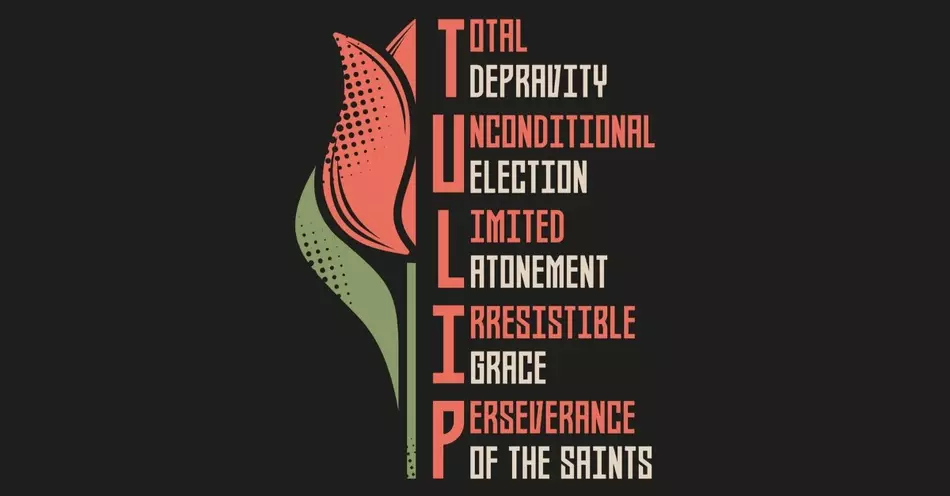
Since the early 1500s, the French priest Jean Calvin has had an important influence on Protestant theology. Presbyterians principally, but also Episcopalians, Baptists, Anglicans and Methodists of some stripes either conform to some of his distinct "reform" theology, or have to reckon with it in delineating their distinction from it, as do Lutherans and Arminian theologians. His "five points" of soteriology were in ascendancy in the western frontier of the United States such as it was in Joseph Smith's day (meaning upstate New York, Pennsylvania, Ohio, and points south, but barely more western). So the following doctrine, received in this section as the text of a revelation, but which is also a distillation of the Book of Mormon's "fullness of the Gospel," must have created a new space for a return to the Biblical text on which Calvin's five points purport to be drawn--a new point of comparison, a new perspective from which to judge the truth.

Summarized in the acrostic TULIP, these five point find counterpoints in Smith's 1830 revelation.

T for total depravity.

Calvinists hold that there is no impulse for good in the nature of humans. For them, the human family has been enslaved to sin by the fall of Adam, and inherits from the conditions he caused the impossibility of not just saving themselves from sin, but from any choices that would even incline them toward repentance, good works, virtue, or any other Godly quality. While this philosophy provides for an abundantly healthy skepticism of human motivations, and therefore prevents many abuses of power (or helps its adherents prepare adequately against them), it can't apply without evacuating the concept of moral agency.

Smith's take, from verse 25 provides a clue to a corrective:

"as many as would believe and be baptized in [Christ's] holy name, and endure in faith to the end, should be saved"

The word "would" does all the work and makes all the difference here. Humans do have a will all their own. and while God's omnipotence will have its full will implemented on Judgment Day, there is a space He has created for a temporary liberty to defy Him. This theoretical power to run contrary to His will, even temporarily, creates the conditions by which humans have the capacity not to, even in this fallen world. And it also creates the conditions for our own responsibility to choose the right, such that our punishments for not doing so fully and justly rest upon ourselves. The act of will to believe in a Savior and then choose to act accordingly is the Good News that His Gospel signifies. We are not totally depraved, just fallen. We are not off the hook, but accountable. We are not predetermined puppets, but real moral agents.

U for unconditional election.

God's omnipotence and omniscience has implications for a Calvinist. A Being of such power that He can't fail and of such intelligence that He knows the eternities beforehand means that His mercy extends only to a select few, and that no merit, faith, or virtue on their part--no condition they control or belong to--has any role in their selection. He predestines the elect, and they are powerless to reject His gracious election.

While this concept does deep deference to God, and again places healthy distrust on one's own virtues, merits, and faith, from the outside it appears utterly circular--if nothing you did puts you inside the group of the "chosen" then when you make choices that show you can't be one of the "elect" the only explanation available is that you must not have been "truly" elect in the first place.

What makes a person "elect?" according to the Restored Gospel? What "saves?" What grants "justification" and then "sanctification?" It's still the grace of God. But notice how it's phrased here in verse 29:

"all men must repent and believe on the name of Jesus Christ, and worship the Father in his name, and endure in faith on his name to the end, or they cannot be saved in the kingdom of God."

Notice how it's the responsibility of the "men" (all humans in 1830s parlance) to take on certain acts and make certain choices, and then to stick with them. God's grace enables all of that--we can agree with the Calvinists there--but His grace also grants to each of us a will, and that will is accountable to make those choices, perform those acts, and hold firm in an all-in commitment that is matched in heaven, but which is ours to initiate and develop with that omniscient and omnipotent partner who takes our burdens on Himself when we are yoked with Him.

 L is for limited atonement.

However incomprehensible to the human understanding the Savior's sacrifice was, Calvinists believe that it had a target, and therefore a scope. Its effect was intended for the "elect" and since God never misses His target, it was therefore perfectly and infallibly only for them. We may all get benefits from that supreme act of mercy and sin-coverage, but not everyone benefits fully.

For these Calvinists, who can never quite be sure, this concept paradoxically both makes them shrug off personal failures in case they just aren't the elect, and makes them intensely pious in case they are. So while they are prone to consistency in humility and gratitude for a Savior that saves the elect from their depravity, and they generally live lives of service and faith, their philosophy tends to allow them an out for their excesses.

Section 20:31, on the other hand not only notes above that "all men" must and can repent, and hold on in faith, but also offers the following:

"sanctification through the grace of our Lord and Savior Jesus Christ is just and true, to all those who love and serve God with all their mights, minds, and strength."

Again the determiner "all" is doing all the work: there is no one exempt from the responsibility of aligning with the conditions of acceptance of Christ's sanctifying grace--the application of their own might, mind, strength, and love.

I is for irresistible grace.

One other corollary of a god-concept so sovereign is that it can overpower the human will, and that therefore it must and will. No one who is among the elect has sufficient power to forestall the effects of his grace. If you're a recipient, no sin, no resistance can prevent your salvation. To be fair, Calvin's approach to God's sovereignty as continually unlimited, even in mortal spaces, doesn't equate to force. Instead, with a subtle distinction, he posits that the Holy Spirit overcomes whatever resistance an "elect" may have by its own forms of persuasion until God eventually wins over the sinner.

The subtle distinction between outright force and gentler force holds sway with Reformed congregations in which testimonials about how God's influence turned around the path they were on abound. And yet, the philosophy, pursued to its end, at its logical extremities, does ultimately remove agency from humans, and both prevents them from imputing growth toward the model of Christ to their own choices and lets them off the hook for their bad choices.

The above quote also points to an investment by each agent, who must turn their hearts, no matter the material and spiritual obstacles in the way, to the Lord with all their might, mind, and strength. Under the Restored Gospel, saints are just as likely to impute to God's grace the gifts of energy, intellect, and muscle He grants unto them to accomplish His commandments, but they understand the purpose of the gift of moral agency to be necessarily their own, because in no other way can they grow and have the growth be their own.

P is for perseverance of the saints.

With God's sovereignty able to overpower the human will, and with the omniscience pre-selecting the few predestined for salvation without their knowledge, the concept of a fall from grace is a logical impossibility to Reformed theologians. This brings us back to the tautology of labeling a relapsing sinner as falsely elect in the first place.

In response, on the day of the Restoration of His church, the Lord inspired verses 32-34:

"But there is a possibility that man may fall from grace and depart from the living God; Therefore let the church take heed and pray always, lest they fall into temptation; Yea, and even let those who are sanctified take heed also."

When the biblical pattern of mantic revelation to a current-day prophet factors in, it becomes more and more clear what the Savior meant when He told a farmboy willing to ask the question of which church to join that he was to join none because their creeds were an abomination to Him. It's not that their faith is bad or insincere. It's not that their devotion and piety are unacceptable. Quite the contrary--we should all recognize the good that people do, and that their motivations count. But to the Lord, who must insist on a purity of doctrine because being off by even a degree makes a valued son or daughter miss the mark in far-off eternity, any impurity destroys infinite potential. He wasn't judging people, He was inviting all to add to their faith, or refine the direction of their faith. As in the times of the Pharisees whose piety was acceptable when it wasn't false, and whose service was acceptable when it was from the heart, Calvinists have a credo that prevents them from sound, contextualized interpretation of only a very few, but very important scriptures.

And it takes a Restoration, not a "reform" to correct them. The Constitution of the Church was not revealed as a rebuttal to Calvinism. In none of the verses I've cited does Joseph Smith engage in exegesis, biblical reference, or homiletics. There is no debate presented, no explanation of how to ground doctrine in the Bible or in the Book of Mormon--the only two books of Scripture available at the time--but rather a simple, positive statement of what salvation consists of, how to tap into Christ's grace, and what a walk in grace looks like. God revealed it. It comports with all prior scripture, just not one credo's take on scripture. Christ saves, and He wants to save us all, so He commands us to use our will to choose Him out of love just as He chooses us in His perfect love.

Sunday, March 16, 2025

The Expressive Atonement - Hematohidrosis in Gethsemane - D&C 4-12, 16-20


"For behold, I, God, have suffered these things for all, that they might not suffer if they would repent; But if they would not repent they must suffer even as I; Which suffering caused myself, even God, the greatest of all, to tremble because of pain, and to bleed at every pore, and to suffer both body and spirit—and would that I might not drink the bitter cup, and shrink—Nevertheless, glory be to the Father, and I partook and finished my preparations unto the children of men. Wherefore, I command you again to repent, lest I humble you with my almighty power; and that you confess your sins, lest you suffer these punishments of which I have spoken, of which in the smallest, yea, even in the least degree you have tasted at the time I withdrew my Spirit."

 Of all the four Evangelists, only Luke mentions--and only in a single verse--the physical effects visible to Peter, James and John on the Savior's body during his prayers at the Garden of Gethsemane. The doctrine of the Church of Jesus Christ of Latter-day Saints joins the greater Christian community in the worship of the Son of God, made flesh for us, to die on the cross and be resurrected on the third day. But we alone recognize that Christ's atoning sacrifice began in Gethsemane. The Savior, according to Luke

"being in an agony[, ] prayed more earnestly: and his sweat was as it were great drops of blood falling down to the ground."

Curious about this phenomenon, I discovered a medical condition that appears to describe what happened to Jesus by the name of hematidrosis. Apparently, it's extremely rare, but not entirely unheard of in medical history for a stress response to heighten blood pressure enough to burst capillaries adjacent to sweat glands, and for the resulting sweat to take on the color of the blood. Also mentioned are cases of depression and emotional distress producing similar results. Anecdotally, prior to looking this up on medical websites, I had also heard of two classes of occasions where this rare symptom had been manifest. One was reportedly a civil war soldier undergoing amputation in a period before modern anesthetics, and the other was a mother enduring a prolonged and difficult childbirth. In both cases, I was told, a single drop had appeared on the forehead.

Given the facts surrounding this kind of symptom, and given Luke's record that it happened to an unidentifiably many sweat glands under the skin of our Savior's mortal body, the account we have in the Savior's voice above is eclipsed by none for its poignancy. Our Lord's subsequent flogging and public shaming added pain and ignominy to His suffering and death, but it was the cause of the bleeding from every pore that caused Him to will not to continue in such agony, and yet to reject His own will in favor of His Father's. That agony was not from physical, but spiritual causes. The infinite weight of all of Creation's fallenness, of all of God's children's sin, yours, mine!--the utterly unfathomable burden of eternal separation from all Love--was borne by the babe of Bethlehem, the Son, both of God and of Mary, the Great I Am of whom the prophets had all testified. This Messiah did not shrink. He finished His work, to the glory of the Father. And now our repentance has efficacy. Now our state is no longer hopeless. Now, we can be redeemed through our Redeemer's loving self-sacrifice, be forgiven, and take upon ourselves His easy yoke. These Doctrine and Covenants verses relay, as best as language is fit to describe, the reason for joy we have in His Gospel--the "good news" that came at an unimaginable cost that only He could pay, and which propels us as disciples to every confidence in His victories over every evil thing.

Martin Harris came to the prophet Joseph Smith with doubts about an investment he had been asked to make for the publication of the Book of Mormon, and this expressive set of verses must have helped him compare, realize how insignificant his own potential suffering might be, and hold firm on the steps of faith required of him. He too had a work to finish, but how encouraged he must have been to realize that the Being whose Gospel he was called to proclaim, whose Word this investment would support as it would be distributed widely, was offering to be his Partner. Harris's role, as is ours, was not to suffer for sin, but to accept Christ's suffering for sin. To refuse to let it go to waste. To repent, and let Him change our heart, our state, our eternity.

And it wasn't so long ago--less than a year--that Harris's role in the theft of the manuscript pages entrusted to him left him with a hint of the separation from God. So that experience could drive the message home even further. Just prior to explaining just how close to the precipice of turning back Christ Himself came because of the "exquisite" quality of the suffering He experienced, the Lord revealed a mind-blowing twist on the very terms our human languages are limited to in its description:

"Surely every man must repent or suffer, for I, God, am endless. Wherefore, I revoke not the judgments which I shall pass, but woes shall go forth, weeping, wailing and gnashing of teeth, yea, to those who are found on my left hand. Nevertheless, it is not written that there shall be no end to this torment, but it is written endless torment. Again, it is written eternal damnation; wherefore it is more express than other scriptures, that it might work upon the hearts of the children of men, altogether for my name’s glory. Wherefore, I will explain unto you this mystery, for it is meet unto you to know even as mine apostles. I speak unto you that are chosen in this thing, even as one, that you may enter into my rest. For, behold, the mystery of godliness, how great is it! For, behold, I am endless, and the punishment which is given from my hand is endless punishment, for Endless is my name. Wherefore—Eternal punishment is God’s punishment. Endless punishment is God’s punishment." (emphasis original)

For a Being to whom a thousand years is as one day, who has past, present and future continually before Him, words that appear to us to be bound to incomprehensibly long concepts of time, like "endless" or "eternal" may be bound less to quantity than to quality. Descriptors signifying duration become descriptors of kind, category, essence. So rather than take up his generation's propensity for fire and brimstone preaching about the length of time sin can make a person disqualified, Harris, Smith, and all modern-day Apostles and students of the Master's meaning, can concentrate on the Lord's redemptive power--a healing affixed in opposition to the quality of suffering that only the Eternal could bear, offered freely to us on condition of repentance. Again, what new and profound appreciation must Harris have taken away. The Lord suffered what only He could, and His torments, qualitatively impossible for humans to bear, had a purpose! They were so that Harris, like Smith, like us all, could enter into His rest. An eternal rest. An endless rest. A peace not like the world gives.

Whatever your calling, whatever your sacrifices, whatever the Lord calls you to endure, hang on. Walk with Him, so the burden can be light. Repent, and begin enjoying the reward of the Endless forgiveness, Eternal salvation. Act in faith. God is with you.

Friday, March 7, 2025

Dealing with Persistent Doubt - D&C 19:1-3, 13-14


"I am Alpha and Omega, Christ the Lord; yea, even I am he, the beginning and the end, the Redeemer of the world. I, having accomplished and finished the will of him whose I am, even the Father, concerning me—having done this that I might subdue all things unto myself—Retaining all power, even to the destroying of Satan and his works at the end of the world, and the last great day of judgment....I command you to repent, and keep the commandments which you have received by the hand of my servant Joseph Smith, Jun., in my name; And it is by my almighty power that you have received them"

The guy who let himself get pressured into convincing Joseph Smith to release 116 pages of manuscript, and then got them stolen and therefore lost his role as scribe and got Smith's translation privileges revoked for a time stayed close. This Martin Harris supported the ongoing translation even if he could no longer be involved directly, staying abreast of progress and continuing to desire further and greater witnesses than those he had already received. Some of it was persistent doubt and bowing to pressure from others to check on his investment, but some of it was genuinely taking steps forward despite what skepticism he was confronted with externally and internally. 

As time came for the translation to be published, publishers were consulted and it became apparent that they were leery of the normal risks of publication. Usually printers fronted the labor, paper, and ink costs in order to own the rights to profit if a book project surpassed the costs of its printing run. E. B. Grandin in Palmyra knew this particular book would have stiff opposition, and so he demanded all the costs up front. He would charge what at the time must have seemed astronomical to Smith: $3000. Harris, however had the means. But it would be his deepest investment yet, it would require the mortgage of his substantial farm. His marriage was on the rocks, and would eventually be lost, but at this point in history, his wife's pressure was at its fullest--she couldn't stand to see him put their wealth in jeopardy. And while he did resist that pressure, and did mortgage his family's means of support, the feeling that he may have just risked it all for something that might fail must have loomed over him. So he asked Joseph, one last time, to inquire of the Lord over what he should do--just one more little assurance surely couldn't hurt, right?

Note the tone of the opening verses here. Finality rings throughout. There is Christ as the Alpha Creator, Word who was in the Beginning, who was with God and was God, in whom Harris already has faith. But there is also Christ as the Omega, the end, the accomplisher and finisher of the work of His Father. As our model, these twin aspects must not have failed to impress Harris's mind with the idea that he was small, but still must follow in faith--he too must end the things he begins, he too must be "all in" even when the outside voices question the wisdom, he too must not just set good faith goals, but follow through with action, trusting the Lord would bring about the object of faith.

While finality and seriousness is the overarching tone, there is also encouragement. Like the wisest of coaches who know how to motivate players to their best performances even when the stakes are high and the chips are down, the Lord reminds him that the power is His, and if it's His, and you are on His errand, His power is yours too. What greater confidence can one have?

Just like courage is not the absence of fear, faith is about action through doubt, not the absence of doubt. The key is to remember how invincible you are with God backing you up. The key is to keep your eyes on Him, not your fears. The key is to obey before you know for sure. And the pattern is that His power empowers.

Harris's actions in faith, through persistent doubt, led to the conversion and eternal salvation of many millions. Yours can too.

Monday, March 3, 2025

The Worth of Souls - D&C 18:2-5, 10-15


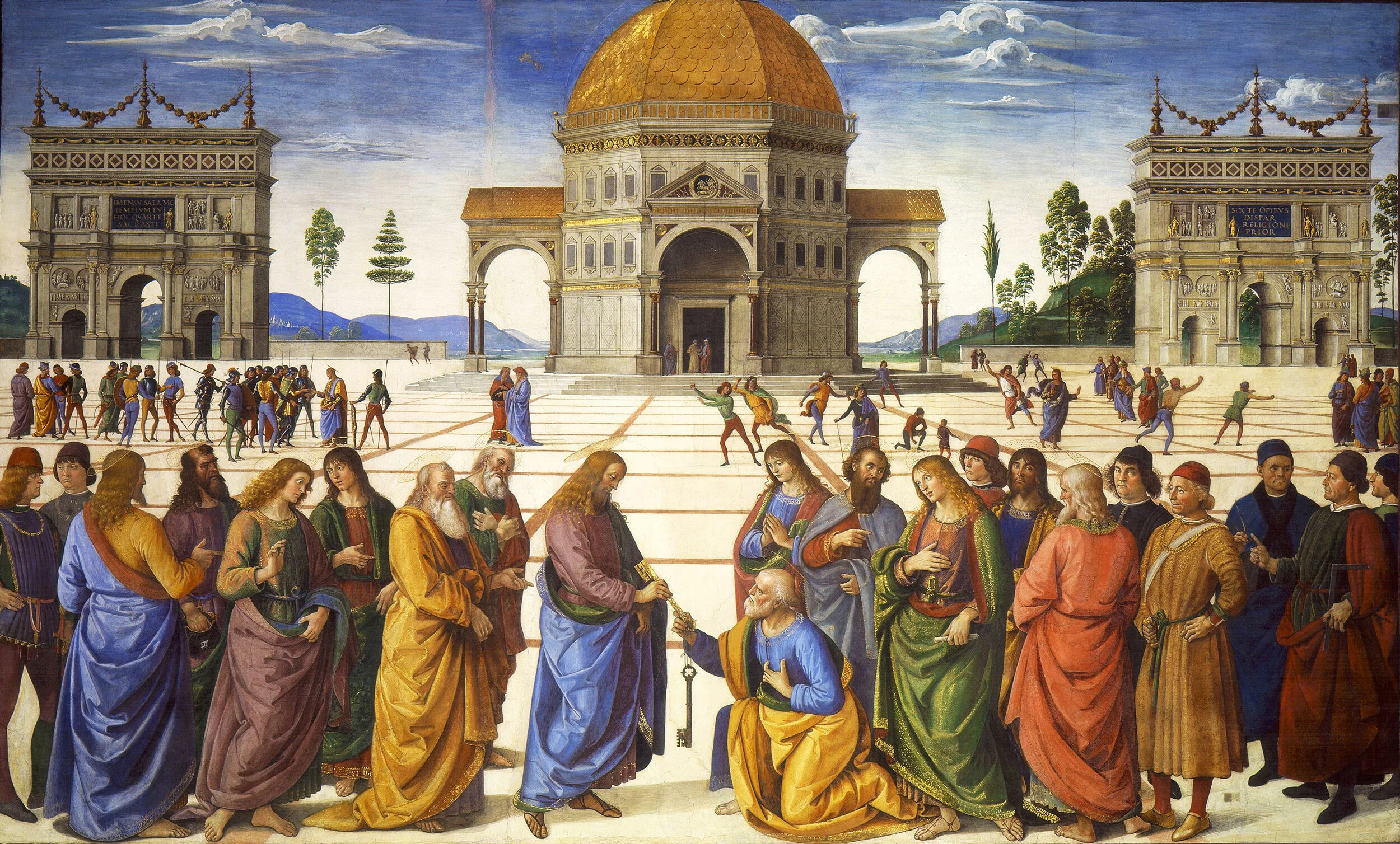
Delivery of the Keys - Pietro Perugino

"Remember the worth of souls is great in the sight of God; For, behold, the Lord your Redeemer suffered death in the flesh; wherefore he suffered the pain of all men, that all men might repent and come unto him. And he hath risen again from the dead, that he might bring all men unto him, on conditions of repentance. And how great is his joy in the soul that repenteth! Wherefore, you are called to cry repentance unto this people. And if it so be that you should labor all your days in crying repentance unto this people, and bring, save it be one soul unto me, how great shall be your joy with him in the kingdom of my Father!"

If there's a scripture passage unique to LDS believers that they are likely to memorize, this may be one of the most popular. In her signature 80s style, with musically complementary melody lines combining in counterpoint, Janice Kapp Perry popularized it for child and adult audiences alike in her song How Great Shall Be Your Joy. The doctrine is clear and simple: repentance is not a burden--neither to the sinner, nor to the Savior--but is a cause for great joy. It is a duty, sure. It is a message that those called must courageously bear to the world, yes. But its purpose, its telos, is a cleansed being made pure by the Cleanser whose sacrifice for each individual makes each soul of infinite worth--equal in weight to the sacrifice itself. To Him, we are that valuable. To Him, we should lift up our heads in joy at our redemption when we repent, and in gratitude for His eternal love.

And let's also examine the context and a few intertextualities for clues to expand this meaning, or anchor its direction. The section, as with most, is a response to something. The questions asked aren't always clear from the contextual paragraphs that head each section, but it doesn't take much reconstruction from this one to imagine Oliver Cowdery and a friend from the Whitmer family realizing that now that the work of translation of the Book of Mormon is pretty much complete, there are next steps. There is a church about to be established, and it's going to require new roles for them both, as well as for Joseph Smith. I think they both wanted to have a better understanding of "now what?" They were eager, willing to buckle down and get to it, and each had their different mix of talents, abilities, and hang-ups, so the Lord is basically preparing them for those parts of the next steps that would be best suited to their abilities and zeal.

Later in the section the idea that the Church would eventually need Apostles, and that Cowdery and Whitmer would be charged with seeking them out forms the concrete answer to their question, but the Lord saw fit to establish a few things in the preceding verses:

"I have manifested unto you, by my Spirit in many instances, that the things which you have written are true; wherefore you know that they are true. And if you know that they are true, behold, I give unto you a commandment, that you rely upon the things which are written; For in them are all things written concerning the foundation of my church, my gospel, and my rock. Wherefore, if you shall build up my church, upon the foundation of my gospel and my rock, the gates of hell shall not prevail against you."

1. He re-affirmed their testimony of the truth of the Book of Mormon. Because they knew that was true, they could build further in confidence that Smith's revelatory role as prophet was, in fact, the authorized pipeline from which they could trust other words and charges from the Lord. You can't build toward the Savior in faith without trusting His prophets.

2. He anchored them back to the content of the Book of Mormon. Because they knew what it contained, they should "rely" upon it as source for the next steps. On several layers of analysis, the Book of Mormon lays a foundation--for prophets, for a restoration of lost scripture, for a restoration of lost doctrinal purity, for chapters of handbook-like language detailing modes of worship and prescriptions of liturgy that are missing in the Biblical accounts of Church operation, even for the name of the Church itself, and its first principles and ordinances, all centering on Christ.

3. Then He connected their general charge to be among those who preach repentance as a way to build the Church on the "foundation of my gospel and my rock" both to their own salvation (failing to take up the charge might permit the gates of hell to prevail against them, which is sobering language) and to an understanding of Christ's reasons.

Stated that way, the point about repentance being joyful is not merely about wishing to please Deity in ways He finds pleasurable. There is a deeply, personally implicating setting of mission that the passages are accomplishing here that Cowdery and Whitmer are needing to lean into, needing to catch the vision of. They have a role, but it's not for their place in history, not for the tales told about them by posterity--it's for His glory, not theirs. They, like Peter to whom the "gates of hell" commentary alludes, needed to know not just that the Book of Mormon was true, not just that Joseph Smith was a prophet, but that Jesus Christ was the Son of God and Savior of all--even them. Their work would be to bring one, or many souls unto Him, but He was the one that suffered for those souls. As souls returned with broken hearts and contrite spirits to the waters of baptism, the personal connection with each forgiven child would belong to Him. They could have joy WITH Him, but the source of that joy is the individual loving relationship that the conditions of repentance restore when the gift of His suffering is accepted rather than wasted. The rituals, authorities, and doctrines enabling the acceptance of Christ were about to drop on the world, and servants to spread the word were about to be necessary en masse to gather His sheep, one by one.

The rituals, authorities, and doctrines of Christ. The doctrinal "good news" that He wants to covenant with us, on condition of our faith in Him and repentance, to receive Him and His Spirit--receive His salvation--is his Gospel. The organization of believers with an attendant hierarchical structure of a Priesthood order and with rituals of a prescribed manner--all tooled toward enabling covenantal relationships between Christ and members--is his Church. What is His rock?

Is that a mere metaphor for Himself? Both the Church and the Doctrine are built on Him, after all. Is the Atonement His rock? There are two high profile references to "rocks" to be built upon within the mortal ministry of the Savior, among the many others in scripture, both of which consist in some form of figurative language.

The first is in the Sermon on the Mount, where the Lord lays out a set of higher laws beyond the Mosaic ones and explains the analogy that accepting true doctrine, but not acting on it is like building a house on sand, but that behaving in consequence of truth is the only way to build on a "rock" that will last through storms. Could action over knowledge be the "rock" to which the Lord was referring here in D&C 18? Could "relying" on the Book of Mormon scripture to guide actions, or repenting be the actions that make faith real? That allow the foundations to hold up a larger edifice? Metaphorically this reading has legs, but there's another reference available.

In the second, Peter and the other disciples have been questioned by Jesus about who they think He is, and Peter responds that he knows Jesus is the Christ. The Lord's reply has spawned voluminous commentary because of the crucial claims Protestants and Catholics base off of it.

"Blessed art thou, Simon Bar-jona: for flesh and blood hath not revealed it unto thee, but my Father which is in heaven. And I say also unto thee, That thou art Peter, and upon this rock I will build my church; and the gates of hell shall not prevail against it. And I will give unto thee the keys of the kingdom of heaven: and whatsoever thou shalt bind on earth shall be bound in heaven: and whatsoever thou shalt loose on earth shall be loosed in heaven." (Matthew 16:17-19, emphasis mine)

Simon, son of Jonah (or Bar-Jonah) had a surname that translates to "rock:" Peter. So, Catholics have grounds to assume the Redeemer's word play was personal to the senior apostle, and that there was a very real centering of earthly authorities, in the figure of keys, on which the Church would be built later. Peter was, in fact, the Church's highest mortal functionary after Christ's ascension, as even Protestants readily admit. To them, however, the "this" was not a reference to Peter, but rather to Peter's recent admission that Jesus was the Christ. To Protestants, no priesthood is necessary, no authorities intervene between the Savior and His Church, and they ground the church directly in the same--the "rock" therefore is not metaphorically Peter the person, but Christ Himself.

What neither seem to allow, but which the text itself does, is a third reading in which Peter is not the rock, and while Christ still is, it's the testimony of Him and the necessity of building our own "house" upon Him that the "rock" may also be referring to. Just as Venn diagrams may have multiple overlaps, the existence of another layer of meaning shouldn't trouble the accuracy of other layers. In this case, the "this" may be referring both to Christ (His Person, His Atonement, the content of the revelation which was not revealed to Peter by "flesh and blood" but by the "Father") as well as to the revelatory process itself (the means by which knowledge of the Redeemer comes to Peter and us all--by the Father revealing it). In other words, the force binding earth with heaven is authoritative and belongs to a hierarchical order on one level of symbolism, but on another equally valid one, that revelatory link is not only accessible to all, but is required of all. We must build on the Savior by obtaining a personal witness of His relationship to us, His purpose in our lives, His atoning effect on our eternity.

The worth of a soul is indeed great because of its cost in infinite suffering to that Being to whom each soul belongs. It is also of great worth because of the joy it brings Him when souls repent and He can welcome them into a covenant relationship with Him. Whether that soul is your own, or another's, bringing another into faith sufficient to produce repentance is building on His Gospel, His rock, and His Church, in all senses of the word, and the prevents the gates of hell from prevailing against you.


Receiving Him - D&C 84:33-38

  "whoso is faithful unto the obtaining these two priesthoods of which I have spoken, and the magnifying their calling, are sanctified ...