Sunday, May 25, 2025

Enlightening Spiritual Meaning - D&C 50:1-3, 17-35


"If it be some other way it is not of God."

Did you happen to grow up, as I did, in a technological society largely organized and structured around Western Enlightenment ideas? That particular bundle of ideas supports a wide range of beliefs about spiritual things, but it also uplifts skepticism as a value, and a neat scission between the domains of science and religion. I don't mean to suggest that the two are incompatible--far from it: I staunchly believe that there is one single source of truth and that all truths can be circumscribed into one great whole, such that the dichotomy is ultimately false. But while religion is ultimately compatible with all scientific truth, science can't claim purview over truth with no limits. There are questions that science can never claim to answer because it proceeds through a method that has to be empirical at bottom. Unfalsifiable claims are simply not its purview, and so those who value science as a pathway to truth often end up reinforcing a distinction between faith and knowledge as if it were tantamount to the true distinction that exists between opinion and fact.

And Westerners like myself swim immersed in concepts of empiricism, of the progressive march of humanity's wealth of objective knowledge, and of trust in the applications we put that knowledge to, that a great many phenomena that we find difficult to apprehend through rational thought strike us as wrong, hokey, or as merely temporarily troublesome because we haven't yet learned the secret rational explanation. I'm not talking about common, but subjective experiences with the ineffable--the excitement you feel when your team wins, the stirring you get from the chord progression of your favorite band's best song, the depth of awe you feel in front of an artwork you admire, the love you share at the birth of your child. These are all things science can't explain either, but it's because they're indescribable, utterly subjective, and don't appear as apparent contradictions, illusions, or uncaused consequences. I'm more exploring the magician, the psychic, the ghost whisperer, the worshiper entranced into a paroxysm of frenetic motion, who claims not to be in control of their own body temporarily. When confronted with these--which exist only on the margins of our Western societies--isn't your mind also more cautious, more vigilant, reticent to take the phenomena at face value, seeking the key to the rational explanation that you don't have, but you can't proceed without insisting must exist? Doesn't our modern experience teach us to be skeptical of polytheistic practices and beliefs, and only flirt with "spiritism" because there's never any real threat to indulging it--it's not rational, so it has no power?

I don't think the 1830s Western frontier gateway communities were fully Westernized in that sense. Christian theology is profoundly rational and powerful as an explanation of human nature and the ways to integrate self-control in the service of higher aims that it produces at all levels from the individual to the national. But in this period, its doctrines were more frequently mixed with charismatic practices, ecstatic experiences, and openness to explanations for some phenomena that we would find unsatisfactory today, even within the realm of religion. Divining rods for water or treasure seeking, seer stones for connection to unworldly sources of wisdom, relics imbued with supernatural power--Christians of various kinds had various orientations toward these kinds of connection to God and His Spirit through means of some kinds or others, and they weren't always seen negatively. Similarly, the surrounding decades marked the beginnings of a transition between dealing with the mentally ill or palsied as if they were a family and community problem of spiritual possession, and dealing with them as if they were a state responsibility to be handled by medical expertise. All this to say that the idea of imputing to "spirits" the cause of a material disturbance, a divine communication, a malady, or a claim of involuntary action has been thoroughly drummed out of our current collective imagination, but was an available explanation among Christians in 1831 Ohio.

I have never seen an exorcism. Or a ghost. I don't expect to. I believe that every body alive has a spirit inside, but that's a matter of rational shorthand to explain an essence I can't directly observe which leaves the body inanimate at death. Its existence makes a system of corollaries equally rational: spirits are the "deciding" faculty of humans; they're made of immortal stuff we can't measure, but we see the effects of; acting through a body, spirits affect the world for good or evil, and the Father-God who created them as His children will hold them accountable for their use of that agency, out of perfect justice and perfect love. There are others, but while belief in spirits makes life's purposes and my theology make sense in the abstract, this doesn't mean I have to believe any concrete claim that a deed done, a word spoken, or an ill effect experienced was due to any given spirit. The scriptures may speak of cases that I do believe in, like the Legion cast into the swine by the Lord, but I'm skeptical of reports of them today.

Maybe you're like me in this. Today, we'd more likely see a trance not as a possessed person, but as a dissociative state fully explained by psychological science. We'd be more likely to see multiple personalities as a disorder scientifically possible within a single mind, the result of a childhood psychological trauma, not of a spiritual force. We'd watch ghost-hunting TV shows and expect electromagnetic sensors and other technological "tools" to add on to the "spiritual" explanations of the showrunners.

When we think of the term "spiritual" now, it comes up as the opposite of physical or material. It might sometimes be used to distinguish an adherent to organized religion from someone who wanted to maintain institutional independence, but claimed more subjective sensitivity to non-material ideas, forces, and experiences (think new age woo-woo). But we rarely deploy the term to describe a separate unseen agent compelling or persuading a human to do, say, or believe anything.

But this latter meaning is clearly the sense in which Smith deploys it in this Section. Members of the Church professed belief in Christ, made baptismal covenants with Him, and were bringing in elements of their prior modes of worship--including shaking, babbling in tongues, claiming to receive prophecies, claiming to have visions, and a host of other practices that no longer feature in LDS services, and haven't for almost two centuries.

So how do we reconcile taking the contextual meaning of "spiritual" for what it was at the time, and still being able to draw out applications for the current day? Those "spirits" that we don't understand aren't literally among the things we encounter because we're not open to that explanation. We would reject them outright, rather than seeking to understand such. So what's our lesson?

One way to draw out a meaning is to abstract out a principle, and sometimes that requires metaphorical extension. It's clear that there is both a principle and a process still applicable today in these verses. We may not believe someone is possessed BY a spirit, but they can be possessed OF ideas that don't add up, aren't fitting the truth, or come from contexts we're unsure of. There is a spirit, Satan, who whispered those lies to them through some agency we can't materially detect. Can we test those like the Lord reasoned to the Elders that the spirits could be tested? Could we know if ideas were not from God and not be deceived just like we can know, by their "way" if spirits are not from God? I think that's not only licensed by the text, but it's the essential principle of the teaching. We must share light as we discuss truth, and do it in such a way as to edify, build common understanding, and leave our encounter with both sides feeling positive.

I don't always succeed at this, and even Jesus didn't either. He's the perfect teacher, and yet some truths, by their nature and by the nature of the recipients and their choice to accept it or not were rejected by the majority of those Christ ministered to. Just because someone feels icky or targeted by the truth, doesn't mean the Spirit wasn't there. One party can't hijack the test of whether X is from God. Sometimes--and I'm very much still learning when and how, and have made egregious errors in judging the right way to approach sharing some truths to some people in some situations--they just won't listen, no matter how right you are. But when the efforts to create a baseline of common ground and mutual openness to honest communication are successful, the Gospel's light does tend to dispel darkness all by itself. All you have to do is share it, and the Spirit of the Lord touches the mind and heart of your interlocutor. I've seen this happen a gazillion times, and have been on the receiving end even more. I know how it feels to teach, and come together with my child, my friends, my students, and "get" each other. And all other ways are not of God.

Are you open to the light? Do you share what you have? Are you speaking in code that baffles or not giving enough space for your conversation partners to experiment on your words? Or are you instead meeting people where they are, in their language, in comprehensible terms, with appropriate expectations of freely chosen growth? You can know these ideas are from God because of the peace and joy in your heart, because of how they make sense internally, coherently, and between sharer and receiver, and because they grow the relationship between you. And you can act like He acts, by bringing peace, love, and edification together. No railing accusations required if they don't accept the truth, or share something that's not quite right. Just share the light. It will eventually illuminate the darkness they still hold onto. The darkness, in fact, has no permanent defense against your magnification of God's warmth. We'll all line up with His truth sooner or later. Until then, we can love, lighten burdens, and enlighten each other according to the Spirit of God that we have received. We can "reason" with others as He reasons with us--in patience.

Saturday, May 24, 2025

Gently Shaking Shakers - D&C 49


I must confess, I sometimes dive into rabbit holes because my curiosity is piqued by my incredulousness. The more I learned of the context for Section 49, the harder it was for me to understand how Shakerism got started. The Wikipedia page suffices to share the salient facts, but what it can't do is help a modern reader like me, with the background in scripture I have, see how anyone could take the obviously selective readings and partial analogies of the United Society of Believers in Christ's Second Coming seriously. There are just too many holes, too much incoherence. Live and let live, of course, but let's not pretend they have legs to stand on logically or scripturally. Or at least, if they do, they have to admit that some of their doctrines are extra-biblical. Those beliefs stemming from outside the canon share that quality with a substantial number of doctrines from every self-professed Christian sect, so please don't believe I'm singling the Shakers out. But their particular bundle of tangential beliefs that began somehow rooted in the Bible struck me as so untenable as to be impossible to gain root: a mortal woman claiming to fulfill the prophetic criteria of Christ's second coming; an insistence on celibacy for all; Jesus as son of Joseph, not of the Father. I also, mostly by convention, but also by doctrinal understanding, find ecstatic forms of worship inherently off-putting, since I believe in a unity of Spirit, a usefulness for all spiritual manifestations, and in order and authorized direction of meetings. So the Shaker manner of loud, trembling, and "charismatic" worship, perhaps akin to today's Pentecostals, would have left me unenthused to investigate further.

With that said, it's not judgmental to disagree with an interpretation on logical grounds, and leave the other free to learn, to change their mind, or to continue in peaceful pursuit of their own path. Let them worship how, where, or what they may as long as they allow me the same freedom. Furthermore, while it's okay to patiently take efforts to help them see their own errors (which is a delicate task unless your interlocutor is humble), it's also not self-contradictory to applaud the good within another's doctrines and/or motivations. And it's probably the best strategy 99% of the time to approach negotiating of doctrinal meaning with adherents of other faiths, through simple positive building upon common ground rather than to try to root out the errors first. Faith is a vector. It has magnitude and direction. And while I may know that an idea is misdirected, I can still celebrate the magnitude of the holders.

This is the approach that Copley, Rigdon, and Pratt were commanded to take in the text of the Section, but which, apparently, they didn't quite carry out as we can tell from the Section's heading. They were to reason with them. They were to take a friend of theirs (Copley) who was a recent convert and use his knowledge to find the common ground on which to build; take a biblical scriptorian with them (Rigdon) who could help ground the inevitable back and forth in appeal to an outside authority; and take a faithful student of the Book of Mormon (Pratt) whose conversion story is the likeliest direct antecedent to Smith's framing of the Lord's command to preach the Gospel they had received "even as ye have received it."

But let's not mistake the frame of the revelation for the historical frame of its delivery to and rejection by the Shakers. Pratt, I'm told, was the instigator, in his zeal to be direct, of laying Smith's revelation out to the Shakers rather than taking a more patient approach, and so one might be tempted to reproach Pratt for cavalier overboldness as the cause of the Shaker rejection of the Restored Gospel. Maybe to that audience, the text of this revelation seemed too pointed, too confrontational, and therefore it prompted a defensive reaction rather than a reasoned response.

Maybe.

But let's step back into the revelation itself. Who is it addressed to? Not the Shakers, but the missionaries. Who was it teaching in bold clarity? The missionaries. Who was it instructing as to doctrinal purity? The missionaries. To whom was it dismantling false doctrines? The missionaries. The text itself isn't inflammatory, its misapplication to an outsider audience may be, but its intended use is not.

And even where it does boldly correct error, it actually does so in a very gentle way! Rather than hammering down on the ludicrous falseness of the concept of Anna Lee as Christ and thoroughly dismantling claims supporting her by appeal to biblical proof-texts, it gently reminds the Elders of the core positive doctrine they must teach: salvation comes through Jesus Christ and no other name. Instead of deconstructing a ridiculous misreading of the Bible centering on how false it is to believe a mortal reincarnation of Christ, the Section positively restates the essence of the purpose and symbolism in Christ's crucifixion and return: he died only once, in submission to His Father's will, and will return in glory, submitting all other powers unto Him, having earned the Glory. So that they wouldn't take the true doctrines to be expressions of superiority, the Lord made sure to remind them that all were "under sin," and to teach "like Peter," who shared testimony, not recrimination, and invited all to come to the waters of baptism on the day of Pentecost (that day of striking parallel which featured manifestations of the Spirit of the kind that these ecstatic Shakers were drawn by).

As Smith's wording got to specifics, its sharpness was on substance, not accusatory. Celibacy is not ordered by God, but by humans--this is bluntly true. But mistaken humans need to understand the purpose of progeny in order to let their false conclusions fall. Knowing there was a purpose for marriage BEFORE this life allows for a re-centering of the debate on the grounds of telos and design, rather than on the ick Shakers were taught to feel for contact between the sexes because of the innuendo they believed about the "fruit" Adam and Eve ate being code for intercourse. Shakers had taken a narrow reading of a symbol to a conclusion unwarranted by the context, they had insisted on it, and expanded upon it until it became a fundamental principle to them, no matter how self-destructive to their own community it nevertheless objectively was. But the Lord's revelation wasn't merely a correction, but a reasoning that these missionaries could lean into: marriages answers "an end of [humankind's] creation," and therefore had a logical purpose that scripture attests to and testifies of.

Vegetarianism likewise wasn't condemned per se, but the elevation of such a diet to the level of commandment was simply incorrect. And again, rather than confrontationally insisting that, no, it's just false, the Lord provides a purposive reasoning that helps ground the missionaries in His balanced approach to providing for the food and clothing of all people: animals are part of the mix and there should be no abuse or waste of the resource they provide.

Curiously, as if breaking up the coherence of the explanation on what dominion over animals should look like, there is a surface non sequitur in the text that stumped me for a minute. Between a verse on all humans having food and raiment in abundance because of balanced use of animals, and a verse condemning abuse or waste of animals, lies verse 20: "it is not given that one man should possess that which is above another, wherefore the world lieth in sin." Why, I wondered, break up the discussion on animals for a broader comment about the connection between sin and inequality of property? Is that even really true that God doesn't "give" more resources to some humans than others, and that some having more constitutes a sin? We're commanded not to covet, even our own property, but it's not actually the mere fact of being blessed with greater resources at a given time that constitutes sin--that's not what the parable of the talents shows--but instead the unwillingness to consecrate surpluses for the benefit of the needy--the ingratitude of refusing to contribute to equalizing the means to supply all human needs is what's sinful. It took me learning about the Shakers' mode of communal living, and comparing it to the fledgling United Order that the Kirtland community of saints was barely getting started before I noticed that the "abundance" from verse 19 was the logical link. The Lord was being careful to show the missionaries that the Shakers weren't to be condemned, but rather congratulated for their willingness to live according to the light they had received--to ensure, in their own way, that differences in human abilities were used to address human needs within their community, without respect to property. They were trying to avoid sinfulness in some of their strictures in style of living, and while the vegetarianism went too far, the "all things in common" concept they were trying to live could serve as a point of commonality to build upon. The missionaries could make a through line to conversion through that approach.

The Shakers ultimately rejected the message. And if the missionaries thought, by this fact, that their purpose was confounded, it would be understandable. However, the Section's promise was not strictly that their immediate purpose wouldn't be confounded--it promised that THEY, the individuals, would not be confounded. And the three in question were, in fact, strengthened in their own testimonies and abilities to reach potential members in the future. All three later served missions and garnered souls for the Lord's community of saints to varying degrees, and as long as they stayed repentant and went with the Lord, they truly were not confounded.

Sunday, May 18, 2025

The Spirit and the Purpose of its Gifts - D&C 46:9-28


"All have not every gift given unto them; for there are many gifts, and to every man is given a gift by the Spirit of God. To some is given one, and to some is given another, that all may be profited thereby."

As the sophic forms of broader Christianity who care about solid exegesis can tell you, the list of gifts of the Spirit in 1 Cor 12 is not intended as an isolated excerpt, but is part of a larger discourse and serves a communicative purpose. Paul was correcting natural tendencies of diverse sub-groups of believers to faction out and glom on to the most persuasive humans, rather than seek Higher discernment. The Corinthian converts had longtime Jews among them, but also people from a wide variety of pagan traditions--mostly Greco-Roman, of course, but as a cosmopolitan center it had others as well--who each came with some baggage to let go of as they warmed up to new worship traditions after accepting the faith. Paul's purpose was to insist on unity through: a. doctrinal purity; b. appreciation of all contributions to the unified walk. Under Paul's purpose, the list was designed to help people value each other, and look for ways to serve and grow together in love.

Restored Christians who take a more mantic approach to scripture and revelation must also hold to high standards of exegesis, but have access to more contexts for some parallel passages from which to triangulate or at least derive comparative significance from. As a case in point, this particular list--with some substantive additions that will require a later study to fully explore--is essentially revealed in two other scriptural contexts: one in the Book of Mormon, the other in this Section.

The Book of Mormon's version is found in its last chapter. Moroni, final prophet at the end of a tradition of prophets stretching back a millennia, has scant space available for a last testimony and message, and he spends it on an appeal to the finders of his record to ask God if the compilation of revelations he and his father had made is true. The key he gives to knowing the answer to that question when it comes, is that the Spirit will make the truth manifest. Moroni has no congregation to convince to work together. In his context that's already out the window--his entire civilization has collapsed into genocidal, internecine war. His purpose for listing the gifts of the Spirit isn't so much to help present individuals have more patience with each other as they each grow more toward Christ by enriching their own gifts, seeking out ones they don't have yet, and benefiting the whole by their exercise. Instead it's to future converts to be able to recognize the signs when the Spirit diversely manifests itself.

In the Doctrine and Covenants version, the context more closely mirrors that of Paul's Corinth: recent converts learning to be one, learning to be the Lord's. There is a tighter focus, in the revelation to Joseph Smith, on a climate of outsiders and pretenders making false claims to know the way the Spirit should manifest in public meetings, thereby diluting or misdirecting the worship of new saints by degrees, but the function of avoiding deception through unity of doctrine, of authority, and of purpose in Christ is essentially the same as Paul's appreciation of diversity within the unified body of Christ.

What I was struck with in comparing the three, however, is not how similar they are or what purposes overlap or diverge, but rather what was missing.

We almost always refer to the Spirit as something that is accompanied by feelings. It's true that one of His descriptive names is "the Comforter," and it's true that the fruits He produces can be described as pure forms of emotions like peace, love, joy, temperance, meekness, patience, etc. as Paul also laid out for Galatians who weren't otherwise getting the point. It's true that a "burning in the bosom" is one sign of its confirmation of truth. But to limit the operation and effects of the Holy Ghost to mere sentiments is also missing the point. None of the "gifts" in any of the three scriptural lists is particularly emotion-based. Some of them are epistemological (gifts of wisdom, knowledge, belief), others are functional (tongues, interpretations, administration), some are revelatory (prophecy, discernment), and others have physical effects (healing, being healed, working miracles). But if you are trying to become one with Christ and His community of saints, and you are trying to receive His evidence of His Spirit working in you and others, and you are judging truth by scripture as well as by revelations God gives you and others around you, then if you're expecting God to "touch your heart" in some ineffable and uncontradictable way, and you're not open to the reason-based and diverse set of ways in which He animates you and those around you, you'll miss Him.

My testimony of Christ's divinity and the Book of Mormon's veracity came in two forms. In a single answer to a single prayer, the Lord spoke words to my heart that I cannot deny came from Him, in a way beyond whatever other rational reason can attempt to convince me otherwise. But that moment was build on the back of decades of swimming in the Spirit--yes, sometimes the peace, joy, love, and growth that the Spirit sponsors in all who honestly seek and act on the Good--but usually in the form of hundreds of little moments when I had to admit: "Yes, that's true, that makes sense, that's right and good, and I love it." The Spirit's effects don't look the same for all, but they are rarely mere feelings, and are often quite explicitly rational in nature. He testifies of Truth after-all, not just happiness, hope, and confidence. When you have doubts, look for signs in the rational, not just the emotional. The truly spiritual is not and never was opposed to the scientific or the philosophical.

Sunday, May 11, 2025

The Purpose of Prophecy - D&C 45


I don't have time this week for a point for point comparison, but it needs to be done. I wasn't able to verify that this Section preceded the "translation" of Matthew 24 we now find in the Pearl of Great Price that we call Joseph Smith-Matthew. That chapter is an inspired stretch of corrective that restores lost meaning to the King James text, and one day--perhaps during a New Testament study year--I'll do a close comparative reading of both. But, based on Stephen Harper's contextual commentary, I don't believe it was complete and fresh on Joseph Smith's mind as he received Section 45.

If true, this makes Section 45 a truly one-off commentary, directly from the Savior Himself, on His own "Olivet" discourse given nearly 1800 years prior. During His last week, the Lord spoke to crowds and railed against the hypocrisy of the Pharisees, but as He dropped the prophetic hint that He would be leaving Jerusalem desolate for a time, but would return in glory when they were ready to acknowledge Him, several of the disciples asked Him for further explanation. His reply is recorded not just in Matthew 24, but in all of the synoptic Gospels (Mark 13, and Luke 21). It details conditions of depravity, and prophecies destruction and calamities both shortly to befall the Apostles, and later to form our current "latter days." 

The bleak woes pronounced in Matthew come with a solemn charge to the faithful: be ready! And this is precisely why I often fail to dwell on the specifics. It doesn't matter if I remember the moon turning to blood, the wars and rumors of wars, or the hearts of humankind waxing cold. My role is the same no matter if I memorize the prophecy or not: be ready! As one who tries to be ready, I'll no doubt have more awareness than those not trying--to them the signs will be markers of being too late--but the point is not to be the smartest analyst of the signs of the times, the point is to be the most faithful keeper of the charges we're given as His servants. That way it doesn't matter when He comes--He doesn't even know!--He'll find us doing what we were asked anyway.

But think, now, about what a chapter full of woes and lamentations might mean to the three chronologically separate peoples referenced in Section 45: the few faithful in Enoch's day who removed themselves from the wickedness around them and established Zion; the few faithful in Peter's day who converted and removed themselves from the wickedness around them to establish the Church; and the few faithful in Smith's day who converted and removed themselves from the wickedness around them to re-establish the Church. Especially to this latter group was newly centralized in Kirtland, not yet settled enough to push back on the rhetoric, but alarming enough to the local rumor mills because of the "weird" doctrines and even economic practices they live by to gin up significant opposition--soon to the point of armed mobs tarring and feathering leaders. What purpose do dire predictions serve for a group already anxious about the immediate future and all the suffering it seems likely they'll face? These people came for peace, and seem to be caught up in its opposite.

My hypothesis for all three groups, is that the prophecies ARE the now. The Lord isn't telling them essentially that it will get worse before it gets better. But He IS insisting that the peace He brings isn't like the world's peace. His is eternal. If they remain faithful, the prophecies that they get (and the outside doesn't) helps them know how to hold on just that little bit longer in patience and in faith. It gives them specifics on which they can hang their doubts about whether it's worth it, because they know that they were told in advance, we prepared, and now the they can set their eyes of faith so far beyond the sufferings that they have no effect on the now. Prophecies of doom promise deliverance, and they therefore deflate worry and enable purpose. Tribulation loses trepidation when the forewarned can contextualize them as merely the middle of the match--the final score is known, and we are already on the winning team.

The Saints could receive doomsaying with joy, because the doom is no longer their lot. There may be sufferings to wade through in this mortal period, but Eternal life starts as soon as you accept the Redeemer, not just after judgment day, so enduring to the end is merely a matter of holding on in the sure knowledge that your Savior saves from the effects of that too.

Let Him swallow up what you're going through. Yoke with Him, and let Him pull your burden for you.

Thursday, May 8, 2025

Christ the Advocate - D&C 45:3-5


"Listen to him who is the advocate with the Father, who is pleading your cause before him— Saying: Father, behold the sufferings and death of him who did no sin, in whom thou wast well pleased; behold the blood of thy Son which was shed, the blood of him whom thou gavest that thyself might be glorified; Wherefore, Father, spare these my brethren that believe on my name, that they may come unto me and have everlasting life."

 An omniscient judge who knows our guilt is at the bar. Everything about our state repulses Him, or rather repulses us from Him. We defiled the perfect bodies and spirits He created for us. We spurned His love. We hurt others. We hurt ourselves. We damaged our eternal potential. We hurt Him. Our choices have earned our sentence. There's no doubt about the crimes or the perpetrators. There is no argument for mistaken identity, for temporary insanity, for insufficient evidence, for procedural irregularities. We did what we did, we knew what we were doing, and that Perfect Being of love who "cannot look upon sin with the least degree of allowance,"(Alma 45:16) is saddened with an unimaginable dejection that we simply don't belong among the pure of His House--our own conscience would destroy us from the inside to attempt life with that level of holiness. The justice by which all Creation hangs in obedience to His unvarying will erects an impenetrable wall in our mind and heart: we deserve no glory, we cannot enter there.

But there is one case left to plea. It's the unlikeliest. It makes no appeal to the balance of our deeds, to our own natures, or to anything connected to the subject of judgment at all. Instead the appeal is to the Advocate Himself. He alone merits the acquittal, and yet He alone served the sentence. And to quell justice's unflinching demands, He answers: don't look at him, look at Me. The eyes of justice shift to the grace of the great Atoning One, and soften to mercy. This soteriological substitution can only suffice because our Savior satisfied justice's exigencies--it's not that justice slacked, it's that the debt has been paid in full. The judge must admit that, on the strength of the Advocate alone, no more can be required of His client.

No more can be required by the law. But the higher law of love must now spring forth an everlasting obedience, an eternal progression, a never ending march toward completion, toward sanctity, toward a measure of the stature of the fulness of Christ. We must come unto Him. Even the everlasting life He promises is an infinite submission of will to His goodness and light, to the use of that life for His purposes, to oneness with Him as He is one with His Father. Not in the mystical way the trinitarians mistakenly believe, but in the immortally corporeal way in which He prayed, "Father not my will, but thine be done." We have to allow Him to teach us, to mold our very being--our will--into a match for His. The Advocate serves the Judge, and serves us as well. Only by satisfying Him, can we satisfy them both. And this will require the journey of eternity. But what a sweet sentence, full of grace, adding line upon line, precept upon precept, increase and honor flowing through us to the Father with no compulsory means forever and ever.

I need precisely that Advocacy. My journey starts afresh with every step, with every renewal of my covenant with Him.

Monday, May 5, 2025

Faithful in the Covenant - D&C 42:22-23


"Thou shalt love thy wife with all thy heart, and shalt cleave unto her and none else. And he that looketh upon a woman to lust after her shall deny the faith, and shall not have the Spirit"
A wonderful lesson in Sunday School can sometimes help draw more from the scriptures than an initial reading offers. For this reason, I'm backing up and taking things a little out of order. I was brought to notice a few more things about how the Law of Chastity was singled out among the "laws of the Church" in Section 42.

For those who don't recall, there were four watershed commandments which could earn offenders a sentence of being "cast out" from the Church, and the new economic arrangement that combined its doctrine with the collected property of its members. Murder, of course, is the hard line: offenders don't get forgiven. But lying, stealing, and adultery can be repented of, and so the chance is offered. In listing the commandments, however, the law of chastity is the only one expressed positively--thou shalt not lie, thou shalt not steal, but thou shalt love they wife...and none else.

This command to love, to commit the heart fully, is a command usually reserved for devotion to God. And in service of helping those in attendance connect full commitment of heart to faith, the teacher, under the influence of the Spirit, asked the class to help him define "deny." Several synonyms suggested themselves quickly: refuse, reject, repudiate, dismiss, oppose. All make the point quite effectively: denying a portion of covenant love to a spouse is analogous to rejecting the love of the Lord.

One comment, however, included a vertical look at the word, rather than at the horizontal connected meanings. The term "deny" has the same etymological root as naysaying. And that's worthy of a little deeper thought. 

The Lord frequently chose the metaphor of a marriage to symbolize His all-in and self-sacrificial relationship to those who believe in Him, and are organized by covenant into His Church. We, in turn, are also bound to Him by an eternal, covenantal ritual marking a change of relationship from individuals to a family, to oneness of heart, might, mind, and strength. It's this symbol which teaches us the very nature of His own oneness with His Father and with the Holy Ghost. So what is the process by which these eternal covenants begin? We know it, at least in the abstract, as the first principle of the Gospel: faith. Taking steps of trust that knit the hearts as one requires acting as if the trust hoped for is real--experimenting on the object of hope to discover whether it is true. It's the positive movement of making sacrifices of energy and emotion, of risking rejection, of making an invitation, of sharing something personal without yet knowing whether the other will appreciate the sacrifice, the movement, the invitation, or the self shared. Faith in Christ--the process of coming to learn of and love Him, of accepting His love, of receiving His forgiveness--is entirely parallel. The analogy of the marriage to the Church can now apply not only love and commitment in the family and religious domains, but to the very process of committing itself.

Withholding love, holding back to any degree are poisoning omissions to faith in Christ as to oneness with a spouse. Actively encouraging or even passively allowing an outside party to interfere with the covenantal love both literally destroys the love, and introduces psychological and symbolic negation--doubt, the opposite of faith--into the relationship. Just as naysaying interrupts the power of positive thinking--the inertia of forward obtained through work toward what we can only as yet see with eyes of faith--a wandering eye disrupts not just the marital relationship, but reverence for the deeper love for Deity as well. Being a nattering nabob of negativism prevents success in all domains, and is the inevitable result of indulgence of impure thoughts.

Think about any real or fictional account of an adulterer you have ever seen, read, or experienced. Examine their story, and tell me if the participants weren't also both liars and pessimists.

The Gospel teaches us to live as Christ lives, and His truths shone through multiple layers of analysis. Let us keep the faith in all our sacred relationships. The eternal rewards are worth it.


Sunday, May 4, 2025

Coming in at the Gate - D&C 43:5-7


"this shall be a law unto you, that ye receive not the teachings of any that shall come before you as revelations or commandments; And this I give unto you that you may not be deceived, that you may know they are not of me. For verily I say unto you, that he that is ordained of me shall come in at the gate and be ordained as I have told you before, to teach those revelations which you have received and shall receive through him whom I have appointed."

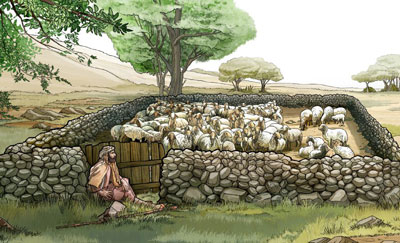
Do you remember 15 Sections ago (5-6 months) when Hiram Page, witness to the Book of Mormon, was deceived into believing he was receiving revelations for the Church? Funny how we seem to need to get taught the same lesson over and over. There is an inherent tension between the concept of unmediated access to our Father's guidance and blessings through the Holy Ghost and the concept of an authoritative hierarchy through which in-scope inspiration can guide beyond the personal level--between personal and institutional revelation. Both are heaven-seeking, both require individual worthiness and faith, and both are encouraged and rewarded by the Lord. But the institution has order, and revelations have scope, and just as a fenced pasture has a gate dividing inside from outside, only authorized leaders, recognized for having entered in the appropriate manner at the appointed place and time can properly protect the membership.

Page's case, if you recall, came from a place of sincerity, from a heart yearning to know more and be more useful. Oliver Cowdery, to whom the revelation was addressed, was also involved, and was invited both to pull Paige aside to explain the deception, but to also feel empowered to teach and interpret scripture by the Spirit, just not by way of "commandment" to the church, and to prophecy, just not in written form.

In the case of the early Kirtland gathering, the saints--several newer members, it seems, who might not have been aware of the Paige case from the year before, seemed to be caught up in a proliferation of pretension to revelation for the Church. As Mantic as the early Restored Christian approach to revelation was, there needed to be limits on the ground-up confusion that could result if there was no top-down structure. So this time, rather than pulling one person aside to confront them with the truth that they had been personally duped by the father of lies, and instead an institutional insistence on the single, powerful metaphor of the shepherd's gate.

Keep in mind that the Lord Himself deployed this metaphor as He taught His disciples about love, oneness, and self-sacrifice. In a sense, the symbol of the gate must be understood on several levels at once: it is the literal entry point for the sheep, the place of identity verification for all visitors, and the locus of avoidance for all ill-intending others. The Redeemer taught in parabolic code, on this occasion, as an on-ramp to their later understanding of His self-sacrificial love, and role in the Plan of Salvation--He was the Good Shepherd, and there are rules of recognition to distinguish between true love and counterfeit control.

The idea that the Holy Ghost offers a chaotic democracy of direction is dangerous. It can produce heterodoxy of such popular influence that many can be deceived, and it can absolve people of the need to submit to the checks and balances of scripture. The idea that only a priest or a prophet can intercede on behalf of the people is also dangerous. It can concentrate an idolatrous devotion to a mortal, and absolve the people of responsibility to earn their own understanding of scripture.

I'm grateful for the balance in the doctrine of a modern-day prophet. We must listen to His voice as if it were the Lord's. But we can also achieve the same closeness with the Spirit He has. His key-holding position doesn't diminish our communication with the Lord, but ensures that we, the Church, not fall prey to every wind of doctrine, and instead come to a unity of the faith, to a measure of the fulness of the stature of Christ.


Saturday, May 3, 2025

Law of the Church versus Law of the Land - D&C 42:74-93


"if thy brother or sister offend thee, thou shalt take him or her between him or her and thee alone"

Some quick reflections on the "law" received as promised once the saints gathered at the Ohio: 

1. Part of living in Zion means having no poor among you. Section 41 had revealed a previously unattested calling in the Restored Church: Bishop. The term comes from the Greek episcopos--literally overseer. Section 42 lays out the economic system of Zion and the role of the bishop in it, and boy is there a lot of oversight involved. People have to be willing to sit down with their ecclesiastical leader who determines with them the spiritual overlap between temporal needs and temporal resources, then leave behind good things they've earned or inherited for the benefit of those whose resources aren't sufficient for their needs. And this new bishop is the discerner. The Church is no longer merely a spiritual state of the heart, but an embodied institution organizing to meet collective embodied needs through its embodied members. New saints were learning a mind-blowing new set of pragmatic concepts about what it means to truly live like the Lord does--caring for one another.

2. There are some watershed beliefs and commandments we submit to accountability on in our modern bi-annual Temple Recommend interviews. We can be presumed worthy and in compliance with standards of finer detail if we can honestly attest to compliance with standards on a key subset of major spiritual dividers. This group didn't yet have the Word of Wisdom in force, and I'm uncertain as to the teachings and practices on the Law of Tithing at this time. But steering clear of murder, theft, lying, and adultery certainly seem to me an apt proto-temple recommend set of questions.

3. The Zion-like society the Church was newly organizing to live was not conceived as entirely isolated. They were subject to local, state, and federal law, and interfaced with broader society in as friendly and mutually beneficial a manner as the surrounding society permitted. I was curious, however, in reading the list of prescriptions of how the Church was to deal with members that broke the "big four" commandments listed in point 2 above, that in 3 of them, the solution was to turn members over to the law of the land, but not for adultery. Why not adultery? At the time, in New York, Pennsylvania, and Ohio, there were anti-adultery laws on the books, as was common for the states. Did the Lord feel that the laws against murder, theft, and lies were sufficiently anchored in righteousness, and made adequate provision for degrees of crime, process of determining guilt, and range of sentencing severity that the Church didn't have to have higher standards? Was it that He knew that the saints would soon need to have something standard on adultery to apply even if frontier states like Missouri didn't have anti-adultery laws in place (it didn't)? My current hypothesis is that adultery is treated differently because it involves not merely a damaging act against another person (and, in fact, our modern argument against all such anti-adultery laws is wrong when it asserts that sex between consenting adults does no harm to either party), but a breach of at least two separate covenant relationships: the marriage itself, and the economic consecration that the entire household is bound to with the Church's new economic system. Infidelity harmed not just the members of the family, but created a new need to redistribute property committed to a kind of property arrangement that no federal, state, or local laws were yet prepared to deal with.

4. Finally, in laying out a new spiritual and economic order, in proscribing already long-forbidden acts and setting forth the Church's processes for dealing with serious infractions, the latter few verses of Section 42 also prescribe a manner of avoiding the escalation of minor issues outside the category of these other two. People with good intentions, living worthily, are still going to have friction from time to time. Why? Because we're diverse humans, and each need our space to learn how to grow together. So how do we handle offenses? The key is privately. Pull the offender aside. share your perspective on what they did, focus on the acts, not your assumptions of their intentions. And give them a chance to own up, or at the very least explain their perspective. When we give each other chances to repent, not only is there less friction, there's more healing. As we go about our own efforts to establish and confirm our own individual, household, ward, community, and broader micro-Zions, let's keep in mind our model--the Lord Jesus Christ--is one of forgiveness. The laboratory of life knits our hearts in one, and lifts the poor in substance and in spirit only as a function of our own individual willingness to forgive expands. If we are here on this earth to learn to become like our Savior, we have to learn to forgive as He forgives. Eternal peace is built from nothing less.

Thursday, May 1, 2025

As seemeth me good - D&C 40:3

...was right before me, for he covenanted with me that he would obey my word. And he received the word with gladness...

Historian Christopher Jones joined Hank Smith and John Bytheway on their popular Come Follow Him podcast partly because of Jones's personal role in publishing details on the Methodist minister James Covel mentioned in D&C 39 and 40. In this short post summarizing those insights, I'll add my insistence that each contextual element added to a given text obliges readers to re-examine assumptions, and be willing, at least, to jettison old conclusions drawn in the lesser light of previous givens.

The two sections can hardly not be read together, and their surface forms a cautionary tale: Section 39 sets up promises, and gives commandments to a new convert who had extensive theological training and experience on whom God and the saints could have relied. And Section 40 reveals why he turned aside from his recent covenants. There's value in learning from both good and bad examples, and this one was canonized probably because of its exemplarity--we should all think of ourselves as potential James Covels, and take steps to avoid the pride and punishments of being too afraid of men, or seeking after their praise to the point of giving up on sacred covenants. God will not be mocked. Smith had received similar personal "bad example" revelations for us all to learn from, including close peers, family friends, benefactors, and even himself in the cross-hairs of the Lord's chastening when occasion required. So this isn't out of the ordinary or singling one man out, unless we let it become that.

But just because that surface lesson is valid, doesn't mean we're guiltless if we stop there and take this cautionary tale as license for judgment. All we are told in the revelation is that the Lord would deal with him as seemeth Him good.

Jones discovered elements to round out the picture of what it did seem good for God to do with him. And it wasn't poverty, poor health, ignominy, or anything else we might consider "just desserts" for an oath-breaker. He apparently served to preach the Gospel as he understood it to significant congregations, worked to organize relief efforts for the economically disadvantaged, and died as respected leader in his community. He wasn't a "bad guy", and, in fact, was an instrument in the Lord's hands for the benefit of many of His children in a variety of ways.

There's a certain insistence that faithful members of the Restored Church of Christ must hold to on matters of authority--there is such a thing as counterfeit authority, and our claim is the only eternally valid one, ultimately--but that doesn't give us license to condemn those who don't have it, or disagree with our claim to it. The Lord can do His work through those who reject our faith perhaps just as much as He can through those faithfully serving in His Church. Let us, as He would, look upon others for the good they do, and the potential they have for eternal blessing, not for the flaws we perceive. That would run us afoul of a certain Sermon on the Mount teaching about beams and motes. Let us reach out with consistent love, drawing in those who are receptive, but staying in a place with those that aren't so that when they are ready to receive, we are well positioned to welcome them in. Even with the Pharisees, that's Christ's pattern.


Receiving Him - D&C 84:33-38

  "whoso is faithful unto the obtaining these two priesthoods of which I have spoken, and the magnifying their calling, are sanctified ...