Monday, April 21, 2025

Last Supper, New Covenant, Beloved Friends


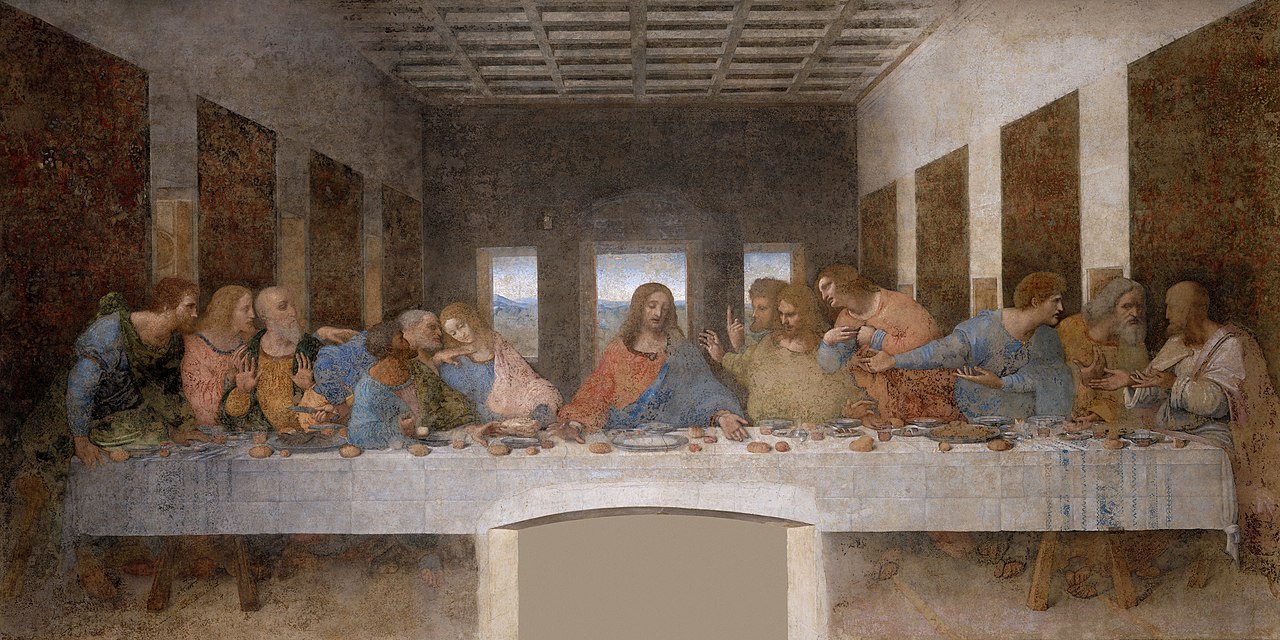
Whatever else one can comment about Da Vinci's high renaissance aesthetic choices, the title of his famous painting, the Last Supper is an utter misnomer. It was neither a supper, nor the last meal Jesus ate with His apostles. Of course, the title has a certain accuracy of intention--Jesus and his disciples did, in fact, eat an evening meal and it was, in fact, the last recorded ingestion of nourishment our mortal Lord took in before the vinegar sponge on the cross and then His death. Instead, what I'm pointing to is that calling it a mere "last" supper drains all of the significance of the event. The meal was so much more than a social gathering with food and its function did mark the end of something, but only to inaugurate something new.

First, while not precisely the modern version, this began as what the Jewish apostles in attendance thought of as a seder--a Passover meal full of symbolism and covenant renewal. Since the time of Moses, the Hebrews were commanded to hold their covenantal identity as their highest, to integrate cyclically repeated religious rituals as markers of national togetherness under a God of liberation. This "meal" was a highly metaphorical performance in which music, scripture, and specially prepared tokens were literally incorporated--put into the body--to become physically one with the covenant individuals, all in unity. It faced both backwards and forwards chronologically, reminding the Jews of the miracle of the Exodus by which they emerged from slavery as a nation and as a covenant people and pointing them forward to the final miraculous liberation from the slavery of sinful conditions at the last day.

Secondly, while this was the performance of a longstanding religious event, and was the "last" Passover prescribed by Elohim, its function was less about an ending than a beginning. It was also the initiation of an alteration of the ritual and a reframing of its significance. It was training for the disciples in the new procedures of the sacrament. Thinking of it that way makes the social conclusions Da Vinci wants your eyes to draw from his busy and lengthy table, with side-conversation and even disorder, seem less apt. But even the food elements must be reconceived. Rather than focusing on the meat of a blemish-free and innocent animal slain, whose blood was symbolically painted on the doorframes of the obedient as a mark for the destroying angel to pass by, Jesus focused on the wine as the symbol of His atoning blood. Rather than focusing on the urgency with which the nation of Israel had to prepare its meal in the symbol of the unleavened bread, Jesus focused on the brokenness of the pieces to signify his freely offered mortal flesh.

Finally, the covenant the Lord made with Moses and the Hebrews was that He would redeem them. The seder symbols were all directed toward the hope this redemption brought. But, as is often the temptation, many thought of fidelity to tradition as the purpose, rather than covenant renewal. Their myopic insistence on the rearview mirror prevented these from preparing their hearts through repentance, from enjoying the windshield full of purpose-filled vistas of the eternal destination that a redemptive prayer in the Garden of Gethsemane and a redemptive sacrifice on the cross were driving them toward. The apostles, enthralled by both conversation and the spirit of the ritual were learning something new, however--that taking the emblems of Christ's sacrifice (which they hadn't yet witnessed, and therefore could only retroactively make sense of) made the group one, and made each individual one with Christ in a commandment-keeping, name-taking, always representing way. They performed to themselves and to the all-seeing God they worshiped that they were willing--willing to take upon them His name, to keep His commandments, and to always remember Him with the kind of active remembrance that imbues all of their actions with His imprint.

And let's also keep in mind the nature of the new commandment itself. He laid out for them, alongside His promise to send the Comforter as a constant companion in fulfillment of the covenant relationship that they submitted their will to take upon themselves that they must love even as He loves.

In describing that love, the King James Version, among many others, makes a curious choice of translation from the Greek. A god can perhaps have a greater love, but "greater love hath no man that this," the Savior who was about to do just that said to those gathered, "that a man lay his life for his friends" (John 15:13). He immediately qualified the term defining the receivers of the benefit of that life laid down in the next verse, with the phrase "Ye are my friends if you do whatsoever I command you," and then gave the commandment to love "one another" (John 15:17). In each of the iterations of the word "friends," the translators had an alternative for the Greek philon: beloved.

I don't know about you, but for me, a friendship can range from a minor acquaintance to an intimate partnership. It has to go beyond business, and it doesn't rise to family, except maybe metaphorically. It can mean something banal, and yet something good but not ultimately important, something fulfilling when close and yet can have distance and lower gradations. It seems less apt to me than beloved.

 Beloved, on the other hand, can't exist without the word love. It's filled with choice and affection, and communicates clearly the radiance of the heart. Friends are not always loved ones, but loved ones are always family. We are children, metaphorical sheep, who the Father and Shepherd protect, gather, and feed in safe pastures. The relationship between the Savior and those He redeems is not mere camaraderie, but utterly intimate knowledge and embrace--it is one of knowing our sin, uniquely feeling the full weight of its eternal consequences, and taking us into the outstretched arm of His love, which is His power, despite it.

And we are His beloved when we do what He says not out of some blind or perverse pleasure He takes from control, but rather out of the joy of discovering, as a parent does a child, that learning to behave as He does, learning self-control as He exudes, unlocks our own joys and liberties. Conformity is not the goal of the Creator, but oneness in Him sparks the only true diversity: eternal progression.

May each sacrament meeting fill you with His love, because you've prepared for it through repentance, and expand your hope and faithful walk, approaching, in as great an increment as our mortal limits allow, His life more abundant. May every teacher's preparation, priest's blessing, and deacon's passing of the sacred aspects of His remembrance--the symbolic bread and water--evacuate your sin, and prepare you for the indwelling of the Spirit. May Easter week's new covenant make you one with Him, beloved, and ready to love one another.

Sunday, April 13, 2025

Palm Sunday and the Plan of Salvation


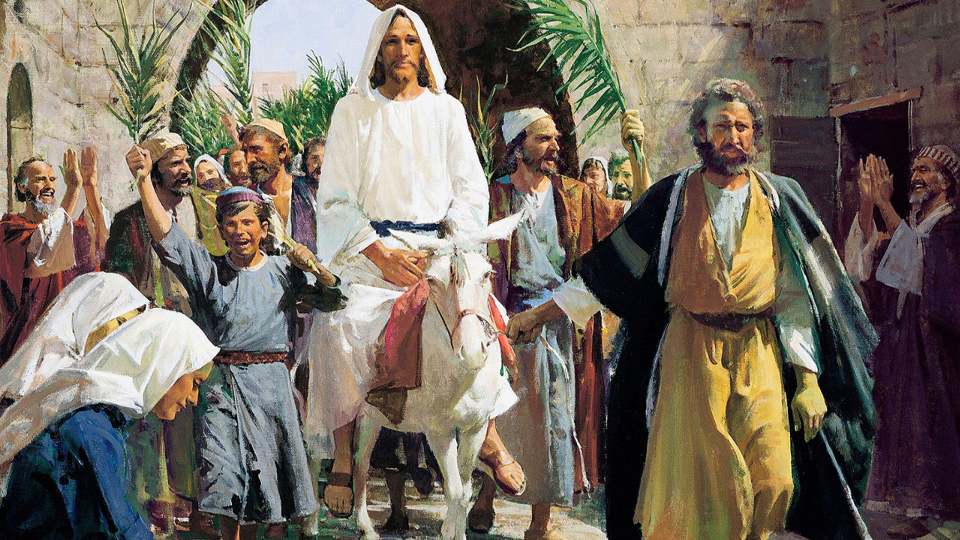
Who is this Jesus of which all the world speaks? At the time of His mortal ministry a great variety of opinions prevailed at one time or another. At the moment of Palm Sunday, however, popular opinion aligned in the positive column. Authorities chafed, but the people believed he was at the very least a great rabbi, healer, worker of miracles, and perhaps even a Messiah. Whether they were believers in His divinity or not, whether they thought of Him as a Savior from Roman political and military oppression, or whether He was, instead, to save from something more eternally consequential, they bestowed upon Him a triumphal Passover-week entry into the Temple city, with the traditional markers of Hebrew royalty: the colt of a donkey, the palm leaves, and the shouts of Hosanna. This fulfilled prophecy in scripture.

Before the week ended, this Figure of intense popularity would suffer an ignominious death on the cross, His followers in hiding, and with nearly all popular support entirely evaporated. He trod the winepress alone. He didn't fulfill their expectation of the role of the Messiah. The bulk of the people had misinterpreted the words, the works, and even the Being of the Great I Am.

He was the heir to the throne of David by two separate reckonings of His earthly lineage. But the people's use of palm branches as symbolic of His kingship mostly mistook his purpose as earthly. Instead, He gave us new symbols of an eternal victory engraved on the anatomical site from which the tree etymologically draws its name: His palms. The cares of this mortal world influence us, increase or decrease our liberty, or our suffering. But He didn't come to defeat Caesar, but rather sin, a far more lasting source of misery and slavery.

Which palms deserve our worshipful meditation on a Palm Sunday like today? I choose the latter.

But in doing so today, my mind felt moved toward another similar symbolic mistaking. Just as the Jews at Jerusalem used the perfect imagery while missing the deeper point, I wonder if we sometimes, as members of His Church, don't miss the deeper point when we speak of the Plan of Salvation.

Ask anyone over the age of 8 what the Plan of Salvation is, and they're likely to ask for a piece of paper so they can draw it for you. It's become such an instant codeword that we feel satisfied laying it out as if it's self explanatory, or at least it gives us some visual aids with which to sketch out God's broad cosmic chronology and discuss His purposes for His children as they traverse its various spheres and barriers. It's often schematically laid out below.


None of the schema is wrong. None of the doctrine attached to it is incorrect. Humans are the literal offspring of Elohim, eternal spirits who existed before birth, but who could not obtain our divine inheritance without a mortal testing period. The earth really was created as the space for our mortality, and after death, we do await resurrection and judgment in a Spirit World for our assignment to whatever degree of glory the Supreme Justice renders to us based on our acts and repentance in this mortal realm. There's nothing mistaken in using the visual tools to describe any of these true points of doctrine, and they correctly schematize an arc of progression that God has planned for all of His children.

But a map isn't a plan. A plan has steps. A plan breaks an objective down into decisions. A plan details the tasks and resources required to achieve an intention through agency. The above schema is handy as the architecture of the Plan of Salvation, but it is not, properly speaking, a plan of salvation.

The soteriological steps in God's economy are more essential and simpler than the map. God's Plan of Salvation is to receive the loving Atonement of the Redeemer by covenant. The plan is to learn of Jesus, act in faith on His name, repent, be baptized, and receive the gift of the Holy Ghost. God's plan to save us, is to judge us for our actions in mortality, but first to give us His Son as an infinite covering for the physical and spiritual death we all deserve, and to give us the free will to choose Him as our Advocate rather than suffer our own just desserts. His Plan of Happiness is Christ.

Let's keep his palms in view of our eyes of faith this Easter and throughout the year.


Saturday, April 12, 2025

Nephi, Sheaves, and Filling Mouths - D&C 33:8-10


"Open your mouths and they shall be filled, and you shall become even as Nephi of old, who journeyed from Jerusalem in the wilderness. Yea, open your mouths and spare not, and you shall be laden with sheaves upon your backs, for lo, I am with you. Yea, open your mouths and they shall be filled, saying: Repent, repent, and prepare ye the way of the Lord, and make his paths straight; for the kingdom of heaven is at hand"

At the time of this revelation, the Church has been restored for under six months, and the first and second General Conferences are barely complete when the mission calls and training begins. There is fierce opposition early, with some small mob intimidation tactics interrupting baptisms, threatening tar and feathering, and even arrests that the courts release for lack of credible evidence on the trumped up charges of disorderly conduct.

And yet, despite local opponents, there is growth as well. And there is fervor to go out and share the message. In four separate sections, the Lord's missionary training program seems to center around one core, repeated commandment to individuals: "open your mouth."

To Oliver Cowdery, the Lord promises unparalleled strength if he will "open his mouth and declare my gospel as with the voice of a trump, both day and night" (24:12) and do it "with the sound of rejoicing"(28:16). To Peter Whitmer, brother in law to Cowdery, witness to the Gold Plates, and longtime family friend, the great Head of the Church promised "power" to build up the church among the Lamanites (which they assumed Native Americans were by ancestry) alongside his brother by obeying the command to "open [his] mouth to declare my gospel" (30:5). The theme of the open mouth gets its last mention in scripture for about another year here in Section 33, resurfacing next in Section 60. This time, however, the command shifts the locus of control in one important way--rather than the agents of filling it being the missionary, this time the Lord repeats a passive voice twice, leaving the connotation that the Lord Himself will be the agent of filling it.

The lesson is useful, and was repeated often in training sessions all throughout my own mission experience--you supply the willingness, and the faith to initiate the speech acts, and the Spirit does the work of making the words and the persuasion flow. This is also a pattern extendable by metaphor to all acts of faith--you start, and let God finish. He's the one that does the work. This doctrine is both liberating (I don't have to stress about the "how" and feel pre-consoled in the face of my own clumsiness or their rejection, because it's not me responsible) and motivating (I have to supply the effort and willingness). As I type, I feel to contact my ministering families just knowing how that's the step that demonstrates my faith so that they can have whatever blessing the Lord has conditioned it on.

But there are also two references in this particular use of the phrase "open your mouth" that deserve comment:

1. The sheaves, piled in a poke in the above image, might not seem an obvious metaphor to those of us unfamiliar with pre-modern grain farming techniques. I don't like the thought of being more burdened than I am, or having heavy things laden upon my back. But this is harvest imagery. If the grain represents the souls gathered in for care and storage, providing the winter's sustaining provisions, then sheaves are about the biggest bundle of converts individuals can support on their own. The image is not one by one ministering, but success in connecting souls with Christ through covenant by the armload. The bundles of stalks are organized for transport, and are therefore signs of completion of purpose, and the feeling a harvester has carrying one to the poke is not one of burden, but of satisfaction at a job well done, and at the prospect of prosperity each one brings.

2. Nephi seems an odd example for a missionary. His mission efforts--Gospel teaching efforts, broadly conceived--within his own traveling community ended up largely rejected by his most specific targets. While he was a stalwart on his own, and did bring Zoram, Sam, and his own progeny to truth and peace, his mouth opened in fiery sermons and grievance for his brothers' recalcitrance and wickedness in great power, but not with the result of persuasion. Laman and Lemuel, and the Ishmaelite family they influenced, fell into forbidden paths and sought to take the life of Nephi on multiple occasions. Being "as Nephi of old" isn't an apt motivating image for a missionary commanded to open his mouth unless you narrow the scope of Nephi's example to the immediate moments he was constrained by the Spirit to speak great words of truth--the kind the wicked take to be hard--and calling for repentance, for faithful action, for trying again, even when the first time and the second time don't work, and finally being "led by the Spirit." Nephi's faith kept his family together and advancing in Gospel unity in ways that prevented immediate crumbling, and that allowed for the robust faith and growth of future generations. Even Laman and Lemuel repented from time to time, learned about the nature of God by listening to their brother, and contributed to family and community success through much of their lengthy and arduous voyage. Nephi was a success when he did his best, trusting the Lord would not give a commandment that he couldn't accomplish, and letting God guide him.

Sunday, April 6, 2025

Honor, Spirit, Word, and Power - D&C 29:36


"the devil...rebelled against me, saying, Give me thine honor, which is my power"

Did you ever have a teacher, a coach, a parent, or some other kind of leader that you admired? What made them admirable? Did they impress you with some act of wisdom or example or self-sacrifice? Their sphere of influence seemed to work well, despite challenges and differences, didn't it? What was it that made their class so inspiring, their team so effective and cohesive, their family so loving, their influence so beneficial? I'm sure some of their own individual traits were contagious and some of their ways of influencing were memorable. I'm sure they set high expectations, and their wards achieved great things because they rose to the standard.

But I would submit that some of the honor you hold for them is reciprocal. They trusted you to do the right thing, and supported you as you reached for it. In other words, your efforts--likely combined with the efforts of others--in a good, maybe even unified direction produced the good outcome that is then imputed to the leader. Good teachers hold students accountable for their own learning.  Good coaches organize drives for personal achievement, which helps the team. Good parents produce loving and well-adjusted children who become responsible adults because they model love, responsibility, and self-sacrifice, and they find joy in the journey of it all. Good leaders enable productivity, peace, stability, and prosperity in others. It's because you honored their leadership that you and others grew and it redounded to the honor of all.

The famous Robin Williams movie, Dead Poet's Society, demonstrates how students who are previously kept in line by fear and by excessive use of authority learn to love a subject they previously hated, learn to love the teacher who opened their eyes to freedom of expression, and then who could never further be repressed. Don't get me wrong, there are examples of misuse of freedom and loss of freedom in that movie's plot, but the relationship of love for an honored teacher brings students to take a courageous stand in the face of fearful authority, and to demonstrate the power of a true teacher. "O captain, my captain!" the intrepid students exclaimed as they stood on their desks in protest of the unjust firing of their beloved pedagogue.

Now extend this principle to a Being of utter perfection, limitless intelligence, and absolute purity of both love and justice. Can you begin to imagine, now, how the principle of honor becomes a principle of power? Can you begin to imagine how whatever sphere of intelligence prevails must bend and acquiesce when the will of He whose love and justice is absolute expresses it? How His Word, which is the power of His Spirit, is obeyed without compulsion because of the respect Creation owes to its perfect Creator? Because of how all that can act knows that He who acts absolutely deserves alignment to Him? Can you see how working with His Spirit brings power to both Him and you, when you partner with Him for the blessing of others? How honor is connected to true, cooperative power?

And can you also see the crime of Lucifer: pridefully commanding God to bestow unearned honor upon him; seeking his Father's power; seeking to use it to compel obedience? Satan was cast out--this was a literal death sentence, when you understand how removal from the Spirit (read: honor, power, love) is defined as spiritual death from the surrounding verses in this Section. But it should be more meaningful now why that needed to be the punishment: Lucifer's "plan" makes no sense, doesn't work because it can't, and distorts everything about mercy, love, justice, and eternal progression. It's impossible to steal honor (read: power, Spirit, Word), to try is to betray the very principle of it.

Because Christ atoned for our sins, He became the Word He always was--the One worthy of honor, power, and glory; the embodiment of love who can cover our sins and justify the guilty, even exalt the worthy. His is the only name given under heaven whereby we can be saved. Not even Elohim can. Because to excuse us without repentance and covenantal oneness with the Son would shake all creation, betraying His own honor, and He would cease to be God. Christ, our only Advocate with the Father, completed that infinite atonement that allows Him to declare that justice has been fully paid, glory be to the Father, and yet mercy claims those on His right hand.

My pondering on this topic began in my youth with a famous talk by the late, great BYU religion professor Cleon Skousen. His talk, then on tape, is not official church doctrine, but provides a compelling testimony-boosting narrative that helped me put scriptural pieces together along these lines in ways that have sustained my faith throughout challenges and even my periods of separation from God. I encourage all to spend the hour and 20 minutes with him--it's well worth the time.

Saturday, April 5, 2025

The Spirit and Spiritual Laws


"Verily I say unto you that all things unto me are spiritual, and not at any time have I given unto you a law which was temporal; neither any man, nor the children of men; neither Adam, your father, whom I created. Behold, I gave unto him that he should be an agent unto himself; and I gave unto him commandment, but no temporal commandment gave I unto him, for my commandments are spiritual; they are not natural nor temporal, neither carnal nor sensual."

1. You can eat anything here, except that. Don't eat that. 

Does that sound like a spiritual law to you? From the outside, it appears arbitrary, actually. With no other context, it's possible to see the command as a flex. It's disconnected from any clear benefit. It could be merely an ego-stroking exercise of control.

When you understand it's a loving father speaking to his son, the context forces a new interpretation. Now the rule is an expression of love and higher wisdom. The child doesn't know himself yet, and can't tell the consequences of his actions. He has no way to predict the outcomes, and it could be dangerous for him to put some things in his mouth, so the father communicates the guiderails that will ensure that the alimentary needs get met under conditions of safety. The father prevents needless suffering by communicating healthy boundaries to behavior.

But is that a spiritual commandment yet? Certainly all expressions of love and sharing of care and intelligence have spiritual causes and effects. But unless you're willing to entertain a deeper level of context to inform a deeper level of analysis, you might miss that this isn't just about avoiding suffering and isn't just about the safety of the body. It's about teaching us that natural appetites must be subject to higher purposes and that moral agents must proactively choose the right (sometimes otherwise neutral choices like what to eat rise to the level of a question of morality, if the ingested substance is morally dangerous). It teaches us who we can trust, listen to, obey, and grow in understanding toward.

A commandment from a loving God about what not to eat is no mere health code, and is no mere safety regulation--it's a design element in His plan to teach our spirits to properly act through the bodies we are given and on the other matter surrounding us. It's a principle of faith, power, enlightenment, peace, and joy. It enables a widening circle of ability to act, and brings us closer to the Source of all righteousness.

The concept that all commandments are spiritual should expand our conception of all of the 10 commandments, maybe the last 6 most expressly. The spiritual context for understanding the Word of Wisdom, the laws of sacrifice, obedience, and even chastity can be circumscribed into one great whole: that "fear" (although the Hebrew word translators deployed as "fear" here, is really more like humility, awe and reverence, and not terror or dread--it's awareness of God's goodness, and our smallness in comparison) of the Lord is the beginning of all wisdom, faith, power, and honor. God's laws teach us His nature, and through obedience, we approach both it and Him, we align with the principles that frame His nature and "know Him" in the way the great intercessory prayer calling for the oneness of the believers with the Father and the Son expresses: "this is life eternal, that they might know thee, the only true God, and Jesus Christ whom thou hast sent."

God doesn't demand honor and obedience because He's petty and enjoys controlling us. He is pleased when we are humble before Him, but His commandments aren't for His benefit. He doesn't demand honor and obedience merely because they benefit us in mortality. Societies that do implement His prescriptions live freer, more prosperously, and more stably than others, and minimize harm. But they aren't primarily self-help recommendations or social harmony suggestions. God demands honor and obedience because eternal individual and social conditions depend on implementing and growing through the principles He Himself is eternally bound by. Taking seriously the idea that we really are His children and heirs means we are under obligation to prepare to shoulder the awesome creative power of His Word and His spirit in some far-off eternity, accepting competently whatever eternal crowns or responsibility He has in store for us. We have to learn to live like Father. And understanding how His spirit made the physical world means understanding that the physical laws He prescribes are also spiritual in nature. As we learn to act as He acts, with spiritual purpose through material means, we simultaneously learn to act and not be acted upon, as He--the Prime Mover--acts and is not acted upon.

2. As all master pedagogues do, the Lord teaches Smith and the others to whom this Section is addressed what His key terms are, sometimes by opposition. He has built up an argument to blow their minds: that commandments are spiritual, not temporal. But the binary between spirit and time is not sufficiently clear by itself to give the proper contours of the concept. It is immediately suggestive that the opposite of temporal--meaning time-bound, or understood by chronological means--would logically be something like eternal, endless, or achronological, and that therefore putting spiritual opposite temporal equates the spiritual with the eternal.

But the Lord also provides three other opposites for our triangulation of how he understands the term "spiritual." Spiritual is not only non-temporal, it is also the opposite of natural (or not bound by what we can understand as the cause-and-effect world of the material that we understand by the sciences), of carnal (or not limited to the appetites, needs, and decays of biological flesh), and of sensual (or not apprehended by what inputs our mortal minds can process, or what appeals to our senses). We have to conceptualize the spiritual not only as that which lasts into the eternities (and is therefore of most value), but as that which transcends our senses, our bodies, and our mortal conditions. We have to think of the spiritual as not subject to what understanding of our bodies, senses and mortal conditions we can derive from senses, from matter, and from human rational thought. Our spirits are supernatural, disembodied, and eternal, and cannot be comprehended without new eyes, new tools beyond our abilities.

The fact that mortality consists of a pairing of these agential forces of spirit with physical bodies, bound in time, flesh, and nature, and bound by senses as they are, is not only a miraculous wonder in and of itself, but a huge impetus to get our preparation time right. Now is the time to prepare to meet God--He too is an embodied spirit, but glorified through obedience to eternal principles of joy, peace, love, and justice.

Thursday, April 3, 2025

The Power of the Word - D&C 29:30-33


"Remember that all my judgments are not given unto men; and as the words have gone forth out of my mouth even so shall they be fulfilled, that the first shall be last, and that the last shall be first in all things whatsoever I have created by the word of my power, which is the power of my Spirit. For by the power of my Spirit created I them; yea, all things both spiritual and temporal—First spiritual, secondly temporal, which is the beginning of my work; and again, first temporal, and secondly spiritual, which is the last of my work—Speaking unto you that you may naturally understand; but unto myself my works have no end, neither beginning; but it is given unto you that ye may understand, because ye have asked it of me and are agreed."

A small group of elders and members, preparing for the first General Conference (we're coming up on another one to which you're all invited) had questions about specifics of their Book of Mormon study and how they connected with Biblical doctrine. They brought their questions to Joseph Smith, uniting to hear if the Lord would provide interpretive guidance or reveal new doctrine as He had on several occasions recently. The questions were about two topics specifically: the whereabouts of the New Jerusalem, which passages from 3 Nephi and Ether indicated would be somewhere in the Americas; and on Adam's fall, which they had various opinions about.

As was the case when Smith himself went to a grove as a boy to ask which church to join, the effusive response to these questions went much further than their questions naturally implied. In the course of helping the faithful foresee where, why, and how to gather the elect--including the urgency of the task--and helping them understand the doctrinal context of the chronological steps of the Plan of Salvation, which was not yet explicitly established as such, the Lord used evocative language that deserves a close look:

1. John the Beloved opens his Gospel with quasi-mystical poetic language to describe Christ in ways no other book of scripture does. The association of God with the Logos--a polysemic Greek term of impossible complexity often translated as "word", but just as easily capturing the concepts of "logic", "reason", "principle", or "order"--has inspired lengthy treatises on the nature of God as "first cause" and "prime mover" of creation, as underlying principle of all reality, and as connection between word and thing, signifier and signified. Monotheists who believe in an omniscient, omnipotent, and omnipresent Father full of love and mercy can agree that there may be something quite literal for a Being so powerfully beyond our understanding to speak and for creation to simply align in obedience like magic. LDS doctrine, emboldened by the demonstration to Joseph Smith that the trinitarian notion of a god of "no body parts or passions" was a misinterpretation, retains all the awe and reverence for that Father, while avoiding the irrational superstition that makes the Being who communicates His nature to us through the familial term "Heavenly Father" into something unrelatable and distant. We understand that Jehovah was a spirit before His embodiment as the child of Mary, and that He is a spirit still, although eternally ensconced in glorified and immortal flesh as He has promised we all will be after the resurrection. His bodily form and the mastery of His spirit over it is the essence of our earthly model, and His power over death is also the sign of His power over sin, or spiritual death. Because we know the Godhead has three separate Beings, rather than believing in a three-in-one Trinity, we can take it more literally when Jehovah reveals that even before His spirit had flesh, He had power--that His organizing, comprehending Logos could create by mere commandment. We can connect the concept of spirit as intelligence--as active matter that can act on passive matter--to the concept of faith. In every act we take, we must first think it in our minds, decide to carry it out, and then move. Christ's power to act is something we too can imagine--our will, though subject to natural forces His has already mastered, follows the same model and principles every step of faith it takes toward becoming like Him: God made plans, and then fleshed them out. May our faith lead our will to be ever more subject to Him, finding in Him power over flesh and all other temporal matters.

If the above seems abstract and esoteric, please know that it's me trying to wrestle with concepts I can barely and only vaguely grasp, and give my best attempt at wrangling them into language. I'm not fully satisfied that I've laid out even what I intend to write here. But if it's not obvious by my content, it should be at least by my demonstration of ineffectiveness at communicating that the concept of the Word being the power of God's spirit is pretty mind-blowing, and deserves more pondering.

2. We can rightly call God our Father. He chose the term as His name and uses it to teach about His nature, as do all of the names and titles He has inspired prophets to teach us that He goes by. Another is "the Alpha and the Omega." Literally the first and last letters of the Greek alphabet, the metaphor seems clear: He is the beginning and ending. He was present at Creation, and will be present at Judgment Day. But He's also an "eternal" Being. As a being locked in a finite chronological system with an irrevocable arrow of time, it boggles my mind to contemplate how a Being who can see the end before the beginning, and who knows each cause before its effect has triggered it, must have to dumb His message way down. If past, present, and future are all present to His eyes and mind, there's no reason to think in the terms we find inevitable--past, start, seconds, minutes, hours, days, years, end, sequence, increments, becoming, last, first. All of it is only for the benefit of us, mortal beings temporarily trapped in temporality. How merciful He is, then, to condescend to help us grasp His project with phrases like the last shall be first and the first shall be last. Smith's intermediary effect allows us to understand how the Day of Judgment will mirror the Creation, reversing a spirit-first, temporal-last process into a resurrection of bodies before an assignment of eternal glories to those bodies according to eternally fixed criteria. As futile as it seems, trying to wrap one's brain around eternal things leads to gratitude both for the magnitude of creation (and the work of its salvation) and for the love in the Creator who speaks to us in terms we can understand about His nature.


Tuesday, April 1, 2025

Shame and the Good Shepherd - D&C 29:27


"And the righteous shall be gathered on my right hand unto eternal life; and the wicked on my left hand will I be ashamed to own before the Father"

A short comment or two on a small detail in a familiar doctrine can hit different. This section contains soaring language as Joseph Smith takes on the Messianic voice to frame prophecies about when the Savior will return in response to a handful of faithful elders of the Church unified in prayer and common inquiry on the subject in preparation for the first General Conference (September 1830). The great work of gathering scattered Israel, creating a Zion society on the earth for heaven to bless, and preparing the way for the Lord's promised return was on their minds and hearts, as was their own roles in this work, and the Lord laid out specifics for them in response.

In this particular passage, the Lord is transitioning between those details of his return, and the first scriptural laying out of the doctrinal skeleton of what we now commonly call the Plan of Salvation. (I maintain that we should be careful what we put under that label, because the plan of how humans are saved is not the same as the map of its main structures, but I digress.) So here, before the insightful doctrinal commentary begins, the Savior relays the endpoints: heaven and hell, those who will be on His right hand or His left hand at judgment day.

Did you notice the phrase "ashamed to own before the Father?" Paul wrote to the Romans that he wasn't ashamed of the Gospel of Christ, and so they shouldn't be either. Peter, whose repentance from having been ashamed of Christ himself three times on a certain fateful night was then complete, invited the church as a whole to not be ashamed of Christ, but rather to glory in His name despite potentially suffering because of conviction in Him. Jesus Himself taught His disciples that those who allow fear of human opinions to paralyze them from accepting the truth that He is the Redeemer, and from behaving accordingly would find, to their own horror on judgment day, that the turnabout will be worse for them.

The doctrine isn't new that Christ will be ashamed of those who are ashamed of Him. What hit different for me was the framing of that shame. In this passage, there was purpose and direction that the other scriptural mentions of shame don't connote. Judgment day consists of a gathering of those worthy to be called Christ's, and by their own acts of will, some will fall short of that worthiness at that time. But rather than the image of a vengeful god who dispenses righteous disgust at the willfully stiff necks whose arrogance makes reject the love of the All-powerful and All-merciful, this hints at a desire to save more, but not being able to. He has to present a group to the Father that meet a certain criteria. He needs to be proud of having covered them with His atoning and cleansing blood because of their acceptance of that infinite gift. Those belong to Him. They are called by His name and know His voice and follow Him. But there are some who simply will not accept Him. He loves them too! He wishes they would just hear Him, but they won't. And He is bound by His own eternal word, by the judgement of His Father, and by the eternal principles of justice and mercy, and therefore His own power is limited by their will.

Another way to put this might be in terms of comfort. When I'm the least well dressed at a formal affair, I can expect a certain level of discomfort. It's an imperfect analogy, of course, especially since some have more aptitude than others at even feeling righteous social opprobrium, but imagine that scenario dialed up to infinite. At the moment of your meeting that Being of infinite goodness and love, having a "bright recollection of your guilt," as Alma put it, your sensitivity and your separation from Him and His nature will be at a matching and infinite maximum contrast unless you aren't going it alone--unless the Lamb of God has embraced you as His. And His discomfort too would kick for all who have un-repented wickedness remaining. As advocate, he simply can't present you dressed in that at the gates of eternal joy at His Father's kingdom of perfect love, perfect justice, and perfect progression. Without accepting Him, your own conscience would shrivel you, knowing you don't belong--not because the "club" is that exclusive, but because your nature is that criminal.

He wants to "own" us all. His burden is light. His requirements are accessible. He requires all of us, but His grace is sufficient all along the way.

Receiving Him - D&C 84:33-38

  "whoso is faithful unto the obtaining these two priesthoods of which I have spoken, and the magnifying their calling, are sanctified ...