Saturday, January 25, 2025

Callings and Qualifications - D&C 4:3


"if ye have desires to serve God ye are called to the work"

 From a total membership of over 17 million, the current numbers of Latter-day Saints serving full time 18-24 month missions or service missions (these latter of which sometimes include part-time commitments as I understand the numbers) is approaching 100,000. For generations since the command for all worthy males to serve and the encouragement for as many women as feel inspired to serve has been in place, nearly all monthly conferences and trainings feature a recitation of Section 4 in its entirety. We take it as a sort of mission motto, a statement of purpose, a reinforcement of commitment to the qualities and attitudes that promote successful service. In that context, this "missionary section" offers material for self-reflection in broad and basic form: work hard, be all in, keep your heart focused, fill it with virtuous thoughts and act on those higher-pointed impulses. And do it in the confidence that you are an instrument on God's work, which He blesses with success as long as you supply the honest effort. The main key is the harvest metaphor which must have spoken straight to the plain heart of the recipient of this revelation, lifelong farmer Joseph Smith, Sr., but which is still relevant to the committed service of every laborer in God's fields, and perhaps most directly to proselyting missionaries.

In its original context, however, there was not yet any missionary program, or even church restored. There was not a framework of authority, or authorized message to clearly argue for or direction to persuade people to. This is not to imply that the Gospel wasn't available through the Bible or that churches built up with the Biblical doctrines had no truth to offer. But from the perspective of the Christian and believing farmer who kept himself aloof for decades from formal affiliation with any of the available organized religions up until this time in 1829, and from that of his translator son who had spoken often and frankly to his family about the heavenly messages and media he had received, all pointing toward something celestial about to emerge on earth, the marvelous work had not yet sprouted. It was not yet harvest, but rather germination time.

And yet, in a general sense, while the Church itself had not yet been restored and authorities had not yet been organized and fully articulated missionaries messages had not yet been elaborated, events were unfolding that individuals in the know could and should share. Testimony should not be held back.

And father Smith didn't. The February visit he made to his son and new daughter-in-law's new home after their elopement some 80-ish miles from the patriarch's farmstead (which, by winter sleigh, may have required several days of travel) was during a school year stretch where Senior had a boarding guest at his farmhouse--a certain school teacher named Oliver Cowdery. Heartened to more direct action by this revelation from God through his son, the elder Smith went home from this visit and stopped his reticence to speak to newcomers of his son Joseph's experiences and opened up what he previously held as family secrets guarded closely by experience of persecution to the man who would later become the most important scribe for the translation work that commenced in earnest the next summer. This is according to this reputable site I consulted.

The passive voice in verse three, embedded in a hypothetical, has often given me pause. There are so many ways to take it. Does the condition of desiring to serve itself constitute "calling?" Or is this implying that if the condition of desiring is present, the serving itself can't be undertaken until there is a "calling" made and received?

Christians of various creeds and persuasions do approach the term "call" from often contrasting perspectives. Catholics, who ground liturgy and adaptation of doctrine in a principle of authority, tend to think of "callings" as a spiritual impulse to take up an office--to hold a function of service for a time, perhaps even for a lifetime--which means accepting a place carved out for such by the organization. For Protestants who argue that the only authority is the Holy Spirit, a calling is a personal spiritual impulse still, but defines more of a personal trajectory, manner, or style of service--maybe even a particular audience, as in ministries for the blind, or for the prison-bound--and so their impulse guides them to seek out institutional support rather than molding themselves to the institutional spot that's already defined. In both cases, the calling is a private and subjective perception, and while Catholic authorities do make assignments to underlings, and both Protestants and Catholics ensure institutional discipline to ratify or excommunicate individuals who feel "called" to the ministry, in neither case is the concept of calling coming through a human intermediary.

From the pattern in the Bible as well as in the revelations to the Church after 1829, a different concept presents itself in its consistency: God is the one who calls, and He extends callings through authorized servants. Callings are not subjective experiences with the Spirit, but rather assignments. The Spirit will quite personally mark the individuals called with impressions of the truth of the calling, of the truth of the Caller, and will give inspired directions on manner of service all throughout the service. But Jesus didn't wait for the Spirit to speak in a way Peter would feel moved by first to go seek out his Lord. Instead the model is that Jesus called them out of their fishing boats and then they gained spiritual witness. They committed to dropping their livelihoods before they even really understood Who they were following.

Don't get me wrong: I'm sure Peter and many of the Apostles had spent plenty of time thinking about scripture, about wisdom, about salvation, and about their place and willingness to act in furtherance of the Lord's work. I'm sure they felt inspired to follow as soon as the call was made. But the pattern was revelation first, confirmation second; the Shepherd does the calling, the sheep are called, and choose to receive the assignment out of love for the Shepherd and recognition of His voice. Other patterns are dangerous because they don't have the same inherent limiting principles, and can sometimes lead to unauthorized action that is disharmonious with the Lord's work and will.

Paul's service in Ephesus in Acts 19:1-8 provides an example. Someone claiming to be John the Baptist no matter his good intentions convinced some unbelievers that Jesus was God and that baptism was a requirement for salvation. they happily received baptism, but then demonstrated ignorance of the Holy Ghost, which the real John the Baptist never failed to speak on. Paul, on the thin suspicion that their baptism was invalid, rebaptized them and the evidence of his authority to do so was immediately manifest. It's worth thinking about this example more thoroughly. The faux John taught enough of the correct doctrines that the converts were truly convinced, heart and mind, in such a way that the Spirit could immediately indwell them after the actually authorized party re-administered the appropriate ritual. Not everyone who says "Lord, Lord" will enter into the kingdom of heaven, and not everyone who claims to be called is duly authorized. Paul (and yes I'm aware that there's controversy surrounding Paul's authorship of this epistle) further spoke to this principle of calling by delegation when he cited the Old Testament example of Moses's brother in whose lineage an entire branch of new Priesthood service was to be organized by priestly caste-like inheritance in Hebrews 5:1-4:

"every high priest taken from among men is ordained for men in things pertaining to God...And no man taketh this honour unto himself, but he that is called of God, as was Aaron."

Even Christ Himself, the chapter goes on to say, didn't just randomly decide one day He subjectively felt compelled to take upon Himself the sins of the world. He did, but only after being called to do so by His Father.

I don't think Joseph Smith Sr. felt like this passage licensed him to devote full-time service to proselytism. I think he got bolder and widened his circle of vulnerability out of faith that the Lord would bless his efforts to work in His field through more open sharing of testimony concerning the marvelous work and wonder that was to come. I think missionaries who are called to that proselyting service are right to take the same inspiration, and thrust in their metaphorical sickles with all their heart, might, mind, and strength. But I'm also glad for the humility and hope, the faith and the power it offers to people for them to realize that the calling wasn't in their head, wasn't in their heart, and may not even have been on their radar, but was instead something some other authorized servant received as a message for them to rise to. Being an instrument in the Lord's hand, in the Lord's way, in a position specified by revelation given to external sources draws us closer to Him, makes us seek His power, gives us space to build our trust in His guidance and direction, and prevents self-aggrandizement, or conflation of self with Spirit. This structure of power favors the opposite of mega-churches in which education, popularity, and marketing talent qualify one for the work--it favors an "eye single to the glory of God" as qualification.


Wednesday, January 22, 2025

Prophet, Seer, Revelator, Chastisee - D&C 3 preamble and verse 5


"Behold, you have been entrusted with these things, but how strict were your commandments; and remember also the promises which were made to you, if you did not transgress them."

 What's your tolerance for the hokey? Almost all religious ritual contains some element of it--of actions, postures, modalities, instrumentalities, sounds, smells, and call and response that outsiders would find utterly strange, if not entirely off-putting. And when I say "religious" I should probably expand even further--just think of a political swearing in ceremony, a sports event, or a fraternity initiation and how bizarre a foreigner might find the fixed verbal scripts, the objects imbued with symbolism, and the behaviors that occur nowhere else in lived experience. My guess is that you don't go through your average day thinking about how comically an outsider might describe your everyday actions, but a comedian would make you roar with laughter showing you how silly some of your routines appear from different perspectives. In other words, it's hard to have an objective perspective on the hokey, but we've probably all got some tolerance for it--we just accept that some groups have ways of doing things that might look weird to us, but which form some kind of tradition we just have to accept is theirs and decide whether we want to maintain the outsider's discomfort or conform to the crowd.

Add to that now, a layer of superstition. When the Harry Potter books started becoming popular, I recall a backlash from the Evangelical community, some of whom refused to allow their children to read books obviously geared for their age range because although they were hardly groundbreaking in the fantasy genre, there was a preponderance of allusions to occult powers in their pages. Deeply convicted Christians, in other words, were trying to pull their impressionable charges back from a line of flirtation with witchcraft, sorcery, and other forms of the worship of powers other than the God they believed in. Some roundly ridiculed them for their intolerance of innocent imaginative fiction, especially since the values the Potter novels teach are manifestly good: resourcefulness, courage in the face of challenge, self-sacrifice, loyalty, community, love of family and friends over power and control, etc.

Personally, when the framing of the tale is fiction, and especially science or fantasy fiction, my tolerance expands even further. And I'm not the only one. Taking Disney alone for its exemplarity as a purveyor of children's entertainment my entire life long, a survey would likely show a high percentage--well over half is my guess--of films featuring some kind of magic, ghosts, genies, gods, shamans, witches, fortune-tellers or other forms of occult reference. Our secular society loves to think highly of our rational selves and show our superiority over superstition by allowing stories containing them to be told innocently--as if no one could possibly indulge their nonsensical ideas seriously, so they are worthy of play, of entertainment, of marginal existence. Yet there is a thread within our society that persists in serious belief in ghosts, gifts of palm reading, tarot cards, and psychic hotlines--enough that a few people profit from such services.

In all of this, please recall that as a monotheist, I believe strictly in the commandment not to worship other gods or devote energy to idols. And I also believe that God can and has worked through instruments and through fellow mortals at times to accomplish His purposes, show His power, and lead His people. When you believe in the Resurrection, you don't really have much of a leg to stand on for refusing to believe lesser miracles, but you do still have to draw a line between God acting through people and instruments versus flirting with belief in some other power.

What strikes me is what we find out of bounds, and how quickly that line changes. I can recall two stories from my progenitors on the subject of folk mysticism that might illustrate. First, my grandmother, who was young in the 1930s, and who lived on the semi-arid great plains of Western Canada where livelihoods depended on grain crops, and where distance from sources of water were often insurmountable, spoke once or twice about divining rods. I remember her feeling particularly talented at taking a forked stick, letting the tines balance in her hands, and walking aimlessly until she felt the tip of the stick seemingly bounce downward with no apparent force of her own supplying the movement. It happened rarely, but when they dug, a worthy well was found. She wasn't the only one in her community who professed such aptitudes and to be in possession of objects, some of which proved better for it than others. She grew up in a Bible-believing home, and kept a devoted Christian faith her whole life long, and while I recall her explaining this with a hint of "I'm not sure how you'll take this" in her otherwise matter-of-fact manner, she seemed to see no conflict between her faith and this practice.

As a contrast, my father--whose adolescence occurred in the early 60s--tells of an instance where he was abruptly asked to leave from a social gathering he had been invited to because he and his family were known as believing Christians, and the Ouija board his fellow teens wanted to experiment with didn't seem to function while he was in the house. Thinking about what that implies for a minute--as far as society advanced in science, technology, and secularism in those particular decades, that same society mass produced an instrument of divination and sold it as essentially a board game. And it still does.

The question isn't whether there are hokey beliefs and practices in our society, it's what's your tolerance for them?--they aren't going away.

So here's one hokey tradition from way before the 1830s, which was extant in Joseph Smith's time: seer stones. Rare individuals claimed to be able to "use" rare stones to receive spiritual or other kinds of knowledge not available through normal means. The manner of their use varied widely, as did the claims of what the limits of their "powers" were. We know next to nothing about how Joseph Smith's various seer stones, or "interpreters" as he sometimes called them were "used", but he claimed to receive messages--whether translated from the Book of Mormon language on the Gold Plates or directly in response to prayer. There are reports of him using the stone in the above image between his forehead and an oversized hat to exclude the light so he could peer up at the stone and "read" in some way what ideas--thoughts, images, or words, we don't know--came to him "through" it.

While the precise manner of revelation reception through these stones, what is clear is that he equated them with the repeated Biblical mentions of Urim and Thummim.

And with that context framing the text, I find two facts to be noteworthy: 1. There are 4 and only 4 sections of the 138 in the Doctrine and Covenants which are explicitly labeled as revelation received "through" the Urim and Thummim, meaning that revelation received by a seer through an instrument is rare, and the fact that they are all very early chronologically suggests that attunement to the Spirit of revelation can be improved to the point of not needing tools; 2. The content of this particular revelation is a rebuke unflattering to the direct recipient of the revelation.

As a literary analyst, the above quoted verse strikes as a turning point in the text. Specifically the personal pronoun "you." Above that mark, the revelation appears to address a general audience and maintain general applicability of its topics. At this point, even the implied "you" in the imperative "remember, remember" from verse 3 gets refocused to become intensely personal to the prophet himself.

Keep in mind that as the preamble explains, Joseph had entrusted 116 uncopied manuscript pages that could not be reproduced except through retranslation to a friend who "lost" them. This friend had traveled a 3-4 day journey by horse, spent months away from wife and family during productive farming months (he was a reputable farmer noted for his success) serving as a scribe in the home of the Smiths, and later supported the publication of the script he had helped with through the mortgage of his own considerable property. There were certainly signs that this was a friend willing to sacrifice personally to serve a cause even if a certain openness to the full visual testimony was denied for a time. And this lack of access to see the plates themselves, so be able to give strong answers for the skeptics within his own family--his wife apparently chief among them, worried perhaps with good reason, that a potential charlatan may be seeking to defraud her husband of hard-earned means--as to the well-foundedness of his investments of time and property to this translation definitely pressed upon Harris. He repeatedly asked Smith for some material proof he could show others.

But note how the language of the revelation centers judgment NOT on Harris, but squarely on Smith. It calls for the latter's repentance, warns against further transgression, relays consequences, and reasserts the importance of the work and the need for strict heed to the directions and rules governing its progress. But even the verses singling out Harris as a "wicked man" guilty of breaking promises and boasting of his own strength stop there--they clearly lay out judgment and the behavior, but don't spend time further upbraiding or calling to repentance. 18 of the 20 verses humble Smith, not Harris, as the more culpable party, and point to reasons for redress to be made, and offer hope for forgiveness and a return of gifts of participation in a work greater than them both.

Whom the Lord calls, the Lord qualifies, to be sure, but He also chastens those He loves. Harris's character flaws notwithstanding, and his ups and downs with the Church and with Joseph Smith personally gave him a bumpy path in life through which he held true to his testimony of the Book of Mormon, and after which, we all hope, he found forgiveness and refinement. But the "you" in verse 5 must have hit like a ton of bricks to the man to whom already much greater testimonies had been given. Imagine also, subsequent to this revelation, the visit of an angel who had coaxed and coached him over years to be able to receive the plates--each year at which he arrived at the location fully expecting he would be ready to take them home with him--coming down one to physically remove the plates and interpreting stones from him.

To put a point on it, Joseph Smith spent weeks working on a translation work that he was primed for years to accomplish, but that he was just getting the hang of--pondering and praying over a script no one on the planet could read--and just when he was in the swing of it, and of how to use the Urim and Thummim efficiently in this revelatory process, he made a mistake and trusted in the promises of a well-meaning partner whose values he didn't completely share over the promises of the Lord. And his next impulse was to try to receive revelation through the Urim and Thummim again. And it was granted! The rebuke you read is a demonstration of mercy--of God's refusal to cut us off if we can be brought back--of His relentless love and pursuit of His children's happiness.

Whatever your tolerance for the hokey, the content and manner of this revelation teaches that no one is indispensable to God's work, that He has means by which He works, and requirements He expects followed, and that He serves up hope for a return to His favor, even when our actions fail Him. This is the perfect balance between motivation to do all the good we can, not letting ourselves off the hook for what we can do, and realizing that the work is actually His, He can do it without us, but will re-entrust us when we rely on His Son to cover our failings.


Monday, January 20, 2025

Prophets versus Experts - Isaiah 29:10-14; JS-H 1:64-65


"PHD." Abbreviations.com. STANDS4 LLC, 2025. Web. 19 Jan. 2025.<https://www.abbreviations.com/term/387815>.

"For the Lord hath poured out upon you the spirit of deep sleep, and hath closed your eyes: the prophets and your rulers, the seers hath he covered. And the vision of all is become unto you as the words of a book that is sealed, which men deliver to one that is learned, saying, Read this, I pray thee: and he saith, I cannot; for it is sealed: And the book is delivered to him that is not learned, saying, Read this, I pray thee: and he saith, I am not learned. Wherefore the Lord said, Forasmuch as this people draw near me with their mouth, and with their lips do honour me, but have removed their heart far from me, and their fear toward me is taught by the precept of men: Therefore, behold, I will proceed to do a marvellous work among this people, even a marvellous work and a wonder: for the wisdom of their wise men shall perish, and the understanding of their prudent men shall be hid." (Isaiah 29:10-14)

 1. Outside of Restored Christianity, the above Isaiah quote generates generic commentary about the choice of attitude each of us have in listening to God. In parallel with Jesus's mockery of Pharisees as "whited walls" who profess a great understanding of the law, but who comprehend its fundamentals so little that they can't even recognize the Messiah right in front of their eyes, Protestant thought teaches that book learning doesn't guarantee spiritual wisdom--that you can have credentials and amass readings, and still miss the point. Both the unlearned illiterate and the learned readers get no benefit from the contents of a sealed book. While that's a fair reading of the passage's general content, two things are true: a. few "experts" feel personally implicated by passages like this even though we all should; b. new information initiates interpreters to new hermeneutic possibilities.

Self-satisfied that they would never be guilty of the errors of the Pharisees, many well-meaning Bible believers and Doctors of Divinity fail to note that their careful sola scriptura strictures put them afoul of the very root of Christ's critique--the Pharisees also claimed that only prior scripture should be trusted as the source of God's voice. Their approach to truth was as sophic as the bulk of Protestantism today--Catholicism too, with the exception of the Pope, one could argue. And in all three cases, as extensive compilation of commentary gradually substitutes for scripture itself over time, the mantic spirit Christ Himself embodied and inspired across the centuries of His manifestations to prophets is lost to erroneous argumentation. Please understand: I mean no insult to honest seekers of truth whose consistent philosophies limit their understanding. I only point out that it's possible to be internally consistent and well-meaning, and God-fearing, and honest, and still wrong.

This passage from Isaiah has a more concrete reference to a sealed book and a learned man being unable to read it--not out of over-education, but out of self-interest in not being able to control the profits from it. And the man without proper letters, the very concrete Joseph Smith, may not have had the formal training, but did have the gift and power given by God to read the book that was sealed to others. Isaiah didn't explicitly tie the unlearned man as the agent of producing the marvelous work, but he didn't forbid it either, and his move to describe the kind of work that would be wondrous and bring hearts back into alignment with the Lord in contrast with the lips that merely profess, but don't honor as one that only the unlearned could do (the wisdom of the wise men being insufficient to this task).

The Martin Harris account, published in this canonized history after he had left the church, but which he continued to attest despite incentives to recant, tells of a hand-copied page of "Reformed Egyptian" symbols which a reputable professor at Columbia verbally certified, but who likely had no clue he was uttering nearly to the letter Isaiah's 2600 year-old words when he ripped up his draft of a written certification upon learning that the book was sealed: "I cannot read a sealed book" (JS-H 1:65).

He also could not have predicted, as self-interested as he was in either glorifying himself in its translation, or in discrediting it altogether, how the coming forth of the Book of Mormon and the consequently Restored Church and its advancement would resemble the marvelous work and wonder Isaiah clearly prophesied. And only those open to the mantic mode of truth-seeking will come to know of its truth, further hiding the wisdom of the world's Christian, but misguided prudent men and other scholars.

2. As part of my own project of study to bring scripture as much to life as I can, I did a little digging into the scholarly atmosphere of the day. Maybe a detail or two here will help someone else get more out of their study as well. Contextual elements like this also deepen my sense of how God prepares the conditions for His actions.

First off, Anthon wasn't an Egyptologist, and while he had a background in other ancient cultures and languages, some of his knowledge of Egypt could only have been in the infancy of the West's earliest modern understanding of Egyptian scripts. Napoleonic campaigns in Egypt brought to France and England a number of artifacts whose procurement was of dubious ethics, but whose importance to history, archeology, and linguistics has proven immense. One such was the famous Rosetta Stone which sat undeciphered in a British museum for decades before a young student in the fledgling discipline of "Egyptology" made a few key assumptions about the hieroglyphs on the stele that appeared to match the meaning of the Greek script it also contained. This Jean-François Champollion had to battle a scholarly misconception about hieroglyphs themselves. It was well known that ideographs, glyphs that convey an entire idea rather than transcribe the phonetic form of the idea, can serve as vehicles for multiple languages. It was also well established that across the millenia that Egypt used writing, there were three identifiable scripts that the spoken language, which also evolved over such lengthy periods, made use of. Because the kinds of monarchs and priests who commanded the construction of monuments were also the kind to want themselves memorialized in the most indelible ways, the surviving exemplars of one of these scripts--hieroglyphics--was almost exclusively found in temples and funerary edifices. This led to the false conclusion that hieroglyphics was only used for religious purposes and therefore didn't represent the spoken language of the normal people. Champollion contested this idea, showing how there might be a progression of the more purely ideographic hieroglyphics to the more frequent phonetic markings used on more corruptible papyrii in the hieratic script could finally lead to the more alphabetic demotic script which itself was likely connected as an ancestor to the modern-day Coptic tongue still spoken in parts of Egypt (it's one of the world's oldest continuously spoken languages still extant). This logical leap allowed him to parse out some names on the Rosetta Stone that were attested elsewhere, and then abstract out a few phonetic symbols which then gave him a key to more and more, until the full stone had its translation worked out.

His work on the Rosetta Stone was published posthumously not long after completed, as Champollion died relatively young (age 41) of a stroke that many attributed to the after-effects of an arduous journey to Egypt and back to France. That publication was less than 6 years old, and not likely available in translated form for the contemporary New York professor Charles Anthon to have digested (although I have no idea whether he spoke French) to have very deep insight as to the nature or meaning of any Egyptian script let alone one written in a derived form of Demotic used to transcribe Hebrew rather than the ancestor tongue of the Copts, and then modified over the thousand years of Nephite linguistic evolution.

The state of Egyptology in the US in 1828, when Martin Harris made the trip to New York to obtain second opinions as to the wisdom of his investment in the Book of Mormon translation and publication projects he was heavily leveraged on, simply didn't have a whole lot to it just yet.

But even if it did, the way to test it is in its pages, not through scholarly examination of the archeological materials. The way to know if Joseph Smith was a prophet is to pray, as he did, with real intent and having faith in Christ to know if the Book of Mormon is true. And this manner of proving the prophets isn't contained only in its pages, but is also among the Savior's own prescriptions as recorded in Matthew: "by their fruits ye shall know them". The fruits and gifts of the Spirit seem to scientism too subjective, but they bring precisely the testimony of truth the world needs. The marvelous work and a wonder is afoot.

Saturday, January 18, 2025

Line Upon Line - JS-H 1:45-46, 49, 54


From the last post describing Moroni's visit to a repentant, 17 year-old Joseph Smith, we concentrated on how Smith's familiarity with scripture prepared him to received paradigm-shifting earthquakes as new contexts for prophecies became the content of an angelic message. We also noted how little of this content was relayed beyond Smith himself--as third party readers, we are told that the bulk of the message is not recorded here, just important summary details.

As a pedagogue who strives for excellence in teaching, what stuck out to me in the next verses was the mercy and didactic skill evident in Moroni's subsequent visits. With Joseph's mind still reeling from familiar passages given new light, the angel again penetrates the room and speaks: 

"He commenced, and again related the very same things which he had done at his first visit, without the least variation" (1:45)

There is a brief addition to the message this time, but then, after leaving Smith alone to ponder, yet again the messenger emerges from his luminous conduit, and, as Smith relates: 

"what was my surprise when again I beheld the same messenger at my bedside, and heard him rehearse or repeat over again to me the same things as before" (1:46)

After the repetition, without the least variation once more, we must assume, there was again an addition to the communication which built upon what was now already firmly anchored in the memory before the being of light once again departed.

Finally, as the night dissipated and the work day on the farm began without Joseph's ability to contribute much, the angel made one last appearance on that property, which is recorded for us with with the inclusion of: 

"He then again related unto me all that he had related to me the previous night" (1:49)

There's a double effect that this pedagogical method produces. First, repetition is the soul of teaching, and reinforces the message and details at each retelling. But it also structurally sets apart the non-repeated elements as even more memorable. In this case, the core was an exposition of scripture--of prior prophecy and pending fulfillment, all packaged in a new paradigm's arc, and the non-repeated additions align as follows: 1. a new prophecy of impending judgments (implying that Joseph's role would help mitigate them); 2. a warning to hold the plates sacred and avoid material temptation to profit therefrom; 3. a commandment to bring his father into the circle of trust about these visits.

I find these additions significant. They ground Smith in a few important ideas: 1. that God provides mantic manifestations and will continue to do so--He's not limited to speaking only through past prophets; 2. that God wants to prepare his servants against particular temptations and forces seeking to stymy the work; 3. that support in his functions and service as prophet will include not only heavenly sources, but earthly ones that know him best and care for him best--that family hearts were being prepared to accept the paradigm shifts that will come through him.

As we each receive callings to serve in the Church, this seems to me applicable as a pattern: 1. we need to seek His specific word on behalf of those within our influence, and expect that He will guide us; 2. He is interested in our success, which includes arming us with foreknowledge of our adversaries; 3. We have a circle of support He is concurrently priming to bear us up as we commit to serve.

On the fifth visit--the one at the hill Cumorah--we have the only one in this passage for which there is no mention of the actual arrival. We don't know at what point the angel appeared--whether it was before the unearthing of the box, during the course of removing earth, obtaining a lever, and peering under the stone, or at the moment of his first attempt to handle and remove the box's contents, as if in sudden warning. However we imagine the scene, what's clear is that the pedagogy was not complete--that the repetitions would continue, at regular intervals, for years. This would both allow Joseph to mature intellectually, spiritually, physically and socially, and would allow the message itself to have space for growth. 

Finally, a quick note on the reception of revelation. As Smith closes this part of his record, he deploys, for the first time, a suggestive term that hints toward a more mutual interaction than the previous verses. As he describes a prayer for forgiveness becoming an angelic visit, his narrative focus is appropriately on the messenger, the message and its reception. But the Cumorah visit and its subsequent annual visits--his fifth through ninth interactions with Moroni--seem described in a way that might have also applied to the previous 4: as "interviews". Joseph is allowed to question, to ask for clarification, to converse. His learning is active, not passive, and this also forms part of the model we should strive for as students of the Divine nature. Let us bring our curiosity, and allow our humility to show through active engagement with the voice of the Lord, whether it be through text (reading AND writing), through intermediaries, or through more direct representatives like the Holy Ghost. As He teaches us line upon line, precept upon precept, here a little, there a little, let us be agents, moving with our minds and our feet ever closer to the higher truths He wants to reveal to us.

Wednesday, January 15, 2025

Context is King - Joseph Smith-History 1:41


"He quoted many other passages of scripture, and offered many explanations which cannot be mentioned here."

Untangling context is sometimes a necessary chore. All valid interpretation depends on it, and yet we, as readers, may have varying attentiveness to or knowledge of its elements, and varying judgments as to the elements' salience.

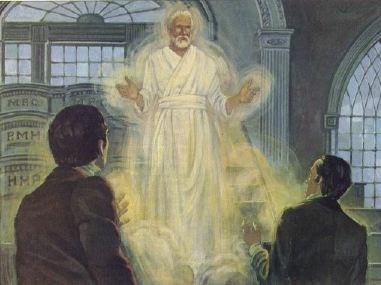
Take the question of how to understand Moroni's first visit to Joseph Smith. You and I, who have read the Book of Mormon and know that this Moroni was its last prophet can't avoid an imposing image when we see the very name. This was a giant of a man--I make no claim on his height, although it's hard not to imagine him as a strong warrior, because we know he was a general in the last of the Nephite armies--whose faith kept him alive and kept sacred records secure for 20+ years after his civilization fell in a great and last battle, and its enemies relentlessly hunted him. We know him as a stalwart Christian who transcribed the record of the Jaredites onto the limited space of the gold plates that he would eventually be inspired to hide up in the hill where Joseph Smith was led to find them. This Jaredite civilization also fell, and its fall was caused by such similar forces to his own, that this Moroni--who knew neither his own people nor his enemies would receive this record, but a Gentile people far into the future--felt the lessons so deeply and powerfully that he felt too weak to communicate them in the ideographic script available to him. In one of the most memorable passages in his recordings, the Lord speaks to him to assure him that only fools would mock at his weakness, but that if men like him came to Christ with their weakness, the Lord would make weak things strong. And how strong is he now! He has come as an angel of glory, able to shine forth, speak messages of world-turning importance with authority, and act as the agent of the fulfillment of ancient prophecy. To us who know him already, this angel is a sign of God's grace, an inspiration, an encouragement to be faithful as he was, to push through despair, challenge, and ill-disposed conditions he had no control over to trust Christ would make something better of himself and his efforts than he could. He is a glorified being as we all can be.

But Joseph Smith at the time didn't know him or his writings or backstory. All 17-year old Joseph Smith saw was a nameless messenger from God of fearfully bright appearance who came as a faithful response to the young man's sincere repentance, who shared news of a calling from God that Joseph needed to rise to, who gave news of a hidden book and tools of its translation, and then who spent the bulk of his visitation time citing and explaining scripture. Smith received basically a heavenly sermon, with text and commentary all pointing toward a Restoration of scriptures, of authorities, of structures, and of a mantic approach to revelation. To the youth in the room, this wasn't a personal example of how strong the Lord could make a weak person, Moroni was instead a dedicated servant delivering messages word for word from God, revealing purpose, giving directions (like those not to show the plates to anyone), and using most of his time and words to contextualize this purpose inside a trajectory of previously revealed prophecies. Moroni was an object of awe, a snap-to-it moment for the young Smith, an abstract position more than a person, and while the bearer of an important and intense message, he was not meaningful in and of himself.

And now take a step away from the agents in the narrative and consider the narrator and his context. This 17-year old experiencing Moroni for the first time is no longer 17, but rather 33. He's a mature leader of a Restored church of over 17,000 members, has completed both the translation of the Book of Mormon and of the Bible, has received over a hundred revelations, and has felt the burden of laying foundations of community amid sometimes mortally hostile conditions. To this more mature narrator looking back on his younger self and selecting the details of his experience most propitious both for responding to growing numbers of critics and for affirming the faith of the believers, Moroni was neither the faceless messenger nor the strengthened and glorified mortal. He was, instead, a seed--the starting point for a trajectory of mighty growth, the miraculous flashpoint from which a growing fire of faith would envelop the earth. Moroni wasn't merely the purveyor of prophecy, but was himself the fulfillment of prophecy, and he signaled the fulfillment of many more. Smith spent much of the year of this history's dictation falsely accused in prison and awaiting trial. Mobs had threatened his people and thought they cut the head off of the snake when they imprisoned Joseph. Joseph's reminder of Moroni as a beginning reminded all who had the faith to see it, that this wasn't Joseph's work--Smith was not the head of the proverbial snake, and no earthly power could stop the growth of the Church because it was the work of the Lord.

Do you see how the same figure of Moroni can have three separate valences according to the contextual details we choose as salient to our interpretive position? Do you see how all three can be true simultaneously? Do you see how the more initiation you have into context, the more you can draw out of the same passage?

Now read the cited verse at the top of this post again.

Smith notes that Moroni relayed verses from Malachi with slightly different wording than in the King James Version he was familiar with. Moroni had no earthly memory of that wording. We have his record, and we know that while Malachi's writings were accomplished a continent away, Christ Himself cited Malachi's words for the Nephites. And those mirrored the KJV exactly.

Between the two versions, and the new context for their delivery, Smith's mind and heart were beginning to open to paradigm-shifting realities.

Moroni also cited Joel and Acts, both scriptures with which he could have had no record (his people's connection with ancient Israel was broken by the year 600, just a decade and less than a half away from the Babylonian exile, and therefore their records couldn't have included Joel or Luke, 1st century author of the Acts of the Apostles), therefore which he could only have learned by some non-terrestrial form of learning. And the context and the guidance given pointed Smith to more new understanding of the imminence of these prophecies' fulfilment.

And apparently there are many others Moroni cited, expounded, and impressed upon the young mind of a Smith hungry for personal forgiveness, and for a purpose to pursue in life, but not necessarily one of such scriptural import. The context and Moroni's way of authoritatively guiding him through all the way from message to interpretation, must have blown Smith's mind.

What ways have new contexts provided you with new applications for familiar scriptures? Do new callings in the Church, or new seasons of life (adolescence, career changes, parenthood, parenthood of adolescents, retirement, serious illness, etc.) give you new perspective on the Lord's Word? Have you allowed Him to blow your mind recently? I promise you, the more you learn about the original context, the more accurately you'll see new applications of truths to your own situation.


Tuesday, January 14, 2025

Turning Hearts - D&C 2


The following text is repeated in some form in all four of the modern Standard Works of scripture, which, by itself, underscores the importance of the prophecy. Similarly, its placement immediately after the preface in our modern version gives it a place of prominence. Other things could have been inserted there--Joseph Smith's history of the First Vision, his retelling of the Moroni visit in its entirety, or, as it was in the 1835 Doctrine and Covenants, the constitution document of the church restoration (current-day D&C 20). But instead, from 1876 on, this portion of the angel Moroni's instructions 4 years prior to Joseph Smith's receipt of the golden plates was what inspired editors placed in this position.

Saints from the original 1831 publication of the "Book of Commandments," which later became the Doctrine and Covenants, all the way until Orson Pratt's 1876 restructuring and properly versified version did not have the following text from the mouth of Moroni, who was paraphrasing Malachi--an old testament prophet his civilization had no direct knowledge of--in visits to Joseph Smith in the 1820s. Saints after 1876 had the benefit of both this prophecy and its fulfillment (in section 110). Since the Moroni paraphrase differs significantly from the King James Malachi with which we are familiar, a study of the differences imposes itself:

"Behold, I will reveal unto you the Priesthood, by the hand of1 Elijah the prophet, before the coming of the great and dreadful day of the Lord. And he shall plant in the hearts of the children the promises made to the fathers2, and the hearts of the children shall turn to their fathers3. If it were not so, the whole earth would be utterly wasted at his coming4." - D&C 2:1-3 (Numbering mine)

"Behold, I will send you Elijah the prophet before the coming of the great and dreadful day of the Lord: And he shall turn the heart of the fathers to the children, and the heart of the children to their fathers, lest I come and smite the earth with a curse." - Malachi 4:5-6

1. Elijah is not a magical being. But he's in limited company among prophets who, tradition holds (but not scripture except between the lines), were taken from the earth without tasting death. Book of Mormon believers are aware of conjecture within that book's pages to the effect that Alma the Younger was also "translated" in this way, but only Moses and Elijah among Old Testament prophets, have had the honor, unless we count Enoch and his entire anomalous city of Zion to which all societies should aspire. 

The place left for him in Jewish tradition during the Passover Seder meal is there for the same reason Christians hold this prophecy dear: His return was a prophesied component of the Messiah's coming. Because Jews believe the Messiah has not yet come, they interpret Malachi's passage as unfulfilled. But even Christians who know that Elijah was present on the Mount of Transfiguration and yet will return before the Second Coming have to reckon with transliterations of his name into Greek: Elias. The angel Gabriel told Zecharias, the serving high priest at the temple in 1 BC, that his son should have the given name John, but that this John, later to be surnamed "the Baptist," would go "before" the Lord in the "spirit and power of Elias" which, in the Hebrew, would have been indistinguishable from the name "Elijah." Later, in explaining that the presence of Elijah on the Mount of Transfiguration didn't negate the prophecies of Elijah's coming before the Second Coming of Christ, Jesus noted how "Elias" was in fact not just a spirit, or power, but an office or a function which applied equally to John the Baptist as it did to Elijah the Tishbite (The Joseph Smith Translation makes the concept even more explicit). 

Because Saints of the Restored Church believe this title and function to apply to more prophets than Elijah himself, or even John, they are more interested in the function and purpose than they are the person. This is evident in the Moroni text, where the purpose is made explicit. Elijah's presence doesn't augur anything, but a Priesthood restoration--the laying on of hands for the passing of keys of authority after the pattern of ordination--is the substantive reason for the visit.

Elijah's coming restored authorities pertaining to the sealing of families beyond this mortal life.

2. In Malachi's version, the turning of the hearts has no explicit cause. We can infer that Elijah's presence itself touches off the turning and reconciliation it figuratively implies. But Moroni's version inserts a causal instrument: promises made of old planted in the hearts of the young. Prophecies made as early as Adam connect all humans into one great family of God. Orders of Priesthood whose offices serve community members which are organized in parallel for our modern-day benefit, were originally part of a Patriarchal order before Moses, before Abraham whose father tragically could not pass it on, causing Abraham to seek after another pathway to the covenants, and even before Melchizedek to whom Abraham paid tithes though not under his lineage. There were reasons that membership among the covenant people and the authorities attached to the ordinances by which the covenants are contracted was conceived as belonging to the family as an institution, rather than to the nation or the church. 

The old covenants are the same in content as the new--that the Messiah would redeem His people and enable their exaltation. And the familial relationships which the Lord has ordered each of us into can now, because of Elijah's return to convey the keys, be redeemed together as well. Christ saves us as individuals, collectively as a church, and intimately as families. These are the promises to which children can turn their hearts, that the heavenly societies we aspire to and render grace to the Savior for have the same basic unit as they do here: the family.

3. The ordinances pertaining to salvation, of which baptism serves as the first and most clear example, are bound to mortality. You can't baptize a spirit, only a body with a spirit inside. All those who haven't received, during their lifetimes, the individual chance to enter into the covenant relationship Christ requires of us all can only do so by proxy, and that authority is what Elijah restored. Because the promises and the temporal corporality are now ours, our hearts in the now can turn to the fathers in the past. But that direction of the heart-turning is only available in the Moroni paraphrase. The KJV Malachi text may still be accurate--fathers and mothers on the other side of the veil are indeed being taught the doctrines that will allow for their faith, repentance, and acceptance of a proxy baptism once one is performed in their name--and are likely therefore filled with the same joy in connection to the hearts of the children whose work can allow their celestial entry alongside those children. The turning of the hearts does indeed go both directions. But the Moroni version insists on the important direction as coupled with Elijah's purpose: that responsibility is ours as the children because they can't do it without us.

4. Lastly, the undefined and general curse the earth would be under if Elijah weren't to come is disconnected with any explicitly causal reason in Malachi's version. We should all take threats of curses from God seriously, even if they aren't specific, and even if they appear arbitrary. But Moroni's relaying of the same basic information adds purpose and specificity. It's not just that the earth will be smitten, it's that the very purpose of the earth--the place where mortal humans may gain experience in a test to become like their Father in Heaven is missing a critical salvific Priesthood power and function which could render moot the end of its entire creation. If Elijah doesn't restore this sealing power to bind families in a chain of covenant stretching back to Adam, the purpose of creation is wholly frustrated. It is, indeed, a waste.

God's great Plan of Salvation, whose center is His Son, our Redeemer, maps a path to Him far in excess of our limited mortal scope. He loves and is mindful of His children whose bodies have returned to the earth from which they sprang, but whose spirits are immortal and destined, by the power of that same Savior, to rise and inhabit their flesh once more, never to divide again. Those spirits in the waiting space before Resurrection are organized intelligences capable of faith and repentance, of decision, but not action, having no flesh to act upon. This Plan of Happiness fills my soul with hope and awe for a Being that allows us to combine our power with His for the individual reaching of all of His children whose choice is not to reject His saving ordinances and binding covenants.

Sunday, January 12, 2025

The First Visions


I broke my own code in a lot of my analysis of Section 1. Because most of the other sections are chronological, we'll get a chance to get back up to speed, but I consider an understanding of context one of the most cardinal hermeneutic principles, and I didn't give enough. The words means things themselves, but unless you have a decent sense of who is writing, to whom, under what circumstances, as framed by which general discursive fields (the conjuncture of historical forces, current debates, broader intellectual movements relevant to the text, etc.), you're very likely to misinterpret something, and maybe even something pivotal.

So let's do a little work establishing things here. Joseph Smith is writing his own account of a heavenly visitation he claims to have received in 1820. The version we're reading, penned in 1838 by dictation to a scribe for publication purposes, is canon as of 1880. But it is not the first recording, and is not considered canonical at the date of its publication. While there are times a prophet speaks authoritatively and the Lord's words must be carried out immediately, this record is of a more testimonial nature, and is more rich in implications than instructions or doctrinal explanation. And while Smith told oral versions of this story to many over the years, even his first written version was 12 years after the fact, in 1832.  Why then?  Why wait 12 years before publishing a first account of something so important?

In the summer of 1832, Joseph's wife of 5 years was pregnant with their 4th child, but the first three had died, as well as one of the twins they had adopted when their own survived only hours after birth. This was also a time of the early spread of the Church. Just 2 years prior, the translation and publication of the Book of Mormon was complete and the Church was restored, and even more recently revelations had been received calling on the Saints to relocate from wherever they originally converted through first missionary efforts to Kirtland, Ohio.

And while growth in the church was robust, so was pushback. Competing churches decried the doctrine and local newspapers were happy to publish inaccuracies mingled with facts so long as it sold copies, which it seemed to in direct proportion to the growth of the church. This is especially important in a protestant world of remunerated pastors whose livelihoods, not just doctrines, would be under threat by a popular Christian denomination preaching that authority didn't come from votes or degrees, and that local priests should provide their own material support and not be compensated for preaching and ministry. Worse, if the Joseph's story were taken seriously, it implies no need for them as intermediaries--either dispensers of authority or dispenser's of Biblical interpretation. 

Joseph's main prophetic priority at this time was split between revelatory work on a revision of the Bible and meeting the various and frequent administrative needs, which included caring for the training and spiritual needs of growing numbers of converts, group and doctrinal discipline (there was at least one competing "prophet" who had deceived some from the inside) and the codification and editing of the "Book of Commandments" for first publication. But public affairs was also a concern and discipline was sometimes thorny, and more than one disaffected recent convert turned sour enough to publish biased and distorted testimony, or worse. A few short months before the first written First Vision was penned, Joseph was tarred and feathered by a mob led by just one such disgruntled ex-member.

It is in this environment--a young, inexperienced father, acquainted with grief and 3rd degree burns, in a barely civilized land of nominal freedom, but in which mob rule was often more likely to settle a dispute than a constitutionally conforming judiciary, under the intense pressures of leadership--that Smith relays the details he deems salient for others to read on his personal story of conviction for sin and answers to prayers, mustering his entire 2nd grade education to write it himself. This is a departure. His norm since obtaining the gold plates seems to have been prioritizing the publishing of translation, and revelation, and the administration of church and community affairs. His concentration, in other words, was on recording God's words and work to the world, not his own faith journey. 

What are those details? While there are significant shifts of focus and detail between the various accounts he gave and others shared that he gave, the canonical version lays out the same basic framework of a youth stymied by competing interpretations of scripture, noting the mismatch between doctrine and behavior and between Biblical and extra-biblical elements of extant churches, and faithful prayer, with intent to act upon it, that led to a theophany. The visit from the Lord spoke of forgiveness from sin, testified that Christ was He who atones, and then warned of an impending anger against unrighteousness, and about lips near Him, but hearts far from Him--all of which confirmed Joseph's tentative conclusions previously drawn from scripture and observation. This early manuscript version clearly establishes the pattern, accessible to all, of personal experience with God, of aloofness from already established Christian denominations, and of the Savior actively and personally directing the preparations for the judgment at His second coming. But it doesn't as clearly do three things: 1. claim God the Father was there and spoke first; 2. claim Smith was interested in joining one of the churches, but was told not to; 3. claim Smith was told he would be a prophet to restore the church.

Tackling those back to front, the 3rd thing isn't in the 1838 canonized version either. That's a misconception critics and uncareful readers assume. The other two, however, are real and are addressed in the following paragraphs.

I have a hard time reconciling point #2. The more polished 1838 version contains the parenthetical comment in verse 18 "(for at this time it had never entered into my heart that all were wrong)." The 1832 version reads: "my mind become excedingly distressed for I become convicted of my sins and by searching the scriptures I found that mand <​mankind​> did not come unto the Lord but that they had apostatised from the true and liveing faith and there was no society or denomination that built upon the gospel of Jesus Christ as recorded in the new testament." In other words, The 1832 version makes the sacred grove theophany sound like it was about mercy for the inability for himself or anyone to be saved from sin because there were no Biblically accurate organizations available to administer the Gospel, whereas the 1838 version makes the primary question about wanting to join one, but not knowing which and not knowing "none" would be the answer.

What strikes me is how the earlier record seems to draw a different picture of Smith's confidence level in his own calling as prophet. By 1832 he has already had massive and extended experiences with angelic visitations, translations, and other revelations. The content of some of the revelations prior to this date include a Book of Mormon passage all but naming him outright as a prophet so pivotal that his namesake, the original Joseph of Egypt, had prophesied about his role three and a half millenia beforehand. And the preface to the Doctrine and Covenants itself made explicit the principle that the Lord speaks by servants. So he should be as confident in himself as the Lord is calling him prophet. Why not start with the start and show the progression from First Vision to Moroni's revelation of the gold plates, and on to the other revelations of the Restored Church?

My best hypothesis, for now, is that as authorized as he was, as exemplary as his story could be for others, he wanted to make conversion to the Restored Gospel about Christ, not himself. The pathway to covenantal belonging in the Lord's true church was through accepting Joseph Smith as a prophet, yes, just as accepting the Father--as Pharisees claimed to want--had to come through that same Jesus they rejected. But accepting Smith as a prophet came through discovering the Book of Mormon was true, not through an analysis of Smith's own testimony of his direct dealings with heaven. At least, that was the pattern from 1829 on.

And if that's the case, then it might make a little sense that he was less concerned with crafting a polished response to extant criticisms in the biased press (which seems to be the main motivation in 1838, meaning he had multiple false testimonies to address in a single source then) and more concerned with creating solidarity with new converts, many of whom had drawn similar conclusions--they were convinced of Christ, but knew that none of the denominations claiming to represent Him and His church were Biblically sound.

In other words, it was about structure, not personality for Smith. The main un-named, but unmistakable contrasts from this account that investigators to the church would not fail to note in their day and context is that to gain access to the Lord's forgiveness, one could not rely on intermediaries: neither traditional authorities nor Protestant interpreters. There is a Church, and there is scripture, but God's desire was for a direct mantic connection, not a sophic one that bound Christ up in mediated limits under which God doesn't speak anymore, and miracles are no longer in His toolkit. Joseph's story was of personal salvation, and offered an experiment that all could reproduce. But it was not a doctrinal analysis designed to compel reform through argumentation--instead it was the testimony of a demonstration of the need for an entirely restored paradigm of direct revelation.

In this way, Smith's study and experience noting that New Testament patterns are not present among the various churches led him to a hypothesis and an existential angst that He knew only God could resolve, so he asked for that wisdom under the intention to join a church anyway. And this thought is what reconciles the two versions, finally: the anyway. He sincerely thought they were all in apostasy, but it hadn't yet entered into his heart that this meant he should still NOT join one. At least, to me, this nuance helps me hold the two as possibly consistent on, even with a surface detail that seems contradictory.

Smith was likely more self-effacing when the membership was around a more manageable 2000 than when six more years of growth, a population of over 17 thousand, and the experience of struggle against bad press, mob activity, and bad-faith legal challenges to his leadership. In the summer of 1832, by my very schematic extrapolation, Smith is in the early New Testament phase of his "translation" of the King James Bible. We know he worked on it from June 1830 to July 1833, and if one assumes a fairly consistent pace that speeds up when verses require no changes, this reasonably puts the 600,000 words of the Old Testament upon which only 1300 of the verses required alteration most likely in the rear view mirror by spring 1832 as the 2100 verses he altered among the 180,000 words of the New Testament slowed him down and likely took up the last year of the project. Adding this context help remind us of how fresh on his memory the New Testament passages would have been when feeling inspired to alternate writing duties with Frederick G. Williams in a notebook to make that first record of the First Vision for compilation among other Church history records from its infancy. It must have been striking to Smith how structures, principles, and procedures that had been revealed to him directly in the previous 2-3 years were lining up with the passages he was freshly translating. The pattern was not sola scriptura, it was sola revelatio. And those revelations were both consistent and corrective without the need to address 1800 years of argument and commentary in a precise analog to how Jesus' ministry corrected and restored the Spirit of the Law of Moses to Jews whose commentary and creedal additions had contravened it in the most important of ways in His day.

And therein is why the 1838 version became necessary and remains canonical: with the more explicit detail that the Father was also present with the Son in that pillar of fire, those who believe have no need for Niceae, or for a works-cited list dozens of references long to rebut the false doctrine of the trinity, of the closed canon, of the changeable God who is incapable of miracles and direct revelation today, and of a Christ who is one with His Father in an inexplicable and "mysterious" way. Instead Joseph learned before the first word from either deity was uttered, by sight alone, that they were unified, not conflated; that there was a more tightly analogous way to how we need to become one with Christ--not literally, but symbolically; not in person, but in purpose.

And despite all of this, we should remember that while the authenticity of the 1832 account as a draft document is not contested, there was not a choice to publish it until it was lost and recovered from historical vaults in 1965. What was published was the 1838 canonical account.

This vision, and what it implies, fills me with wonder and hope, and because I've received a witness from the Lord through His Spirit that the Book of Mormon is true, and that Joseph Smith was truly a prophet, I am in pursuit of the Lord's pattern of revelation as Smith was--through study and prayer, faith to act and in expectation of direct direction. The heavens are not closed, His authority remains among His servants, and we can become like Him and His Father, as He taught, through unity of purpose with Them. May we all seek His refinements to our purpose and direction as we approach His Son with our weakness, sin, and lack of wisdom.

Friday, January 3, 2025

It is the Same - D&C 1:38

"What I the Lord have spoken, I have spoken, and I excuse not myself; and though the heavens and the earth pass away, my word shall not pass away, but shall all be fulfilled, whether by mine own voice or by the voice of my servants, it is the same"

I referred recently to the lesson of Naaman, respected general of the Syrians who sought out the renowned prophet Elisha for healing when he was stricken with leprosy, and who was offended when Elisha himself didn't come to pronounce the remedy, but rather sent a servant to relay it. It's a great lesson on faith and humility--their interconnection, in fact. If God's interest is our growth in faith, then coming down personally to indelibly mark our consciousness with his blinding light and truth would produce obedience, but not choice. Just as Naaman learned about God's power better by listening to a servant, we come to rely on Him and learn of His character best line upon line, from small obedience to large obedience, from messenger to presence.

This is one of the grand keys to the question of why God chooses intermediaries at all, and especially why so many of them are our mortal peers rather than beings of obvious power and celestial provenance.

Another reason is the obverse: if Naaman hadn't hearkened to the servant, he would have remained leprous, but less culpable for his rejection of the true way to healing. If he had heard Elisha, in whom he already had trust as an oracle of God, and rejected the healing prescription because the Jordan was too simple a river, and bathing too ordinary a solution, his rejection would have come with increased condemnation. In other words, it's an act of mercy for the Supreme Justice to prevent the responsibility for rejecting higher and more obvious authorities until we've demonstrated compliance with the lesser ones and preparation for the higher knowledge and skills He promises. We are just according to the light we receive, and those who reject prophets are less responsible for the knowledge they've rejected than those who reject angelic visitations, or the sure knowledge of the Holy Ghost.

Yet even listening to fellow humans poses challenges. Hebrews who saw the 10 plagues, saw the waters part, saw the cloud by day and the fire by night, and saw the Lord provide miraculous food in the desert, still got worms when they over-picked the manna except on the Sabbath. And the most formally theologically educated group in Jesus's day took up hostile footing when the Son took flesh and began speaking of doing His Father's will. Speaking to these Pharisees, the Lord responded in John 5:23-24:

"He that honoureth not the Son honoureth not the Father which hath sent him. Verily, verily, I say unto you, He that heareth my word, and believeth on him that sent me, hath everlasting life."

Later in His mortal ministry, the Redeemer trained the 70 to prepare the way for His preaching in cities that might not accept Him, he taught in Luke 10:16: 

"He that heareth you heareth me; and he that despiseth you despiseth me; and he that despiseth me despiseth him that sent me."

Our challenge is to accept truth from God, no matter what intermediary He chooses. It democratizes the ability to speak for God for Him to choose mortals like us as vehicles--a source of great hope to all who seek to know Him, since we can all accede to His spokesmanship in our own affairs and in the affairs pertaining to our callings. It encourages magnifying, and looking higher for us to see other mortals look heavenward for guidance, and trust their testimony as we seek and confirm our own. And it builds trust in the Lord to know that honoring His servants honors Him, because His servants point His way. They who need repentance call for it. They who insist on baptismal ordinances as signs of covenant-making themselves need the covenant belonging. And they testify of the Redeemer, and His father's kingdom.

Anyone who accepts Christ as Lord has to logically accept the principle of an intermediary. Anyone who accepts Christ as model must logically take Him at His word that the principle is extensible--others may represent Him just as He represents His Father.

And that nesting of intermediaries is what mercifully and didactically leads us higher.

As long as the source is true, that is.

What a bold, dangerous, and magnificent responsibility we have, then, to learn for ourselves who the servants of God are. If only there were a test...


Thursday, January 2, 2025

Zero Tolerance - D&C 1:31


"I the Lord cannot look upon sin with the least degree of allowance"

 Schools and workplaces sometimes have explicit "zero tolerance" policies for certain kinds of misbehavior they find most egregious. In the academic setting, this most often refers to drugs or violence. The idea is that infractions in these areas aren't matters for explaining yourself to authorities who have discretion as to whether or not and to what degree to apply a penalty. Instead, they are a "you do the crime, you do the time" concept where the penalty is applied automatically no matter how light or "first time" your drug use was, or how justified or defensive your violence was. More broadly, the policies are designed to remove all doubt from all members of the affected community that there is no acceptable reason for the infraction. And they are also popular because the administrators don't need to engage in the messy business of moral judgment--they can just be blind to anyone's reasons, the context of the event, and the prevailing moral baseline of the community, and still come off as supporting high standards of behavior. It's using neutrality as cover for moral relativity.

As the moral law-giver Himself, the Lord doesn't fall into the category of moral relativist in the slightest. This verse casts Him as the embodiment of the opposite: moral absolutism.

But be careful to judge only as He does with respect to two implications: 1. Tolerance and allowance are different concepts; 2. Sins are not the same things as mistakes.

1. I know of now other Christian denomination that declares such bold doctrines as to suggest that God is capable of certain behaviors that would result in His immediate cessation of being God. That there are principles superordinate to the Supreme Being. In order for God to be God, He must be a God of justice, and perfectly so. If He is merely an arbitrary Being whose commands are rooted in whim, not reason, then obedience to Him is purposeless. But because He has a purpose, and it has been revealed, all of His laws have a design serving that purpose: our happiness. Purpose, design, and justice are all inherent principles of our creation.

And so is judgment day.

The principle of accountability for our choices in this mortal life is as immutable as God's just character. No matter how small, no matter how justified we think we are, no matter our weakness or the other guy's bad character, we will all have no excuse one day. No excuse, but perhaps a covering. If we repent, the Savior will take upon Himself our guilt no matter how excuse-free our guilt is. His merciful grace is our Good News.

Until then, however, mortality definitely still is a space where sin is tolerated--only temporarily, of course, but this fallen world with sin and sin's consequences in it is part of what makes the space a worthy test.

God doesn't allow sin, we do. And His promise and design is that this temporary allowance teach us in the here and now what is and what is not tolerable. Until it stops, and we are left either covered or convicted.

2. God has a will, and the more we surrender ours to His, the better we grow and benefit. He directs individuals sometimes in very detailed ways. But when it comes to public pronouncements of His will, He chooses authorized voices--prophets--and gives them commandments. Being under commandment and failing to obey is sin. Knowing the commandment and choosing to disobey it is sin. Is one more condemnable for its active and rebellious nature and another less for its passive nature, and for the weak nature of those who fail to obey it? Maybe, but none of it will be excused, which is to say that all of it will prevent our celestial happiness.

But there are tons of choices we can make that don't fall under the obedience versus disobedience to God rubric, and yet can have serious consequences for us. These are mistakes. These aren't what God is judging, so we shouldn't either. God looks upon weakness differently than He looks upon rebellion. And He looks upon mistakes differently than sins.


Wednesday, January 1, 2025

The Manner of our Understanding - D&C 1:24


 "Behold, I am God and have spoken it; these commandments are of me, and were given unto my servants in their weakness, after the manner of their language, that they might come to understanding"

 With the section opening so strongly on the concept of the voice of the Lord, this connected point about the language of the Lord gains more meaning and deserves more reflection.

First, as a reminder, "hearkening" as we are told to do, not just listen or hear, means that there's an active opening of heart, mind, and will to the message. The implication is that while messages must come from authorized sources, our task as receivers is to convert the symbols into an actionable contribution to our understanding, feeling, and motivation.

As Saussure's lectures on general linguistics establishes, communication presupposes at least two interlocutors (a sender and a receiver), a message, and a shared code, and as Grice adds, there must be a cooperative principle orienting interpretation or else the message received will not be the one intended. This verse insists on all of the above. The message sender is God, who can use proxies and various forms as vehicles for His Word. The receiver is us, and whether through human intermediaries or mediated by the various forms verbal communication can take (audible, textual), we must incline our faculties of interpretation with humble attitudes in order to accept the divine messages. The code we share is the language used.

I find it heartening to know that God adapts his message through codes as part of His design to increase understanding and obtain the goal of everyone "speaking" for the Lord. He spoke to Adam in Adamic, Moses in Egyptian, Isaiah in Hebrew, and to Peter in Aramaic. And while I don't think this principle means He is equally pleased with both King James early modern English and the latest Gen Z slang "translation," it does mean that His messages are not arcane, not meant to be inaccessible, not so far beyond the common tongue that there are educational barriers to understanding.

But that also does not mean that the messages are shallow or lack complexity.

Notice the structure of this section, punctuated and broken down into verse for us after the fact, contains very few independent propositions, but rather includes multiple embedded clauses and other kinds of complex sentence structure. It takes effort to unpack. And I think that's the model for all scripture--it's given to us in understandable form, but the meaning we wring from it is a function of both our effort and our initiation. In fact, it's also a function of our faith: our lived experience heeding and hearkening to what light we have received.

The above image is a common depiction of the Annunciation. Many medieval and renaissance era artists depicted the Holy Ghost in the form of a dove aiming at the ear, not the womb of Mary as the angel Gabriel revealed to her that she would bear the Son of God. The unbelieving poke fun at the idea of a virgin birth, and literalists poke fun at the concept of conception through the tympanic membrane rather than in the usual manner. But these depictions, like all words, are symbolic--sometimes symbolic on multiple levels at once. Just as the Holy Ghost enters only metaphorically through the ear, so the language of the Lord is aimed at our emotion, our reason, and our will, and enters only through our embodied faculties of reception.

Yes, the Being of perfection, or omniscience and omnipotence doesn't compel understanding, even though He could, and even though the behaviors thus motivated would accord with His will more certainly and universally. Instead, this Father adapts to maximize our growth toward Him, which is less about crossing an information gap between us and Him as it is about choosing to take growth steps and beginning what part of the crossing we can begin.

Hearkening has to include effort, but He also makes efforts to be understandable. And since all symbolic communication improves with initiation, the invitation is to learn more about the symbols. Don't just assume that since you are a reader of English your study of the Doctrine and Covenants will transparently grant you the fathoming of all of the Lord's depths.

The dove aimed at Mary's ear to "conceive" of the Savior has another layer--a contrast--that enhances understanding. Eve listened to the serpent and sin was brought into the world. Contrasting Eve and Mary, the serpent and Christ, holiness and sin, the choice to accept temptation versus the choice to accept blessing, all in a single image element draws out multiple facets of the Savior's character and roles. It allows us to identify with new aspects of the avatars for all of us. It allows us new gratitude for the magnitude of Christ's atoning sacrifice.

I hope, in the same way, that as we open our minds and hearts to learning new symbolic entry-points into scripture, our hearkening and gratitude will be continuously drawn toward improvement, toward matching, as best our imperfect selves are able, His model.


Receiving Him - D&C 84:33-38

  "whoso is faithful unto the obtaining these two priesthoods of which I have spoken, and the magnifying their calling, are sanctified ...